



Destination Hub
Private Jet Charter to Chicago

Most private flights into Chicago are planned through DuPage Airport Authority (KDPA), giving the day a clear point of arrival before the city’s skyline, lakefront, and boardroom schedule take over. The value is not spectacle; it is a quieter transfer from aircraft to ground plan, with timing shaped around the traveler rather than an airline timetable.
Quick facts
Why charter a private jet to Chicago?
Private charter gives travelers to Chicago control over arrival time, airport choice, and the shape of the day once they land.
A cleaner way to arrive
DuPage Airport Authority (KDPA) is the primary airport for private arrivals in this charter plan, which keeps the operating brief focused from the start. Instead of building a trip around airline schedules and terminal connections, travelers can organize the flight around meetings, hotel check-in, family commitments, or an evening reservation.
Time matters on the ground as much as in the air
The advantage of flying privately is often felt after touchdown. A well-planned arrival aligns aircraft timing, ground transportation, luggage handling, and any onward movement across the region so the traveler is not rebuilding the day at the curb.
Flexibility for a city with many itineraries
Business in the Loop, private dinners in the West Loop, lakefront weekends, suburban meetings, weddings, sports, and convention travel can all create very different ground patterns. KDPA remains the primary planning point, while KPWK and KMDW may be evaluated when an alternate better supports the passenger’s final destination or the day’s operating conditions.
Discretion without friction
A strong charter plan reduces public exposure, minimizes avoidable waiting, and keeps decisions with the traveler. Departure can move earlier or later when the aircraft, crew schedule, airport conditions, and itinerary allow, which is the practical luxury many clients value most.
“Our charter desk secures preferred routing and handling at KDPA first, then reviews KPWK and KMDW if they better fit the ground plan. For firm June, July, and August dates, early confirmation widens aircraft choice before peak demand tightens availability.”

When is the best time to fly to Chicago?
The most requested time to visit Chicago is June through August, when the lakefront season, festivals, weddings, sports, and convention traffic bring stronger demand for private aircraft.
Summer: plan earlier for fixed dates
June, July, and August are the months to secure early if the itinerary is built around a firm arrival window, a wedding weekend, a major meeting pattern, or a hotel reservation that cannot move. Aircraft choice can narrow as the best-suited cabins are committed, especially around weekends and high-demand travel periods.
Winter: more room to maneuver
January, February, and March often offer better availability because cold weather and the post-holiday lull soften leisure demand. Travelers with flexible dates may find a wider range of aircraft options, though winter operating conditions still make advance coordination important.
Shoulder periods: useful for balanced planning
Spring and fall can be appealing for travelers who want city energy without the same summer pressure on availability. For business schedules, these periods can also be practical when arrival time matters more than a seasonal event calendar.
Booking approach
Firm summer dates should be treated as priority holds, while flexible winter trips can be reviewed for routing efficiency and potential aircraft availability advantages. The best charter plan usually begins with the date that cannot change, then builds the flight, airport, and ground timing around it.
Where our clients stay and go
Chicago draws private travelers for its lakefront setting, architectural presence, serious business culture, and ability to turn a compact stay into a full city experience.
A city defined by water and steel
The first impression is often vertical: towers rising from the flat Midwestern grid, glass catching the light off Lake Michigan, bridges crossing the river, and a skyline that feels both monumental and practical. The city’s beauty is not delicate; it has weight, weather, and purpose.
Where business and leisure overlap
A morning can begin with meetings in the Loop and move into dinner in the West Loop without losing the pulse of the day. River North, Streeterville, the Gold Coast, Lincoln Park, and the lakefront each give a different version of the city, from gallery dinners and hotel suites to neighborhood walks and water views.
Built for decisive itineraries
Private travelers often come for work, but the city rewards those who protect a few unscheduled hours. An architecture cruise, a quiet museum visit, a game, a chef-led dinner, or a late walk along the water can make a short trip feel composed rather than compressed.
A place that changes with the season
Summer brings bright lake light, busy patios, evening events, and a sense that the entire shoreline has moved outdoors. Winter is more restrained, with sharp air, quieter streets, and the kind of indoor culture that suits private dining rooms, performing arts, and focused business travel.
What determines the cost of a flight to Chicago?
The cost of chartering into Chicago is determined by the aircraft selected, the trip structure, airport-related expenses, seasonal demand, and the availability of suitable repositioning opportunities.
Aircraft class and cabin fit
Aircraft class is one of the central cost drivers because cabin size, range profile, luggage capacity, crew requirements, and operating economics vary by category. The right choice is not always the largest aircraft; it is the one that fits the passenger count, schedule, baggage, comfort expectations, and routing with the least unnecessary complexity.
One-way versus round trip
A one-way itinerary may require the aircraft to reposition before pickup or after drop-off, while a round trip may allow the same aircraft and crew to remain connected to the traveler’s schedule. The final structure depends on timing, aircraft availability, crew duty planning, and how efficiently the aircraft can be used around the requested dates.
KDPA positioning and fees
Because KDPA is the primary airport in this plan, positioning into or out of that field can influence the quote. Airport fees, handling, parking, overnight requirements, and any requested services on the ground are also part of the overall charter economics.
Seasonal demand
Summer demand can tighten availability as lakefront travel, festivals, weddings, sports, and convention traffic place more pressure on aircraft supply. During quieter winter months, softer leisure demand can improve choice, though weather and aircraft positioning still need careful review.
Empty-leg availability
Empty legs can create value when an aircraft already needs to move in the right direction at the right time. They are opportunistic rather than guaranteed, and they tend to work best for travelers with some flexibility on timing, airport choice, or cabin category.
Which airports serve Chicago?
Chicago is served in this charter plan by KDPA as the primary airport, with KPWK and KMDW considered when the itinerary calls for an alternate.
KDPA
DuPage Airport Authority (KDPA) is the primary gateway for private arrivals in this plan, making it the natural first choice when the traveler wants a focused handling strategy and a clear operating brief. Its role is straightforward: establish the preferred arrival point, align ground transportation, and keep the schedule organized before the aircraft lands.
KDPA is often the cleanest starting point when the passenger’s plans extend across the wider region rather than only the downtown core. It also gives the charter desk a defined baseline for quoting, positioning review, and service coordination.
KPWK
Chicago Executive Airport (KPWK) is a secondary option worth evaluating when the traveler’s ground itinerary points toward a different part of the metropolitan area. Rather than treating it as a simple backup, the planning question is practical: does this airport shorten the day, improve the passenger’s ground movement, or provide a better fit for aircraft availability at the requested time?
KPWK can also be useful when congestion, scheduling, or preferred handling arrangements make an alternate more sensible than the primary plan. The charter desk confirms suitability before recommending it, so the airport choice supports the trip rather than complicating it.
KMDW
Midway Airport (KMDW) may make sense when the traveler’s final address, meeting pattern, or onward schedule aligns better with that airport than with KDPA. It is not selected simply because it is familiar; it is reviewed against the full day, including aircraft timing, ground routing, and the traveler’s need for discretion.
KMDW can be a useful alternate when the plan benefits from a different access point into the city. As with any secondary field, the decision should be made after confirming aircraft availability, handling arrangements, and current operating conditions.
Routes to & from Chicago
Common questions about Chicago charter
Which airport is primary for private flights into the city?
Chicago charter planning usually begins with DuPage Airport Authority (KDPA), with KPWK and KMDW considered when an alternate better fits the passenger’s ground itinerary or operating conditions.
Can I use an alternate airport instead of KDPA?
For Chicago, KDPA is the primary airport in this plan, but KPWK and KMDW can be reviewed when schedule, aircraft availability, handling, or the final ground destination point toward a better option.
What determines the cost of chartering into the city?
The cost of chartering into Chicago is shaped by aircraft class, one-way or round-trip structure, positioning, airport fees at KDPA, seasonal demand, and any suitable empty-leg availability.
When should I book for a summer arrival?
During Chicago’s June, July, and August peak period, lakefront travel, festivals, weddings, sports, and convention traffic can reduce choice, so firm dates are best confirmed early.
Are winter months easier for aircraft availability?
Chicago can offer better availability in January, February, and March because cold weather and the post-holiday lull typically soften leisure demand.
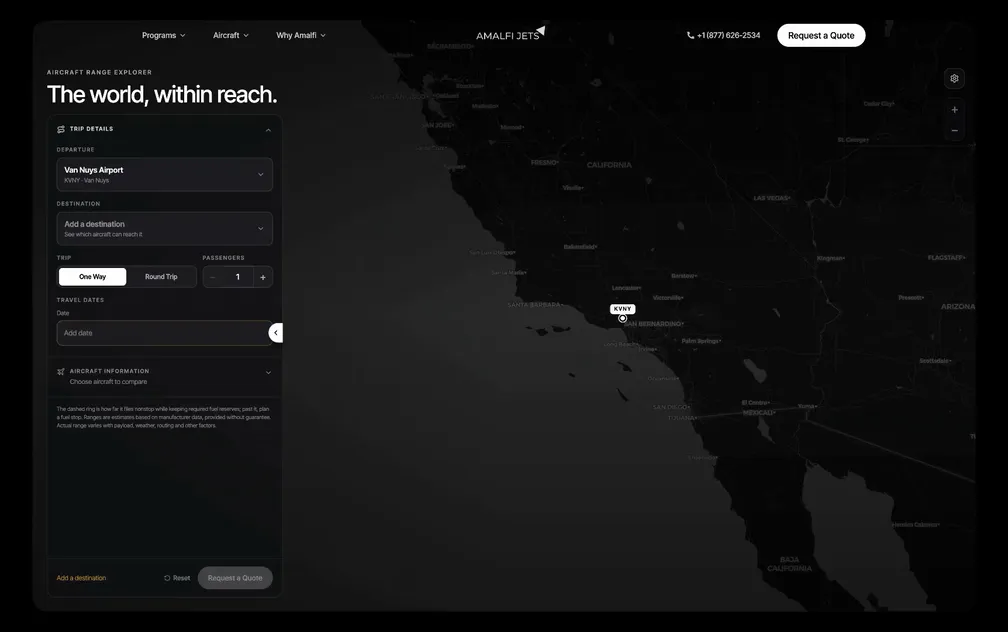
Try Range Explorer
See how far you can fly nonstop
Explore aircraft range, compare options, check flight times, and better understand which aircraft fits your trip.

Ready to fly to Chicago?
Request a charter and our team will tailor an itinerary for your next journey.
*Takes only about 40 seconds to request your quote.
