



Destination Hub
Private Jet Charter to Charleston

Arriving by private aircraft is simplest through Charleston Executive Airport (JZI), where the charter day can be built around one preferred arrival point and a clear ground plan. From the ramp, the itinerary moves at your pace: luggage handled discreetly, timing kept flexible, and the city’s harbor-side rhythm waiting beyond the airport.
Quick facts
Why charter a private jet to Charleston?
Private charter into Charleston is about controlling time, privacy, and the shape of the day from the moment the aircraft is requested.
With Charleston Executive Airport (JZI) as the primary gateway, travelers can organize arrivals around meetings, weddings, estate stays, golf weekends, yacht departures, or a quiet few days downtown without building the trip around airline schedules.
A more efficient arrival
A private arrival keeps the travel day focused on the people in your party rather than the needs of a commercial cabin. Bags, ground transportation, and timing can be coordinated before landing, so the handoff from aircraft to car feels calm instead of procedural.
At JZI, the value is not theatrical; it is practical. The airport gives the charter desk one preferred point to plan around, which helps simplify handling, catering, crew coordination, and onward transportation.
Because the schedule belongs to the traveler, the day can start later, return earlier, or adjust around a dinner reservation, board meeting, ceremony, or weather window.
Flexibility for a Lowcountry itinerary
Schedules often matter most on trips that look simple on paper. A long weekend may include a historic-district hotel, a waterfront home, a beach stay, a plantation-garden visit, or several addresses spread across the region.
Travelers charter privately when they want the aircraft to support that itinerary rather than compress it. A same-day turn, an overnight, or a multi-city sequence can be arranged around the trip’s actual priorities.
For families, executives, and hosts flying guests in for social weekends, that control can be the difference between a polished arrival and a day spent recovering from connections.
Time saved without sacrificing discretion
The private-cabin advantage is not only the flight itself. It is the reduced friction before departure, the privacy en route, and the ability to keep the group together from origin to destination.
On the return, the same logic applies: the aircraft can be positioned around the preferred departure time, so the final morning remains useful instead of being surrendered to a fixed airline schedule.
“For peak spring and October dates, our charter desk secures preferred arrival windows and ground handling first; firm dates booked early usually widen aircraft choice.”

When is the best time to fly to Charleston?
The best time to visit Charleston depends on whether the trip is built around weather, social calendars, event demand, or flexible aircraft availability.
March, April, and May bring the classic spring draw: mild weather, garden tours, weddings, and festival travel. Those months are among the most requested for private arrivals, so firm plans benefit from earlier aircraft selection and confirmed ground arrangements.
October is another peak month, with pleasant conditions and a busy fall social calendar. Travelers who need specific arrival windows for a wedding weekend, board gathering, or hosted house party should expect stronger competition for preferred aircraft and departure times.
January and February can be quieter, making them useful for travelers who prize space on the calendar more than peak-season atmosphere. The winter lull can improve availability, particularly for those who can shift by a day or choose from several departure windows.
August and September may also present value, but the tradeoff is clear: late-summer heat and hurricane risk can influence demand, comfort, and operational planning. Flexible travelers can benefit, while fixed-date trips should leave room for weather-aware coordination.
For the smoothest experience, plan early for spring and October, stay flexible during the value months, and let the charter desk evaluate both the preferred schedule and sensible alternates before the itinerary is locked.
Where our clients stay and go
Charleston rewards private travelers with a compact historic core, a harbor-facing setting, and a Lowcountry pace that feels composed rather than hurried.
Set on a peninsula where the Ashley and Cooper Rivers meet the Atlantic, the city has always been shaped by water. Light shifts across the harbor, palmettos frame old streets, and the skyline stays human in scale, with steeples, rooflines, and shaded piazzas replacing the glass-and-steel urgency of larger coastal cities.
The experience is best understood in layers. Mornings might begin with a walk along the Battery, coffee near the French Quarter, or a quiet view across the marsh. Afternoons stretch toward galleries, gardens, private homes, beach communities, and long lunches where the conversation lasts longer than the reservation.
What draws private travelers is not only charm. It is the ease of combining several kinds of trip in one place: a board retreat with a refined dinner, a family weekend with time on the water, a destination wedding with guests arriving from multiple cities, or a restorative stay split between the historic district and the coast.
History is present here without needing to be staged. Brick, ironwork, churchyards, cobblestone lanes, and preserved homes all carry the weight of a port city that has seen beauty, commerce, conflict, and reinvention. The best itineraries leave space for that complexity rather than reducing the destination to a postcard.
Private aviation suits the city because the trip often has a social or personal purpose. Guests arrive for a specific table, a specific house, a specific ceremony, or a specific weekend, and the aircraft becomes part of the choreography: quiet, precise, and timed to the occasion.
What determines the cost of a flight to Charleston?
The cost of chartering into Charleston is determined by the aircraft selected, the structure of the itinerary, airport-related planning at JZI, seasonal demand, and the possibility of matching the trip to an empty leg.
No single factor sets the final quote. The charter desk builds pricing around the full mission: departure city, passenger count, timing, aircraft availability, ground time, crew scheduling, and the preferred airport plan.
Aircraft category and trip profile
Aircraft class influences cost because cabin size, range, crew requirements, and operating profile vary by aircraft. A short regional flight, a cross-country arrival, and a multi-stop itinerary may each call for a different solution.
Two otherwise similar trips can also price differently depending on timing. One-way travel may require aircraft repositioning, while a round trip can sometimes keep the same aircraft and crew with the itinerary if the schedule allows.
A longer stay can change the operating plan as well. The aircraft may remain nearby, reposition elsewhere, or return later, and each structure affects the economics of the charter.
JZI positioning, handling, and fees
JZI is the primary planning point for most private arrivals, so positioning and airport-specific handling are part of the quote conversation. The charter team evaluates where the aircraft is coming from, how it will be supported on arrival, and what ground services are required.
Fees can vary by the operating plan, aircraft, timing, and services requested. Catering, passenger preferences, crew logistics, and aircraft parking considerations may also influence the final structure.
Seasonal demand
Seasonal pressure can affect both availability and pricing. March, April, May, and October draw stronger demand because of mild weather, spring festivals, garden tours, weddings, Spoleto, and fall social weekends.
During those periods, preferred departure times and aircraft options can tighten earlier. January, February, August, and September may offer more flexibility, although late-summer heat and hurricane risk should be part of the planning conversation.
Empty-leg availability
Empty legs can improve value when the existing aircraft movement matches the traveler’s route and timing. They are opportunistic rather than guaranteed, and they typically work best for flexible schedules.
An empty-leg option should be evaluated carefully against the traveler’s priorities. If the date, departure window, or aircraft type is firm, a dedicated charter is usually the cleaner planning approach.
Which airports serve Charleston?
The airports serving Charleston are JZI, CHS, LRO, DYB, and RBW, with the best choice depending on the traveler’s final address, aircraft plan, schedule, and preferred ground movement.
Charleston Executive Airport (JZI)
For most private itineraries, JZI is the preferred starting point for planning. It keeps the arrival focused on private-aircraft handling, a discreet transfer, and a direct move from aircraft to ground transportation.
This airport makes particular sense for travelers staying in the city, along the nearby islands, or within the broader Lowcountry when simplicity is the priority. The charter desk can coordinate the aircraft, passenger timing, luggage flow, and car service around a single primary gateway.
Charleston International Airport (CHS)
CHS can be useful when the trip benefits from a larger commercial airport environment or when airline connections, crew logistics, or a mixed commercial-and-private itinerary are part of the plan. It is also a practical alternate to evaluate when the primary airport is not the best fit for the aircraft schedule or the traveler’s final destination.
A traveler might choose CHS when meeting passengers arriving by airline, when ground plans point toward the North area of the region, or when the operating team determines that its airport environment better supports a specific mission.
Mt. Pleasant Regional-Faison Field Airport (LRO)
LRO may be considered for itineraries oriented toward the Mt. Pleasant side of the region. For guests staying east of the historic core, visiting waterfront communities, or heading toward coastal addresses on that side, it can be a sensible alternate for the charter desk to review.
The value of LRO is situational. It is not simply another code on a list; it may reduce the amount of ground movement when the traveler’s plans sit closer to that part of the Lowcountry.
Summerville Airport (DYB)
DYB gives the planning team another option for trips connected to Summerville and the inland side of the area. It can be worth evaluating when a traveler’s final address, meeting location, or host property is better reached from that direction.
For private flyers, alternates like DYB matter because the best airport is not always the one with the most familiar name. A shorter or less complicated drive can sometimes be more valuable than defaulting to the primary field.
Lowcountry Regional Airport (RBW)
RBW extends the airport conversation beyond the immediate city area and can serve select Lowcountry itineraries where the traveler is heading farther out in the region. It may be relevant for rural estates, coastal-region logistics, or trips where the ground destination sits away from the usual downtown-centered pattern.
The charter desk considers RBW when it offers a better overall journey, not merely because it is available. Aircraft suitability, ground arrangements, timing, and the purpose of the trip all determine whether it belongs in the final recommendation.
How the desk chooses
Airport selection begins with the traveler’s endpoint, not the map alone. The right plan weighs preferred arrival time, aircraft availability, handling requirements, congestion, car service, and the most graceful route from ramp to residence, hotel, meeting, or event.
Routes to & from Charleston
Common questions about Charleston charter
Which airport is best for a private arrival?
For Charleston, JZI is the primary airport used to plan most private arrivals because it keeps the charter itinerary centered on a private-flight environment and a clean ground-transfer plan.
Can I use CHS instead of JZI?
Yes, Charleston travelers may use CHS when a larger airport environment, airline passenger coordination, crew logistics, or the final ground destination makes it the better operational choice.
What determines the cost of chartering in?
Cost for a Charleston charter depends on aircraft category, routing, one-way versus round-trip structure, crew timing, airport fees, seasonal demand, and empty-leg fit.
When should I book a spring or fall trip?
For Charleston, March, April, May, and October are higher-demand months, so confirmed dates should be planned earlier to preserve stronger aircraft and schedule options.
Are LRO, DYB, or RBW worth considering?
For Charleston, those secondary airports can make sense when the traveler’s final address is closer to Mt. Pleasant, Summerville, or another Lowcountry location and the operating plan supports the alternate.
Do empty legs work for this route?
Empty legs can work for Charleston when an existing aircraft movement matches the route and timing, but they are best for flexible travelers rather than fixed-date itineraries.
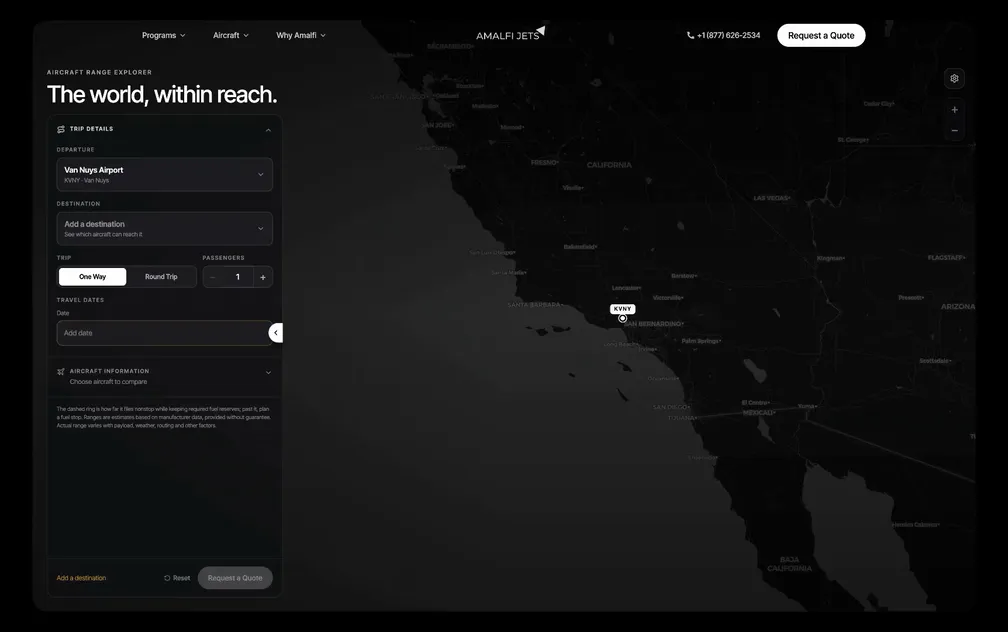
Try Range Explorer
See how far you can fly nonstop
Explore aircraft range, compare options, check flight times, and better understand which aircraft fits your trip.

Ready to fly to Charleston?
Request a charter and our team will tailor an itinerary for your next journey.
*Takes only about 40 seconds to request your quote.
