




Destination Hub
Private Jet Charter to Cabo San Lucas

Most private flights into Cabo San Lucas arrive through Aeropuerto de Cabo San Lucas, keeping the charter day focused and direct. The ramp plan, ground transfer, and departure timing are organized around your schedule rather than an airline timetable.
Quick facts
Why charter a private jet to Cabo San Lucas?
A private arrival into Cabo San Lucas gives travelers control over timing, routing, and the first hour on the ground.
Instead of building a trip around airline schedules, charter travelers can set a departure window that fits villa check-in, yacht boarding, family plans, or a discreet weekend escape. The experience is quieter by design: fewer public touchpoints, a coordinated arrival, and a ground plan arranged before the aircraft lands.
Why private travelers choose this route
For city-focused stays, Aeropuerto de Cabo San Lucas (CSL) is the natural planning point because it keeps the airport strategy centered on the destination itself.
That matters when the trip is short, the group is traveling with luggage or sporting equipment, or the itinerary depends on meeting a host, crew, driver, or property team at a specific time. A private charter compresses the travel day into a more controlled sequence: aircraft, arrival, transfer, residence.
- Schedule control: Depart when the party is ready, subject to airport and operational approvals.
- Privacy: Keep family, guests, and principals away from unnecessary public congestion.
- Continuity: Coordinate catering, luggage, ground transport, and any return-sector changes through one charter desk.
- Regional flexibility: Consider SJD, LAP, or LTO when the broader Baja California Sur itinerary points beyond the immediate resort zone.
The practical advantage is not theater; it is less friction. When the aircraft, airport, and ground plan are aligned early, the destination begins at the ramp instead of after a long series of connections.
“For peak December–April travel, our charter desk secures aircraft availability and CSL handling before building the final ground plan. Firm dates booked early usually preserve more cabin choice and better timing options.”

When is the best time to fly to Cabo San Lucas?
The most requested time to visit Cabo San Lucas is the dry winter-to-spring stretch, especially for travelers tied to holidays, whale season, and school calendars.
December, January, February, March, and April sit at the center of peak demand. Festive travel, clearer winter weather patterns, whale season, and spring break all compress availability across resorts, aircraft, preferred departure times, and ground services.
Peak-season planning
For firm holiday or spring dates, the most valuable decision is to secure the aircraft early. Waiting can narrow cabin choice, reduce schedule flexibility, and make airport coordination more constrained during the busiest weeks.
Travelers who need a specific arrival time should treat the flight, ground transfer, and lodging calendar as one plan. A private charter can preserve flexibility, but the best options still go first when demand is concentrated.
Value months
August, September, and October tend to be softer months for resort demand. Heat, humidity, and hurricane-season considerations can reduce crowding and improve aircraft availability for travelers who are comfortable planning around the weather.
Those months can reward flexible travelers. The charter desk should still monitor forecast patterns, airport conditions, and contingency options, especially for itineraries with immovable events or tight onward connections.
Where our clients stay and go
Cabo San Lucas is a desert-and-sea resort city defined by Land’s End, marina life, and the meeting of the Pacific with the Sea of Cortez.
The first impression is elemental: pale desert light, granite formations at the edge of the water, deep-blue horizon lines, and the constant movement of boats leaving the marina. El Arco gives the coastline its signature profile, while the beaches, villas, restaurants, and yacht culture give the city its pace.
The character of the place
This is the more kinetic side of Los Cabos, polished but not sleepy. Days often revolve around the water: sportfishing departures before sunrise, tenders crossing the bay, beach clubs setting out loungers, and sunset traffic gathering where the marina meets the dining scene.
Private travelers come for control as much as scenery. A villa stay can be organized around a chef dinner, a boat day, a golf round, or a quiet morning away from the main resort current. The city supports both high-touch hospitality and spontaneous movement, which is exactly why flight flexibility matters.
Where the setting does the work
The geography gives the destination its drama. On one side, the Pacific feels open and powerful; on the other, the Sea of Cortez brings a different color and rhythm. Between them, the arch and rock formations at Land’s End create a natural stage that is visible from boats, beaches, and many hillside perspectives.
For a short escape, Cabo San Lucas can feel immediate: land, transfer, change clothes, and be at dinner or on the water before the day disappears. For a longer stay, the appeal is in the contrast between polished resort life and the raw Baja landscape just beyond it.
What determines the cost of a flight to Cabo San Lucas?
The cost of chartering into Cabo San Lucas is shaped by the aircraft selected, the itinerary pattern, airport charges, seasonal demand, and aircraft availability.
Private aviation pricing is not a flat fare. It reflects the whole mission: where the aircraft begins, where it ends, how long it waits, what services are required on the ground, and how many travelers and bags must be accommodated.
Aircraft selection
Aircraft category is one of the most visible pricing factors. Cabin size, range, baggage capacity, crew requirements, and onboard service level all influence the quote, even when two aircraft are flying the same city pair.
The best aircraft is not always the largest one available. A well-matched cabin should fit the passenger count, luggage profile, desired comfort level, and schedule without adding unnecessary complexity.
One-way or round trip
A one-way charter may require the aircraft to reposition before or after the passenger flight. A round trip can sometimes keep the same aircraft and crew attached to the itinerary, depending on timing, aircraft availability, and how long the party remains in destination.
Flexible departure times can also affect options. When travelers can adjust by part of a day, the charter desk may have more room to match the mission with favorable aircraft availability.
CSL positioning and fees
CSL-specific handling, parking, permits, and other airport-related fees are part of the operating picture. These items vary by date, aircraft, schedule, and services requested, so they are reviewed as part of the live quote rather than treated as generic add-ons.
Positioning is equally important. If the best aircraft is not already near the departure city, or if it must relocate after drop-off, those movements can influence the final charter structure.
Seasonal demand
December through April typically brings stronger demand because of festive holidays, dry winter weather, whale season, and spring break travel. During those periods, early planning can widen aircraft choice and help secure preferred schedules.
August, September, and October often see softer resort demand because of hot, humid hurricane-season conditions. For travelers with flexible dates, those months may bring better aircraft availability, though weather planning remains part of the conversation.
Empty-leg availability
Empty legs can be attractive when an aircraft is already scheduled to fly without passengers in a compatible direction. They are highly date-, route-, and timing-dependent, and they usually offer less flexibility than a dedicated charter.
When an empty leg works, it can be a useful opportunity. When it does not, a dedicated charter remains the more reliable way to control the schedule.
Which airports serve Cabo San Lucas?
Cabo San Lucas is served by CSL as the primary private-flight airport, with SJD, LAP, and LTO considered when the broader Baja California Sur itinerary points elsewhere.
The right airport choice depends on where the traveler is actually staying, what level of private handling is available for the operating date, how much schedule flexibility exists, and whether the journey is focused on the city or a wider Baja itinerary.
Aeropuerto de Cabo San Lucas (CSL)
CSL is the first airport to consider for travelers whose plans center on the marina, Land’s End, nearby resorts, private residences, or a fast transfer into the heart of the destination. It keeps the operating plan focused and avoids treating the airport as a separate leg of the trip.
For private travelers, the key question is not simply which airport appears closest on a map. The charter desk confirms handling arrangements, airport permissions, parking expectations, and ground transport before recommending the final plan.
Los Cabos International Airport (SJD)
SJD is the principal alternate when the itinerary points toward the wider Los Cabos region rather than the city alone. It can make sense for travelers staying closer to San José del Cabo, meeting guests arriving by airline, or building a trip around the Tourist Corridor.
Private-terminal suitability should be confirmed for the specific date and aircraft. During busy periods, SJD may also be evaluated as part of a congestion or scheduling strategy, especially when the preferred arrival time matters more than using the primary airport.
General Manuel Marquez Airport (LAP)
LAP is most relevant when the journey shifts north toward La Paz or the Sea of Cortez side of Baja California Sur. It is not a routine substitute for a city-centered stay, but it can be the better planning tool when the ground destination is closer to that part of the peninsula.
A private traveler would choose LAP for geography and itinerary logic. The desk should still verify general-aviation handling, terminal arrangements, and ground-transfer feasibility before positioning it as the preferred airport.
Loreto Airport (LTO)
LTO belongs in the conversation for trips that extend toward Loreto or the central Gulf-side coastline. It can reduce unnecessary overland travel when the real destination is far north of the Los Cabos resort area.
For private charters, LTO should be treated as an itinerary-specific airport rather than a default alternate. Its suitability depends on the aircraft, available handling, permissions, and the traveler’s final address on the ground.
Routes to & from Cabo San Lucas
Common questions about Cabo San Lucas charter
Which airport is best for a private flight to Cabo San Lucas?
For Cabo San Lucas, CSL is the primary airport to evaluate first, especially when the stay is centered on the marina, Land’s End, nearby resorts, or private residences.
When should I book a charter for peak season?
Travelers flying to Cabo San Lucas in December, January, February, March, or April should plan early because holidays, dry winter weather, whale season, and spring break increase demand.
What determines the cost of chartering into Cabo San Lucas?
The cost of chartering into Cabo San Lucas depends on aircraft category, itinerary structure, positioning, airport fees, seasonal demand, and whether a compatible empty leg is available.
Can Amalfi Jets use SJD instead of CSL?
For Cabo San Lucas itineraries, SJD may make sense when the trip is tied to San José del Cabo, the Tourist Corridor, airline connections, or a broader regional schedule.
Are LAP or LTO practical alternates for private travelers?
LAP or LTO can be practical for Cabo San Lucas travelers only when the broader Baja California Sur itinerary points toward La Paz, Loreto, or the central Gulf-side coastline.
Do value-season months change the charter strategy?
For Cabo San Lucas, August, September, and October can bring softer demand and better aircraft availability, but weather flexibility and contingency planning remain important.
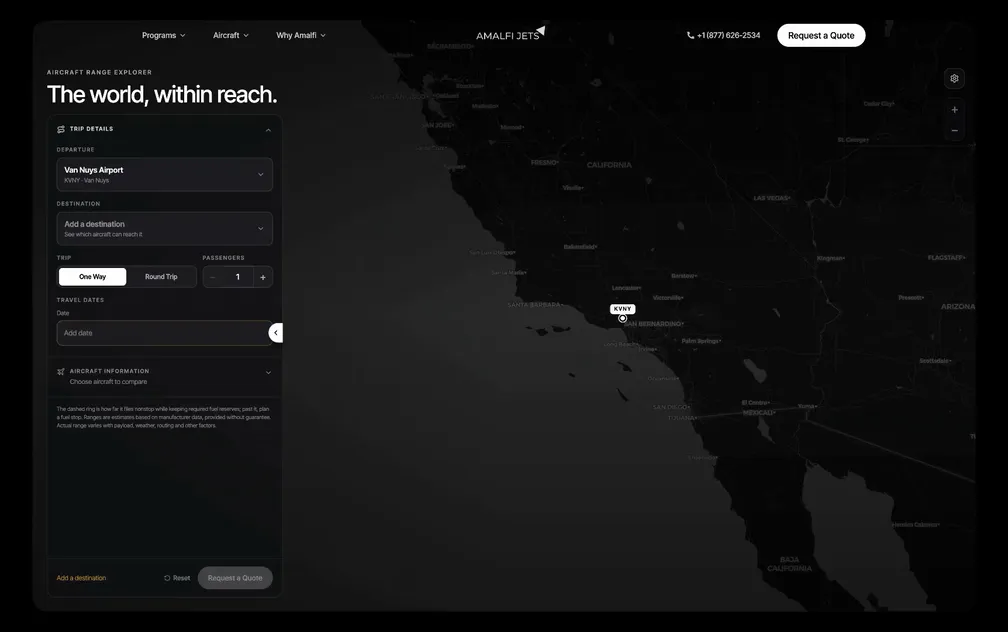
Try Range Explorer
See how far you can fly nonstop
Explore aircraft range, compare options, check flight times, and better understand which aircraft fits your trip.

Ready to fly to Cabo San Lucas?
Request a charter and our team will tailor an itinerary for your next journey.
*Takes only about 40 seconds to request your quote.
