



Private Jet Charter Route
Kansas City to Tokyo

Kansas City to Tokyo by private jet is a long, composed cabin experience: depart MKC on your schedule, settle into an ultra-long-haul environment, and arrive at HND after a typical 694-809 min flight time. Across 5406 NM, the value of charter is felt less in ceremony than in continuity — private departure, uninterrupted work or rest, and a smoother arrival into one of Asia’s defining capitals.
Quick Facts
Departure Airports
Arrival Airports
Skip the terminal queues, connections and layovers of commercial travel. On a private jet charter you arrive minutes before departure and fly point to point — turning a full travel day into a short hop.
Why fly private from Kansas City to Tokyo?
This pairing suits private charter because it turns a complex international journey into a single, controlled itinerary between MKC and HND.
Why the route works
At 5406 NM, this leg belongs in the ultra-long-haul-jets category, where cabin layout, onboard range profile, and passenger comfort matter as much as the schedule itself. The distance gives travelers meaningful time to dine, sleep, work privately, and arrive prepared rather than simply transported.
Airport access
Departing from Charles B. Wheeler Downtown Airport places the trip close to central Kansas City, keeping the first part of the journey efficient and discreet. On arrival, Tokyo Haneda Airport offers a highly practical gateway into Tokyo, allowing the itinerary to stay focused from curbside departure to arrival in the city.
A better use of the long sector
Private charter is especially compelling on this route because the cabin becomes part of the trip, not just the space between two airports. Ultra-long-haul-jets give the charter desk the right class to evaluate for a sector of this length, while the nonstop structure preserves privacy, continuity, and control over timing.
“Our charter desk typically secures the HND arrival plan first, then matches the MKC departure slot to the aircraft and crew duty profile. Early firm dates are useful on this long transpacific leg because they widen the ultra-long-haul aircraft options.”

What determines the cost of a Kansas City to Tokyo private jet charter?
The cost of this route is shaped by aircraft class, distance, flight time, itinerary structure, positioning, and demand around the requested dates.
Aircraft class
For a 5406 NM mission, the recommended category is ultra-long-haul-jets. Within that class, pricing is influenced by the specific aircraft available, cabin configuration, operator requirements, crew planning, and the level of onboard service requested.
Distance and block time
The sector’s typical flight time of 694-809 min is a central cost driver because longer missions require more aircraft time, crew duty planning, fuel planning, and international handling coordination. The length of the leg also makes aircraft selection more exacting than it would be on a shorter domestic trip.
One-way versus round trip
A one-way itinerary may involve aircraft positioning before pickup or after drop-off, depending on where the suitable jet is based and where it needs to go next. A round trip can sometimes create a more efficient aircraft plan when dates, crew timing, and parking logistics align.
Positioning and availability
Positioning is often one of the quiet variables behind a quote. If the best aircraft for the mission is not already near MKC, or if it must reposition after HND, that movement can affect the overall charter structure.
Seasonal demand
Seasonal demand also matters, even without a fixed peak calendar for every traveler. Holidays, major business travel periods, school breaks, and high-demand weeks in either market can tighten aircraft availability, while more flexible dates can widen the field of suitable ultra-long-haul options.
Which jets can fly Kansas City to Tokyo nonstop?
Range-matched to the 5,406 nm leg.
When is the best time to fly Kansas City to Tokyo?
The best time to fly this route is when your schedule can be set early enough to secure the right ultra-long-haul aircraft and support a smooth international operating plan.
Planning around flexible dates
Without a fixed travel window, the strongest approach is to give the charter desk a preferred departure date plus a small range of acceptable alternatives. That flexibility can improve aircraft choice, help avoid compressed high-demand periods, and give operators more room to coordinate crew, handling, and international permissions.
When timing matters most
For business travel, firm meeting times in Tokyo should drive the departure plan from MKC, allowing enough margin for arrival formalities and onward movement after HND. For leisure or family travel, earlier planning is especially useful around school breaks, holiday periods, and weeks when transpacific private-jet demand is more concentrated.
How to choose your window
Travelers who care most about cabin choice should confirm dates early. Those with more flexible arrival plans may ask the desk to compare nearby departure windows, since small date adjustments can sometimes improve aircraft availability and itinerary efficiency.
Related routes & cities
Routes
Common questions about flying Kansas City to Tokyo
How long is the private jet flight from Kansas City to Tokyo?
Kansas City to Tokyo has a typical private-jet flight time of 694-809 min, depending on the final operating plan and conditions on the day of travel.
What kind of aircraft is recommended for this route?
For Kansas City to Tokyo, the recommended category is ultra-long-haul-jets because the route covers 5406 NM and requires a cabin suited to a long international sector.
What determines the cost of flying this route privately?
The cost of flying Kansas City to Tokyo is determined by the ultra-long-haul aircraft selected, the 5406 NM distance, the 694-809 min block time, one-way versus round-trip structure, aircraft positioning, and demand around the requested dates.
Which airports are used for this charter pairing?
Kansas City to Tokyo operates between MKC and HND, giving travelers a private departure point in Kansas City and a practical arrival gateway for Tokyo.
When should I book a private jet for this trip?
For Kansas City to Tokyo, booking as early as your dates are firm helps the charter desk secure a suitable ultra-long-haul aircraft and coordinate the international flight plan with less constraint.
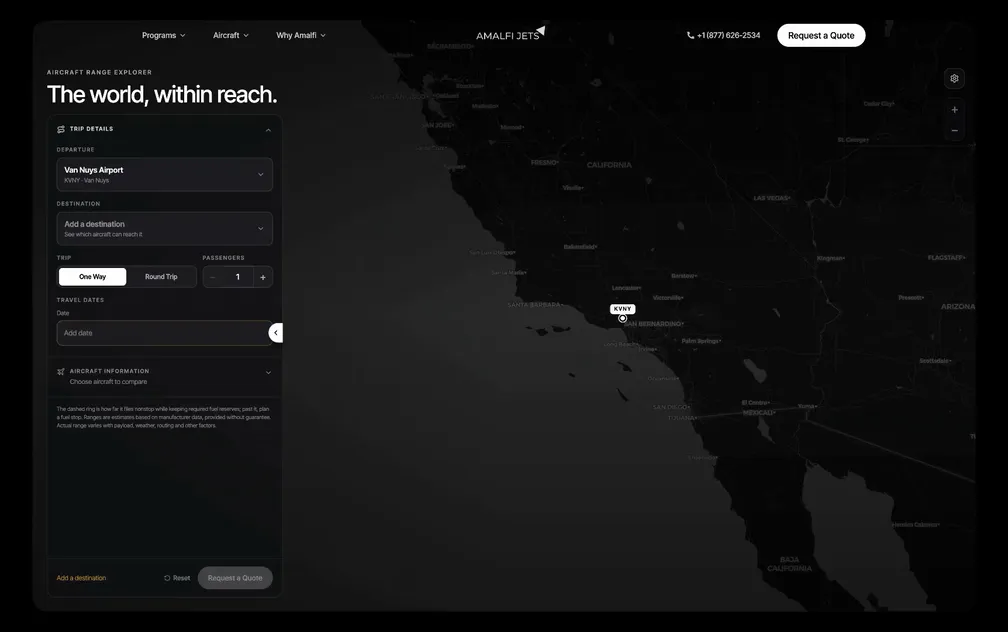
Try Range Explorer
See how far you can fly nonstop
Explore aircraft range, compare options, check flight times, and better understand which aircraft fits your trip.
Ready to fly Kansas City to Tokyo?
Request a charter and our team will tailor an itinerary for your next journey.
*Takes only about 40 seconds to request your quote.
