



Private Jet Carbon Footprint: Why Emissions Are Scrutinized
A private jet carbon footprint reflects more than the fuel burned between departure and arrival. It includes carbon dioxide released during the trip, the number of passengers sharing those emissions, possible positioning sectors, and broader aviation effects that can influence the climate beyond CO₂ alone.
Private aviation attracts particular scrutiny because a flight’s emissions are often divided among fewer travelers than they would be on a scheduled commercial service. The resulting per passenger impact can be substantial, especially when an aircraft carries only one traveler or a small party.
An informed discussion must distinguish total industry emissions from the footprint assigned to an individual passenger. These measures answer different questions, and treating them as interchangeable can obscure what the environmental debate actually reveals.
What Private Aviation Emissions Data Can Tell Us
Estimates of private aviation emissions vary because studies do not always use the same aircraft coverage, operational data, or accounting method. Some include positioning and other nonpassenger sectors, while others focus on passenger carrying flights or a particular aircraft category.
Fuel burn is also not a complete measure of aviation’s climate effects. Aircraft produce CO₂, but activity at altitude can create additional effects, including warming associated with certain contrail conditions. Those effects are more difficult to calculate consistently for an individual itinerary.
A credible estimate should therefore identify what it measures and what it excludes. Aircraft type, expected routing, passenger count, fuel assumptions, and the treatment of positioning can all materially change the result.
How Private Aviation Emissions Compare With Commercial Flights
Private aircraft are generally more carbon intensive per passenger than comparable commercial services. A commercial aircraft distributes its fuel burn across a larger number of travelers, while a private flight may carry only a small group.
Per passenger mile comparisons are useful, but they require context. The result depends on aircraft category, occupancy, route length, the commercial load assumption, and whether the scheduled alternative requires a connection or additional surface transportation.
Passenger count is one of the most influential variables in a private jet CO₂ estimate. When more travelers share the same private aircraft, the emissions assigned to each passenger decline, even though the aircraft’s total fuel use will not fall in the same proportion.
Route length matters as well. Short sectors may produce lower absolute emissions than longer missions, yet takeoff, climb, ground movement, and positioning can make repeated short trips comparatively inefficient. Longer journeys create a larger absolute footprint, particularly when the selected aircraft offers more range or cabin capacity than the mission requires.
What Private Jet Pollution Means
The phrase private jet pollution frequently appears in discussions of short flights, frequent private travel, and low occupancy missions. Critics argue that certain itineraries could be completed through scheduled aviation, rail, or surface transportation with a lower per passenger footprint.
The criticism becomes more pronounced when a larger aircraft is used for a limited mission or when the aircraft must reposition without passengers. It also reflects questions about individual responsibility because private aviation can enable travel patterns that scheduled networks cannot readily reproduce.
A balanced assessment should acknowledge these concerns without treating every itinerary as identical. Private charter can provide direct access, schedule control, privacy, and continuity for travelers whose operational or personal requirements are not served by a commercial timetable.
The relevant question is not whether a privately chartered flight has an environmental cost, as it certainly does. The more useful inquiry is how that cost is calculated, which parts may be reduced, and how the remaining impact is communicated before a traveler commits.
What Determines a Private Jet Carbon Footprint
Aircraft selection is one of the clearest opportunities to influence trip emissions. A properly sized aircraft can meet the mission without adding unnecessary cabin capacity or weight, while an aircraft with insufficient range may require a fuel stop that increases operational complexity and fuel use.
Amalfi Jets can source mission appropriate options across several aircraft categories. Our guide to aircraft categories for different charter missions provides additional context for regional, transcontinental, and longer range charter planning.
Routing is equally important for overall flight efficiency. A direct flight plan may reduce distance, but weather, air traffic requirements, airport procedures, and operational reserves can affect the route an aircraft operator can safely execute.
Passenger count, baggage, catering, and other onboard weight can also influence performance. For that reason, a useful private jet carbon footprint estimate should be tied to the proposed aircraft and actual itinerary rather than a broad industry average.
Private Jet Environmental Impact at VNY, TEB, OPF, and DAL
Van Nuys Airport (VNY) is a key private aviation gateway for the Los Angeles area. Travelers departing from Los Angeles can ask whether a proposed aircraft is already positioned nearby, whether sustainable aviation fuel participation is available for the itinerary, and how any associated emissions estimate will be calculated.
For travel between Los Angeles and the New York region, aircraft category and passenger occupancy can meaningfully affect per passenger emissions. The appropriate option should follow the payload, route, schedule, and operational requirements rather than a preference for a particular cabin category alone.
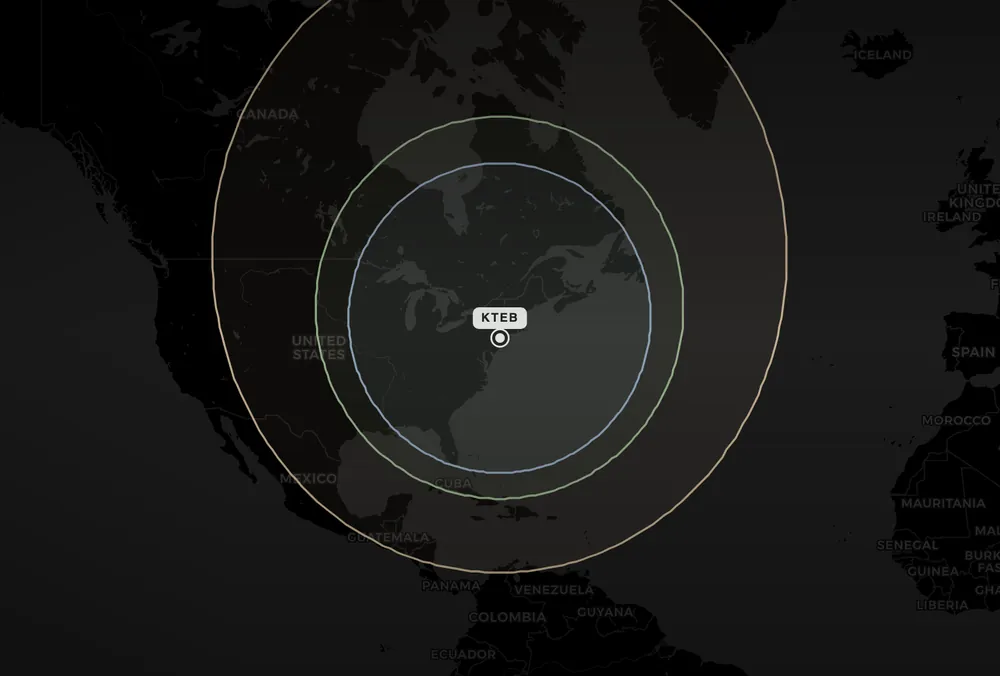
Teterboro Airport (TEB) serves private aviation travelers accessing the New York area. When reviewing a Teterboro proposal, it is useful to consider the aircraft’s starting location, potential positioning, expected routing, and any environmental program offered by the operating carrier.
Miami Opa-locka Executive Airport (OPF) is an important private aviation airport for the Miami market. Current sustainable aviation fuel access, certificate based participation, and operator programs can change, so these elements should be examined for the specific itinerary rather than assumed from the departure airport alone.
Dallas Love Field (DAL) serves both scheduled and private aviation in Dallas. For travel linking Dallas with Miami, New York, or Los Angeles, a broker can compare viable aircraft categories and operator locations while considering passenger count and potential positioning.
Airport choice can influence ground access, aircraft availability, and the structure of a charter proposal. It does not remove the emissions produced in flight, but careful planning may help avoid unnecessary sectors or the use of an aircraft poorly matched to the mission.
How Sustainable Aviation Fuel Addresses Aviation Emissions
Sustainable aviation fuel, commonly called SAF, is considered an important tool for reducing aviation’s lifecycle emissions. It is produced through approved alternative feedstocks and processes, then introduced into the aviation fuel system as an alternative to relying exclusively on conventional fuel.
The term lifecycle is essential in this context. Sustainable aviation fuel still produces emissions when used in an aircraft, but certain production pathways may reduce net lifecycle emissions by accounting for how the feedstock is sourced, processed, transported, and consumed. The potential benefit varies by pathway and should not be represented as a universal reduction for every supply arrangement.
Availability is not uniform across airports or operators in the current market. A traveler may encounter a physical SAF blend at the departure point, a certificate based arrangement that supports SAF use elsewhere in the fuel system, or no participation option for a particular trip.
These structures are not interchangeable, and the proposal should explain what is being purchased. Travelers may wish to ask about the fuel pathway, accounting framework, documentation, and whether the environmental benefit is assigned exclusively to their participation.
How SAF Can Appear in a Charter Proposal
Environmental measures increasingly intersect with charter planning and overall cost. Fuel market conditions, airport charges, regulatory requirements, and voluntary SAF participation can each affect how a proposal is structured, particularly for an international itinerary.
Our private jet charter cost guidance explains why an itemized proposal is highly valuable. Clear presentation allows travelers to distinguish the charter cost from taxes, airport charges, fuel adjustments, and any separately identified SAF or environmental contribution.
Transparency does not reduce emissions on its own, but it supports a more informed decision. When operator programs differ, those distinctions should be visible before the traveler confirms the itinerary.
Amalfi Jets is a charter broker and does not operate aircraft. We curate suitable options from vetted operators, allowing our team to ask how each operator approaches fuel, emissions calculations, and environmental programs when those considerations are relevant to the client.
Beyond Fuel: Aircraft Selection and Operational Efficiency
Sustainable aviation fuel is important, but fuel choice is only one part of the private jet environmental impact. Route planning, appropriate weight management, mission suitable aircraft selection, and efficient coordination may reduce avoidable fuel use without changing the essential purpose of the journey.
Selecting the appropriate aircraft capacity deserves particular attention during the planning process. Choosing an aircraft with substantially more capacity than the trip requires can increase emissions, but selecting an aircraft that requires an additional fuel stop may also produce an inefficient result. The smallest available category is therefore not automatically the lowest impact choice.
Positioning is another significant consideration in private charter operations. An aircraft may need to travel to the departure airport before collecting passengers, and that sector can form part of the trip’s wider emissions profile even though it does not appear on the passenger itinerary.
A broker can compare viable aircraft and operator locations to identify options that may limit unnecessary repositioning. Availability changes with each request, so the assessment must be based on the current itinerary and proposed operator rather than a general promise.
What Aircraft Operators Are Doing About Emissions
Aircraft operators control flight planning, fuel procurement, maintenance, onboard loading, and operational execution. Their practices can therefore influence aircraft efficiency, routing, weight, and access to sustainable aviation fuel or carbon programs.
Approaches vary significantly by operator and location. Some may offer SAF participation, calculate estimated trip emissions, support carbon programs, or review operational procedures intended to limit avoidable fuel use. These measures should be assessed by their documented scope rather than broad environmental language.
Travelers can ask whether an emissions estimate includes all relevant passenger sectors and positioning. They can also ask how SAF participation is recorded, which accounting framework is used, and whether environmental contributions appear separately on the proposal.
No single measure eliminates private aviation emissions entirely. Progress is more credible when direct operational improvements, transparent reporting, SAF participation, and carefully evaluated carbon programs are considered together.
The Role and Limits of Carbon Offset Programs
Carbon offset programs seek to address calculated emissions by directing funds toward environmental projects or purchasing credits. They may be incorporated into a charter booking, but project quality, accounting, permanence, additionality, and documentation can differ considerably.
Offsets should not be presented as though they prevent the emissions created by the flight itself. A stronger approach begins with direct measures such as suitable aircraft selection, route efficiency, reduced positioning where practical, and SAF participation when available.
Travelers should ask what the offset calculation includes and whether it covers passenger sectors alone or also accounts for relevant positioning. They should also request clear information about the supported program rather than relying only on a general neutral label.
This detail can be especially important for organizations reporting against internal environmental commitments. A documented estimate and clearly described program can support more consistent reporting, even though accounting methods across private aviation are not yet uniform.
How a Charter Broker Supports More Informed Choices
An aircraft operator is responsible for the aircraft and the safe execution of the flight. A charter broker has a different role, comparing operators, presenting mission appropriate aircraft, identifying available environmental options, and clarifying related charges without claiming operational control.
The Amalfi Jets charter broker approach centers on curated options and clear advice. When environmental considerations are part of a request, our team can ask how emissions are estimated, whether SAF participation is available, what an offset program covers, and whether the aircraft is expected to reposition.
This perspective is particularly useful for travel through VNY, TEB, OPF, or DAL, where aircraft availability and operator location can influence the structure of a proposal. The objective is not to suggest that a private flight has no impact, but to help travelers understand the relevant choices before confirming it.
How to Request a Private Jet CO₂ Estimate
A thoughtful request begins with accurate passenger numbers, baggage requirements, schedule needs, and route priorities. These details allow a broker to compare aircraft that fit the mission without adding cabin capacity or stops the itinerary does not require.
Travelers can request an emissions estimate alongside the financial proposal. Because methodologies differ, the estimate should identify its assumptions, including the selected aircraft, expected routing, passenger count, and treatment of positioning.
For sustainable aviation fuel, ask whether the participation involves physical supply, certificates, or another recognized accounting structure. For offsets, ask which program or standard supports the credits, what emissions are covered, and whether the contribution is itemized.
The answers may not reduce every part of the trip’s footprint, but they create a clearer basis for comparison. That transparency is central to making environmental considerations part of charter planning rather than an afterthought.
A Clearer View of the Environmental Debate
Private aircraft generally produce a higher per passenger footprint than comparable commercial travel because their emissions are shared among fewer people. At the same time, total industry emissions and individual trip intensity remain separate measures, and both are necessary for understanding the broader debate.
Sustainable aviation fuel, operational efficiency, credible carbon programs, and clearer emissions reporting can improve the picture, but no single measure offers a complete answer. The strongest approach is transparent planning that acknowledges the footprint and examines practical opportunities to reduce or address it.
As a dedicated charter broker, Amalfi Jets curates mission appropriate aircraft from vetted operators and helps clients evaluate environmental options alongside timing, privacy, comfort, and service. This approach gives travelers a clearer view of the aircraft, operational structure, and available programs behind each proposal.
If you are planning private travel through Los Angeles, New York, Miami, Dallas, or another destination, request a private charter proposal from Amalfi Jets. Our team can prepare considered options and help you evaluate the operational and environmental factors relevant to your itinerary.