



Destination Hub
Private Jet Charter to Yellowstone
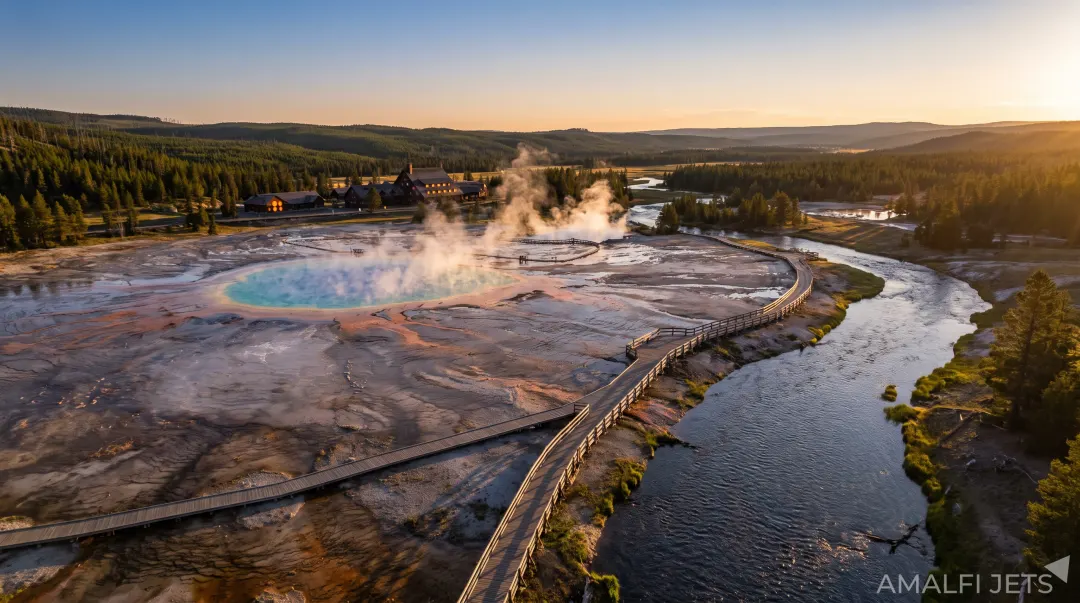
Most private flights arrive through Yellowstone Regional Airport (COD), setting a quieter tone for a journey defined by open roads, mountain light, and national-park scale. From the ramp, your schedule is built around the lodge check-in, the wildlife drive, or the family calendar — not a connection bank.
Quick facts
Why charter a private jet to Yellowstone?
Private charter makes the approach to Yellowstone simpler, more personal, and better aligned with the way high-touch trips in the American West actually unfold.
A more controlled arrival
Yellowstone Regional Airport (COD) gives private travelers a clear primary gateway into the region, allowing the day to be organized around one arrival point and one ground plan. Instead of building the trip around airline schedules, a charter itinerary can be timed for lodge access, guide coordination, family arrivals, or a same-day continuation elsewhere in the Rockies.
Time saved where it matters
Commercial routing into mountain destinations often adds connections, layovers, and fixed departure times. Private aviation reduces that friction by letting the aircraft, crew, and ground transportation work from the traveler’s preferred schedule, subject to airport, weather, and aircraft availability.
Flexibility for a park-centered itinerary
A trip here is rarely just an airport transfer. Plans may include early wildlife drives, geothermal basins, scenic roads, ranch stays, fishing, or time in Cody, Jackson Hole, Bozeman, or Idaho Falls. Chartering privately lets the arrival airport, departure airport, and ground route be chosen around the actual itinerary rather than a single airline map.
Privacy from start to finish
Discerning travelers often value the quieter rhythm as much as the time saved. Private terminals, coordinated ground handling, and direct communication with the charter team help keep the movement discreet, especially during busy summer travel periods when popular gateways see heavier demand.
“For peak June through August dates, our charter desk secures aircraft availability and COD handling first, then compares alternates if lodging or road access points to another gateway. Early firm dates widen aircraft choice.”

When is the best time to fly to Yellowstone?
The best time to visit Yellowstone depends on whether the priority is full summer access, wildlife-focused travel, or a quieter shoulder-season pace.
Peak summer demand
June, July, and August are the busiest months for private travel into the region. Summer road access, wildlife viewing, school vacations, and full park services bring more travelers into the area, which can tighten aircraft availability and make early planning especially valuable for preferred departure times.
Shoulder-season value
April, May, October, and November often offer a softer demand environment. Road and lodge limitations can reduce overall trip volume, but travelers who are comfortable planning around seasonal access may find better aircraft choice and more room to shape the itinerary.
Planning guidance
Firm summer dates should be secured as early as possible, particularly when the trip includes specific lodges, guides, or multiple family arrivals. Shoulder-season travel benefits from an advisor who can coordinate aviation timing with current ground logistics, since access patterns can affect how the day should be structured.
Where our clients stay and go
Set across one of the most geologically expressive landscapes in North America, Yellowstone draws private travelers who want wild country without giving up precision in the journey.
The first impression is scale. High plateaus, lodgepole forests, open valleys, steaming basins, and cold rivers create a landscape that feels both ancient and restless. Morning light often belongs to the wildlife watchers; by afternoon, the roads lead toward geyser fields, canyon overlooks, and lake country.
This is a place where the itinerary rewards patience. A guide may time the day around bison moving through a valley, a geyser window, or a quieter overlook after the midday crowds have shifted. The luxury is not excess; it is having the space, timing, and support to experience the park without rushing.
Cody adds a Western counterpoint to the park landscape, while Jackson Hole, Bozeman, and Idaho Falls can shape broader regional itineraries. For private travelers, that flexibility matters: arrival and departure can be matched to the side of the region they plan to explore, rather than forcing the trip into a single route.
Grand Canyon of the Yellowstone, Old Faithful, Lamar Valley, Hayden Valley, and the park’s thermal basins remain enduring draws, but the quieter moments often stay with travelers longest — steam lifting from the ground at first light, water cutting through stone, and a horizon that seems to keep moving as the road opens ahead.
What determines the cost of a flight to Yellowstone?
The cost of chartering to Yellowstone is determined by the aircraft selected, routing, airport logistics, seasonal demand, and the availability of repositioning opportunities.
Aircraft selection
Aircraft class is one of the main drivers of the quote. Cabin size, range, baggage needs, passenger count, nonstop routing, and crew requirements all influence which options are appropriate for a specific trip. A larger cabin or more complex itinerary can change the operating profile, while a leaner schedule may allow the advisor to evaluate more efficient alternatives.
One-way or round trip
A round trip may allow the aircraft and crew to remain connected to the itinerary, depending on schedule and availability. A one-way itinerary can require repositioning before or after the passenger flight, which may affect the final quote. The best structure depends on how long the traveler is staying, where the aircraft is based, and whether the return is fixed or flexible.
COD positioning and airport-related fees
Using COD as the primary arrival point keeps planning focused, but every quote still accounts for aircraft positioning, landing, parking, handling, crew logistics, and any applicable airport or service-provider charges. These items can vary by aircraft, timing, and the length of the stay.
Seasonal demand
June, July, and August typically bring stronger demand because summer road access, wildlife viewing, school vacations, and full park services all converge. During those months, preferred aircraft and crew schedules can tighten. April, May, October, and November often bring softer demand, especially when shoulder-season road and lodge limits reduce trip volume.
Empty-leg availability
Empty legs can occasionally improve efficiency when an aircraft is already moving in the right direction, but they are never guaranteed and usually require flexibility. Travelers with firm lodge dates, family schedules, or specific departure times should treat empty-leg options as a useful possibility rather than the foundation of the plan.
Which airports serve Yellowstone?
The region is served by COD as the primary gateway, with WYS, JAC, BZN, and IDA available when the itinerary points toward another side of Yellowstone.
COD
Yellowstone Regional Airport (COD) is the primary airport for this destination page and the natural starting point when the trip is centered on Cody, northwest Wyoming, or an eastern approach into the park region. For private travelers, COD keeps the plan straightforward: confirm handling, match the aircraft to the mission, and build ground transportation from one focused arrival point.
WYS
Yellowstone Airport (WYS) can make sense when the ground plan is oriented toward the western side of the park region. It is often considered when a traveler’s lodging, guide schedule, or route makes a western arrival more practical than using COD, subject to seasonal access, handling availability, and aircraft suitability confirmed at the time of booking.
JAC
Jackson Hole Airport (JAC) is a strong alternate when the trip includes Jackson Hole, the Tetons, or a southern approach before continuing into the park region. Private travelers may choose JAC when the broader itinerary begins or ends in that resort corridor, or when aircraft availability and ground routing make it the cleaner operational choice.
BZN
Bozeman Yellowstone International Airport (BZN) is useful for travelers pairing the park with the Bozeman area, Big Sky, or a northern Montana routing. It may also be evaluated when demand is heavy at a preferred gateway and the charter desk wants to compare aircraft availability, handling options, and ground logistics across the region.
IDA
Idaho Falls Regional Airport (IDA) gives planners another regional option, especially for itineraries that touch eastern Idaho or approach the park region from the southwest. It can be considered when lodging location, aircraft positioning, or a multi-stop routing makes Idaho Falls the more efficient point of arrival or departure.
Choosing the right gateway
The best airport is not always the closest on a map. The charter desk weighs where the travelers are staying, which park entrances and roads are practical for the season, how much baggage is moving, where the aircraft is positioned, and whether an alternate airport reduces congestion or creates a smoother ground day.
Common questions about Yellowstone charter
Which airport should I use for a private flight into the area?
For Yellowstone, COD is the primary airport, while WYS, JAC, BZN, and IDA may be considered when lodging, routing, or aircraft availability makes another gateway more practical.
What determines the cost of chartering into the region?
For Yellowstone, cost depends on aircraft class, routing, one-way versus round-trip structure, positioning, airport and handling fees, seasonal demand, and whether a suitable empty leg is available.
When should I book summer travel?
For Yellowstone, June, July, and August bring the strongest demand because road access, wildlife viewing, school vacations, and full park services overlap, so firm dates should be planned early.
Are shoulder-season trips easier to arrange?
In Yellowstone, April, May, October, and November can bring softer demand and better availability, though road and lodge limitations may shape the final airport and ground plan.
Can I arrive at one airport and depart from another?
For Yellowstone, split-airport itineraries can be arranged when the routing supports it, such as arriving through COD and departing through JAC, BZN, WYS, or IDA after the ground portion of the trip.
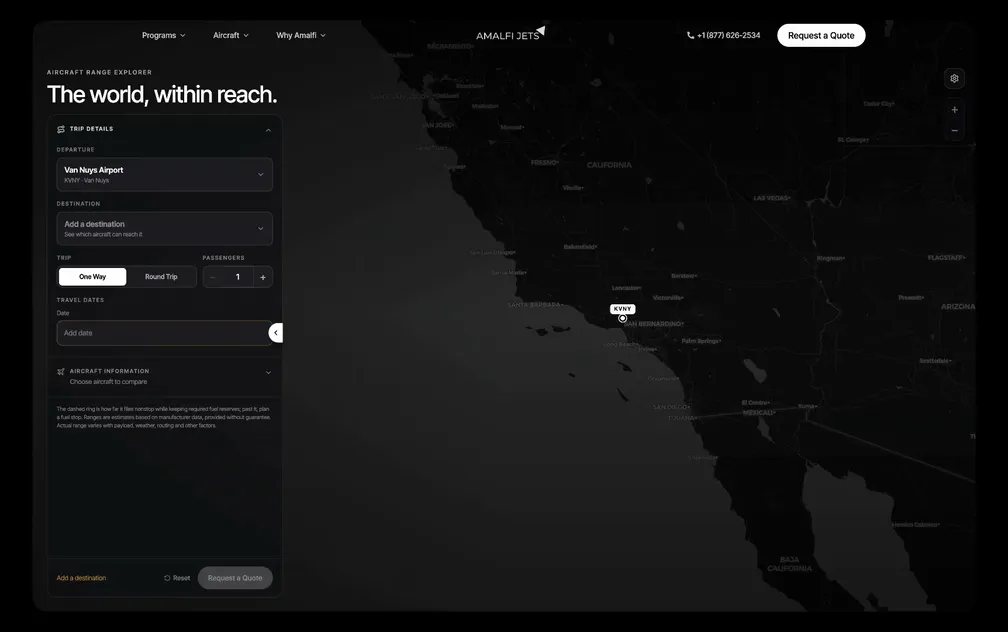
Try Range Explorer
See how far you can fly nonstop
Explore aircraft range, compare options, check flight times, and better understand which aircraft fits your trip.

Ready to fly to Yellowstone?
Request a charter and our team will tailor an itinerary for your next journey.
*Takes only about 40 seconds to request your quote.
