



Destination Hub
Private Jet Charter to Tulum

Most private flights into Tulum arrive through Felipe Carrillo Puerto International Airport, giving the charter day a single, focused arrival plan. From there, the trip shifts quickly from runway logistics to beach-road timing, villa check-in, and the rhythm of the Caribbean coast. Your schedule leads; the aircraft and ground arrangements follow.
Quick facts
Why charter a private jet to Tulum?
Chartering privately into Tulum is about controlling the day rather than adapting your trip to an airline schedule. The value is felt before takeoff, on arrival, and again when plans change: departure times can be shaped around villa access, yacht movements, family needs, or a short stay that leaves no room for wasted hours.
Direct access, fewer compromises
Felipe Carrillo Puerto International Airport gives private travelers a dedicated primary gateway for the destination. Instead of routing through a larger regional airport by default, a charter advisor can build the itinerary around TQO when it best serves the passenger, aircraft, and onward ground plan.
Flexibility that protects the itinerary
Airline service moves on fixed timetables; private aviation is designed around the traveler’s calendar. Morning departures, late returns, same-day revisions, and multi-city pairings can often be organized with far more discretion than a commercial routing allows.
Time saved where it matters
A private flight compresses the least enjoyable parts of the travel day: crowded terminals, rigid check-in windows, and unnecessary connections. For villa stays, wellness retreats, milestone weekends, and executive travel, that saved time becomes usable time on the coast.
A calmer arrival
The best charter days feel uneventful in the right way. Passenger details are advanced, ground transportation is coordinated with the aircraft schedule, and the arrival plan is refined before the trip begins.
“We secure preferred dates, aircraft availability, and TQO handling before refining ground transfers. For December, January, February, New Year, and event periods, earlier firm dates usually widen aircraft choice.”

When is the best time to fly to Tulum?
The best time to visit Tulum depends on whether the priority is peak beach weather, nightlife energy, or greater scheduling flexibility. Private travelers should match their dates to the mood they want on the ground as much as the flight plan in the air.
December, January, and February are the high-demand months. Dry-season beach conditions, holiday travel, New Year stays, and Zamna or Day Zero event periods all concentrate interest, so firm dates are best handled early.
May, September, and October are better suited to travelers who value availability and a quieter calendar. Heat, rain, storm risk, and lighter nightlife demand can soften pressure on aircraft supply and accommodations, while still keeping the coast in play for flexible itineraries.
For peak weeks, the smartest move is to confirm the aircraft once the villa or hotel dates are set. During softer months, keeping departure times adaptable can make it easier to evaluate aircraft options and potential empty-leg opportunities.
Where our clients stay and go
Tulum draws private travelers for its direct collision of Caribbean water, low-rise design, and a social scene that still feels tied to sand and jungle. The setting is part of the appeal: pale beaches, turquoise shallows, palms moving over beach clubs, and a town that shifts from wellness mornings to candlelit dinners after dark.
The coast has a visual language of its own. Buildings stay close to the tree line, the horizon remains mostly open, and the brightest architecture is often the water itself. Even at its most polished, the destination feels more elemental than urban.
In town, the rhythm is different: restaurants, boutiques, cafés, and late-night addresses draw travelers inland from the hotel zone. That contrast gives a stay its texture, with quiet mornings by the sea and evenings that can be as discreet or as social as the guest list requires.
History is never far from the present. The cliffside Maya ruins above the Caribbean give the shoreline a sense of depth, while cenotes and inland roads pull visitors beyond the beach. Private travel suits that geography because the day can be shaped around movement rather than fixed tour times.
For luxury travelers, the destination is less about formality than ease. A strong itinerary might mean a villa with a chef, a private driver, a long lunch near the water, and enough open time to let the coast do what it does best.
What determines the cost of a flight to Tulum?
The cost of chartering into Tulum is determined by the aircraft, itinerary shape, airport planning, season, and live aircraft availability. A precise quote is always trip-specific because each of those variables can change the operating plan.
Aircraft selection
Aircraft class influences the overall charter cost through cabin size, operating profile, crew requirements, luggage planning, and onboard comfort expectations. A short leisure itinerary, a family trip with more baggage, and an executive movement with tight timing can each point toward a different aircraft solution.
One-way versus round trip
A one-way charter may require the aircraft to reposition before or after the passenger flight. A round trip can price differently when the aircraft and crew remain available for the return, though that depends on timing, trip length, and operator scheduling.
TQO positioning and airport-related charges
Quotes into TQO may reflect aircraft positioning, handling, parking, permits, and airport fees as they apply to the specific trip. Those items are operational rather than cosmetic; they help determine which aircraft and operator are the best fit for the requested schedule.
Seasonal demand
December, January, and February typically bring stronger demand because of dry-season beach weather, holidays, New Year travel, and Zamna or Day Zero event periods. During those windows, earlier planning can widen aircraft choice and help secure preferred departure times.
Empty-leg availability
Empty legs can reduce the cost of a charter when an existing aircraft movement aligns with the traveler’s route and timing. Availability is never guaranteed, and flexibility is essential because empty-leg flights are tied to another confirmed itinerary.
Which airports serve Tulum?
Tulum is served principally by Felipe Carrillo Puerto International Airport, with Cancún, Cozumel, and Chichen Itza available as secondary planning options. The right airport depends on the aircraft, handling plan, passenger schedule, and where the trip continues after landing.
TQO
For most itineraries, TQO is the cleanest starting point because it is the designated primary airport for the destination. It keeps the arrival plan focused on the southern Riviera Maya rather than beginning the trip with a default routing through a larger regional gateway.
Private travelers choose the airport when they want the air and ground plans to point directly toward villas, beach hotels, wellness stays, or events along the coast. A charter advisor will still confirm handling, parking, arrival formalities, and ground transportation before recommending it for a specific aircraft and date.
Aeropuerto Internacional de Cancún (CUN)
CUN can make sense when the wider itinerary is anchored farther north in Quintana Roo or when aircraft availability and handling options favor a larger regional gateway. It is also a practical alternate to evaluate when a trip combines Cancun, the Riviera Maya, and a southbound transfer.
For a private traveler, the question is not simply which airport appears closest on a map. The better question is where the aircraft can be handled smoothly, where the passenger experience is most predictable, and which ground route best fits the day’s schedule.
Aeropuerto Internacional de Cozumel (CZM)
CZM belongs in the conversation when the journey involves Cozumel itself or a coastal itinerary that pairs island time with the mainland. Because the airport serves an island, it is a more specialized option than a default arrival point for the beach zone.
This alternate may be attractive when the guest list includes diving, yacht, or island-focused plans. The charter desk should coordinate the air plan with onward transfers so the convenience gained in the sky is not lost after landing.
Chichen Itza International Airport (CZA)
CZA is the inland option to consider when a trip extends toward the archaeological and cultural corridor of the Yucatán. It is not the natural first choice for a beach arrival, but it can support itineraries that place ruins, haciendas, or inland touring at the center of the journey.
For travelers moving between coast and interior, this airport can help avoid forcing every movement through the same shoreline gateway. Suitability should be confirmed against the aircraft, ground route, operating permissions, and the passenger’s exact sequence of stops.
Common questions about Tulum charter
Which airport should I use for a private flight to the destination?
Most private flights to Tulum use TQO, the primary airport for the destination, when the aircraft, handling, and onward ground plan align.
When does Cancún make sense instead of TQO?
CUN may suit Tulum travelers when aircraft availability, handling, or a wider northern Quintana Roo itinerary makes that gateway more practical.
What determines the cost of chartering into the area?
For Tulum, charter cost depends on aircraft class, one-way or round-trip structure, positioning, airport-related charges, seasonal demand, and empty-leg availability.
How early should I request a peak-season charter?
For Tulum, earlier requests are recommended for December, January, February, New Year dates, and Zamna or Day Zero event periods because demand is stronger.
Can I consider Cozumel or Chichen Itza as alternate airports?
Alternate planning for Tulum can include CZM for island-focused travel or CZA for inland Yucatán itineraries, subject to aircraft and handling suitability.
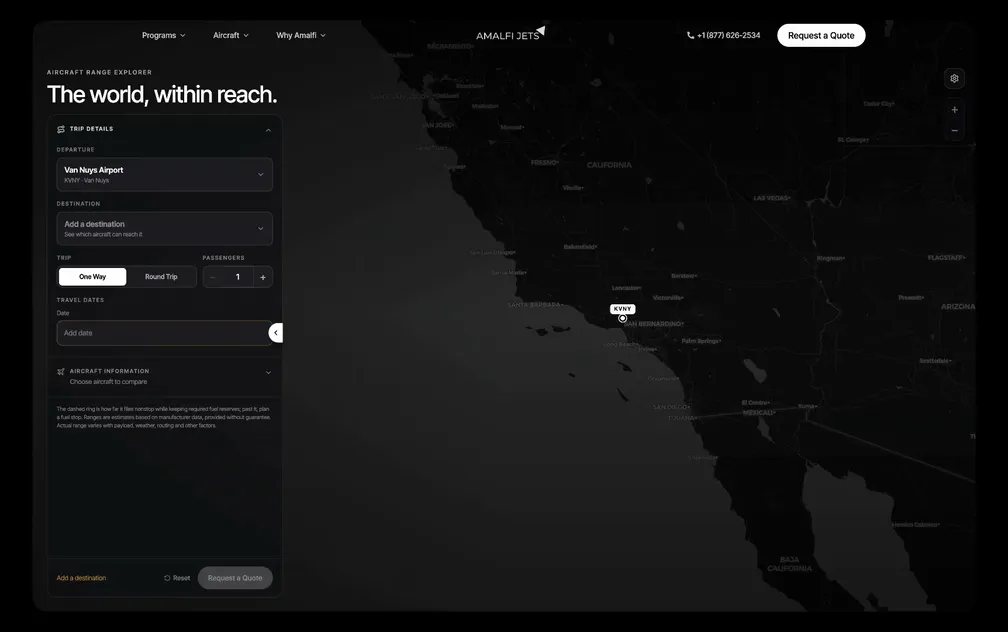
Try Range Explorer
See how far you can fly nonstop
Explore aircraft range, compare options, check flight times, and better understand which aircraft fits your trip.

Ready to fly to Tulum?
Request a charter and our team will tailor an itinerary for your next journey.
*Takes only about 40 seconds to request your quote.
