



Destination Hub
Private Jet Charter to Tucson

Arriving by private aircraft into Tucson International Airport (TUS) keeps the day clean: one arrival point, a coordinated ground plan, and no airline connection to work around. The desert appears quickly from the ramp, with mountain edges, wide light, and a schedule held to your own timing.
Quick facts
Why charter a private jet to Tucson?
Chartering privately into Tucson gives travelers control over both the arrival experience and the hours around it. Instead of building a trip around airline frequency, connections, and terminal dwell time, your itinerary can be organized around resort check-in, meetings, estate visits, golf, or a same-day return.
TUS is the natural primary gateway for most private arrivals, keeping the plan straightforward for passengers whose time on the ground matters as much as time in the air. A dedicated charter schedule also helps when several passengers are arriving from different cities, when luggage or equipment needs to move with the group, or when the return time may change after the day’s commitments are complete.
The value is most visible on compressed itineraries. A morning arrival can turn into a full working day, a winter resort weekend can begin without a commercial connection, and a departure can wait for your party rather than the other way around.
For a private jet charter Tucson itinerary, Amalfi Jets coordinates aircraft sourcing, airport selection, and ground timing as one plan. That integrated approach is especially useful during winter demand periods, when firm dates and preferred departure windows are best protected early.
“For peak winter weeks, our charter desk secures aircraft options and preferred TUS handling as soon as dates are firm. Early confirmation widens cabin choice, especially around Gem Showcase and rodeo-week demand.”

When is the best time to fly to Tucson?
The best time to visit Tucson depends on whether you want peak desert weather and major winter events or a quieter, more flexible charter market. January, February, and March are the strongest demand months, driven by winter sun, the Gem Showcase, rodeo week, golf travel, and resort stays.
Those peak months reward early planning. Firm dates, preferred cabin categories, and prime departure windows should be held as soon as possible, particularly for travelers coordinating multiple households, corporate groups, or a return immediately after an event.
June, July, and August are value months, when extreme heat and monsoon storms often soften demand and improve aircraft availability. Summer trips can still work well with the right timing, but departure windows, ground transportation, and weather flexibility deserve closer attention.
Shoulder periods can be appealing for travelers who care more about privacy and pacing than event calendars. A charter advisor can help align aircraft availability with resort plans, meeting schedules, and the level of date flexibility you are willing to keep.
Where our clients stay and go
Tucson is a desert city with a strong sense of horizon, where the Sonoran landscape presses close and the light changes the mood of the day. Saguaros stand beyond the urban grid, mountain ranges define the edges, and the dry air gives even a short arrival the feeling of having crossed into another rhythm.
The city draws private travelers for winter sun, wellness-focused resorts, golf, collecting trips, university business, and quiet residential stays across the foothills. It is polished in places, but never glossy in the way of a conventional resort city; its appeal is more grounded, tied to adobe tones, shaded courtyards, trailheads, and dinners that carry the flavors of the borderlands.
Saguaro National Park gives the destination its unmistakable silhouette, with protected desert on both sides of the city and a landscape that feels expansive without being empty. Morning can mean a hike among cactus ribs and ocotillo, while evening turns the mountains purple and the streets warm gold.
For travelers arriving privately, the atmosphere suits itineraries that need privacy without isolation. Meetings can sit beside spa days, collector appointments can be folded into a resort stay, and family weekends can move at a pace set by the passengers rather than the schedule.
What determines the cost of a flight to Tucson?
The cost of chartering into Tucson is shaped by the aircraft, the schedule, airport logistics, seasonality, and the availability of suitable repositioning opportunities. A quote is built around the full mission rather than the destination alone.
What influences the quote
- Aircraft category: Cabin size, range profile, baggage needs, passenger count, and onboard preferences all affect which aircraft are appropriate for the trip.
- One-way or round trip: A same-aircraft return may price differently from a one-way itinerary, particularly if the aircraft must reposition before or after your flight.
- TUS planning considerations: Landing, parking, handling, crew, and positioning details can influence the final charter proposal, especially when the aircraft is not already nearby.
- Seasonal demand: January, February, and March typically require more lead time because winter sun, gem-show travel, rodeo week, golf, and desert resort stays can tighten aircraft availability.
- Empty-leg availability: An empty leg can sometimes improve value, but it depends on aircraft routing, timing, passenger count, and whether the itinerary can flex around an existing aircraft movement.
The most accurate way to evaluate cost is to compare aircraft options against your preferred departure time, passenger profile, and ground plans. Amalfi Jets can then present a clear set of choices rather than a generic estimate.
Which airports serve Tucson?
Tucson is primarily served by TUS, with select regional alternatives that may suit different ground plans across southern Arizona.
Tucson International Airport
For most charter travelers, this is the straightforward choice. It is the primary airport for the city, which keeps planning simple when the final destination is a resort, residence, campus, meeting venue, or event address in the metro area. A private arrival here allows the charter desk to coordinate the aircraft, handling, and onward transfer around one clear gateway.
Ryan Field Airport (RYN)
RYN can be considered when the west side of the region is more convenient or when an alternate general-aviation setting better fits the trip plan. It may be useful for travelers whose ground schedule points away from the central arrival pattern, subject to aircraft suitability, services, and the operating conditions confirmed for the day.
Marana Northwest Regional Airport (AVW)
AVW may make sense for itineraries oriented toward Marana, northwest-area resorts, or business activity outside the city core. As an alternate, it can help reduce unnecessary ground movement when the traveler’s first stop is already in that direction, provided the aircraft and support requirements align.
Nogales International Airport (OLS)
OLS is relevant for southern Arizona trips that continue toward Nogales, border-area business, ranch properties, or regional visits well south of the metro area. It is not simply a substitute for the primary airport; it becomes useful when the ground destination makes a southern arrival more logical.
Scottsdale Airport (SCF)
SCF serves the Phoenix-Scottsdale side of the state and can be useful when a trip combines southern Arizona with meetings, resorts, or residences in the Valley. For some itineraries, landing there first or last can create a cleaner sequence than forcing every movement through the same airport.
The right choice depends on where the traveler is actually going after landing. Amalfi Jets reviews the final address, aircraft requirements, schedule, and airport services before recommending the most efficient arrival point.
Common questions about Tucson charter
Which airport should I use for a private flight into Tucson?
For most Tucson trips, TUS is the primary airport to evaluate first because it keeps the arrival plan centered on the metro area and simplifies ground coordination.
Can I use an alternate airport instead of TUS?
For Tucson itineraries, RYN, AVW, OLS, and SCF may be considered when the ground destination, aircraft positioning, or schedule makes an alternate more practical.
What determines the cost of chartering into Tucson?
The cost of chartering into Tucson depends on aircraft category, trip structure, airport fees and handling, aircraft positioning, seasonal demand, and whether a suitable empty leg is available.
When should I book a winter private flight?
For Tucson travel in January, February, or March, booking early is wise because winter sun, gem-show activity, rodeo week, golf, and resort demand can tighten aircraft choice.
Are summer charters easier to arrange?
Summer travel to Tucson can offer better availability because June, July, and August bring extreme heat and monsoon storms, though weather-aware scheduling remains important.
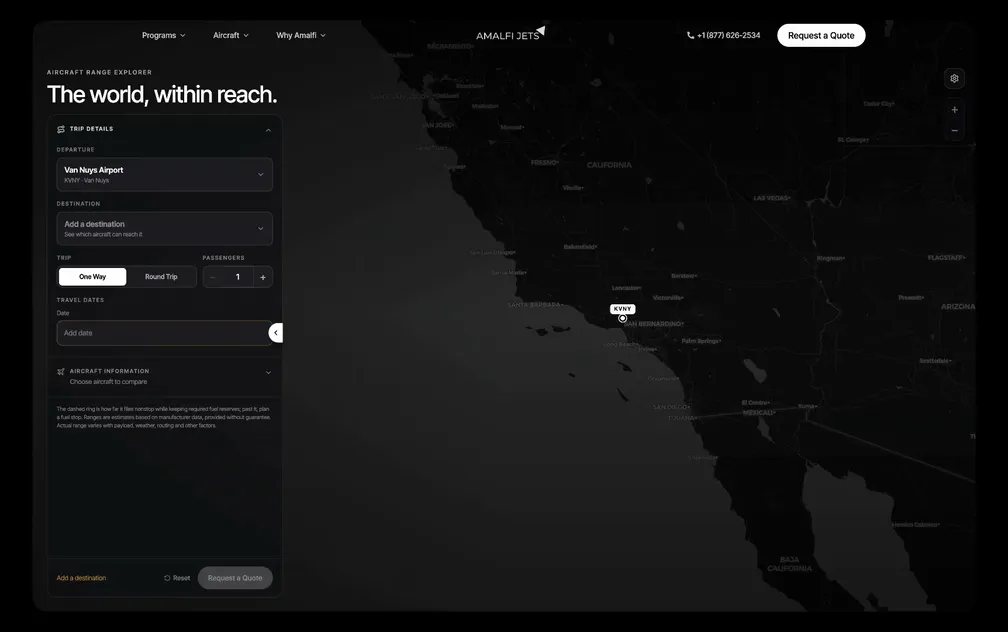
Try Range Explorer
See how far you can fly nonstop
Explore aircraft range, compare options, check flight times, and better understand which aircraft fits your trip.

Ready to fly to Tucson?
Request a charter and our team will tailor an itinerary for your next journey.
*Takes only about 40 seconds to request your quote.
