



Destination Hub
Private Jet Charter to Toronto

Private flights into Toronto are centered on Lester B. Pearson International Airport (YYZ), giving travelers a direct gateway to the city without airline connections. From the ramp, the charter day stays simple: aircraft timing, ground transfer, and arrival flow are organized around your schedule rather than an airline timetable.
Quick facts
Why charter a private jet to Toronto?
Chartering privately into Toronto gives travelers control over the most valuable part of the trip: time on the ground. A private arrival can be planned around meetings, residential stays, film-festival schedules, waterfront weekends, and same-day onward travel without building the day around commercial departure banks.
A simpler arrival through YYZ
YYZ is the primary airport for the city, which makes it the natural starting point for many private itineraries. The charter desk can organize the aircraft, handling, and ground movement as one connected plan, reducing the friction that often comes with airline connections, terminal transfers, and fixed public schedules.
Flexibility that matches the calendar
For executives, families, talent teams, and principals traveling with tight agendas, private aviation is less about spectacle than control. Departure times can be shaped around boardroom commitments, dinner reservations, hotel check-in windows, or a late change in the day’s schedule.
Privacy from origin to arrival
Discretion matters in a city where finance, entertainment, medicine, technology, and culture often overlap. A private charter helps keep the itinerary quieter, with fewer public touchpoints and a more controlled handoff to the ground team.
Time saved before and after the flight
The advantage is not limited to time in the air. Travelers avoid airline check-in patterns, connection risk, and crowded terminal flows, while the charter desk coordinates timing so the aircraft, crew, and ground transportation support the same itinerary.
A better fit for complex travel
Ground plans can be built around downtown, Yorkville, the waterfront, the Financial District, or regional appointments outside the core. That flexibility is often the reason travelers choose charter: the aircraft supports the trip, rather than forcing the trip to fit the aircraft.
“We secure the airport and handling plan first, then refine aircraft options around firm dates. July through September peak weeks narrow choice faster, so early confirmation gives the desk more lift to compare.”

When is the best time to fly to Toronto?
The best time to visit Toronto depends on whether your priority is peak city energy or softer demand. July, August, and September are the most competitive months for private arrivals, driven by summer festivals, waterfront weekends, the CNE, Caribbean Carnival, and TIFF.
Demand during those late-summer weeks can compress aircraft choice, especially for travelers with fixed arrival windows or multi-stop itineraries. Early planning is useful when hotel, event, and ground schedules cannot move.
January, February, and March tend to offer better value conditions for leisure travel. Cold winter weather softens demand, and aircraft availability can improve when fewer visitors are building discretionary trips around the lakefront and outdoor calendar.
Winter still rewards thoughtful planning. Travelers heading in for business, medical appointments, family visits, or cultural weekends should leave room for weather-aware scheduling and coordinate ground movement carefully.
Where our clients stay and go
Toronto rewards private travelers with a polished city rhythm set against Lake Ontario. The skyline rises from the water in glass, steel, and evening reflection, with the CN Tower acting less like a postcard than a constant point of orientation.
Lake light changes the mood of the city throughout the day. Mornings can feel crisp and practical along the Financial District’s towers, while afternoons pull energy toward the waterfront, island views, galleries, restaurants, and neighborhoods that move at very different speeds from one another.
By night, the city becomes more cinematic. Yorkville turns polished and residential, Queen West leans creative, the Distillery District adds brick and texture, and the entertainment core fills with screenings, dinners, and late arrivals during major cultural weeks.
For private travelers, the appeal is how easily business and leisure can be folded into a single itinerary. A morning meeting can lead to an art stop, a lakeside dinner, a family weekend, or a regional appointment without making the day feel overbuilt.
A chartered arrival suits that pattern. The city is large, layered, and international, but the right airport and ground plan can make it feel deliberate from the first step off the aircraft.
What determines the cost of a flight to Toronto?
The cost of chartering into Toronto is determined by the aircraft, routing, airport plan, season, and aircraft availability. A precise quote depends on how those variables come together for the requested date, schedule, and passenger requirements.
What shapes a charter quote
- Aircraft category: Larger cabins, longer missions, premium interiors, and specific aircraft preferences can affect overall pricing.
- One-way versus round trip: A round trip may use the same aircraft and crew more efficiently, while a one-way itinerary may require repositioning before or after your flight.
- YYZ positioning and fees: The airport plan matters because positioning, handling, parking, landing, and related operating fees can vary by routing and schedule.
- Seasonal demand: July, August, and September bring stronger demand tied to summer travel, waterfront weekends, the CNE, Caribbean Carnival, and TIFF.
- Empty-leg availability: An empty leg can create value when an aircraft is already moving in the right direction at the right time, but it must match your schedule closely.
Why quotes vary
Aircraft are live assets, not fixed inventory. The best option for a Monday morning departure may change by the afternoon if another trip confirms, a crew duty limit applies, or a more efficient aircraft becomes available.
How Amalfi Jets approaches pricing
The desk compares suitable aircraft, routing logic, airport handling, and schedule flexibility before presenting options. If your dates are firm, confirming earlier generally widens aircraft choice; if your timing is flexible, the team can evaluate alternates and empty-leg possibilities more effectively.
Which airports serve Toronto?
Toronto is served by YYZ as the primary airport, with YTZ, YOO, YHM, and YKF available as regional alternates when the ground plan points in a different direction. The best choice is not always the closest point on a map; it is the airport that best aligns aircraft suitability, handling, schedule, and the traveler’s final destination.
Lester B. Pearson International Airport (YYZ)
As the primary airport for Toronto, Lester B. Pearson International Airport is the default gateway for many private arrivals. This is the clearest choice when the itinerary is centered on international access, major-city ground logistics, or a straightforward plan into the broader metropolitan area.
Billy Bishop Toronto City Airport (YTZ)
YTZ is the city-airport option when the day is anchored downtown or along the waterfront. Its appeal is ground-side simplicity for central meetings and hotel plans, though the charter desk must confirm aircraft, operating, and private-handling suitability before recommending it.
Oshawa Airport (YOO)
YOO can make sense when the itinerary is weighted toward the eastern side of the metropolitan region. Instead of landing at the primary gateway and crossing back across the area by car, a suitable alternate may reduce ground complexity for homes, meetings, or facilities east of the core.
John C. Munro Hamilton International Airport (YHM)
YHM is useful when the trip points west of the city or toward the Hamilton side of Lake Ontario. For travelers whose meetings, residences, or onward ground plans sit outside the central core, this airport can be the more logical regional fit if aircraft and handling requirements align.
Region Of Waterloo International Airport (YKF)
YKF is a practical consideration when the itinerary is built around Waterloo Region rather than downtown. It can help keep the flight plan closer to a regional business visit, university-related travel, or family stay in that part of Ontario.
Choosing the right airport
A strong Toronto airport plan starts with the final address, not the airport code. Amalfi Jets reviews aircraft suitability, handling needs, arrival timing, and ground routing before recommending YYZ or a regional alternate.
Routes to & from Toronto
Common questions about Toronto charter
Which airport is best for a private flight into the city?
Most private flights into Toronto use YYZ because it is the primary airport, but the right choice depends on aircraft suitability, schedule, handling, and the final ground destination.
Can I use Billy Bishop instead of YYZ?
Billy Bishop Toronto City Airport can be useful for downtown-focused trips, but the charter desk must confirm aircraft, operating, and private-handling suitability before recommending it.
What determines the cost of a charter flight?
Cost for a Toronto charter is shaped by aircraft category, routing, one-way or round-trip structure, YYZ positioning and fees, seasonal demand, and any empty-leg opportunity that fits your schedule.
When should I book for summer or TIFF travel?
For Toronto, July, August, and September bring stronger demand from summer weekends, the CNE, Caribbean Carnival, and TIFF, so firm dates should be confirmed early.
When would a regional airport make more sense?
A Toronto flight may use YOO, YHM, or YKF when the traveler’s ground plans are closer to the eastern, western, or Waterloo Region side of the area than to YYZ.
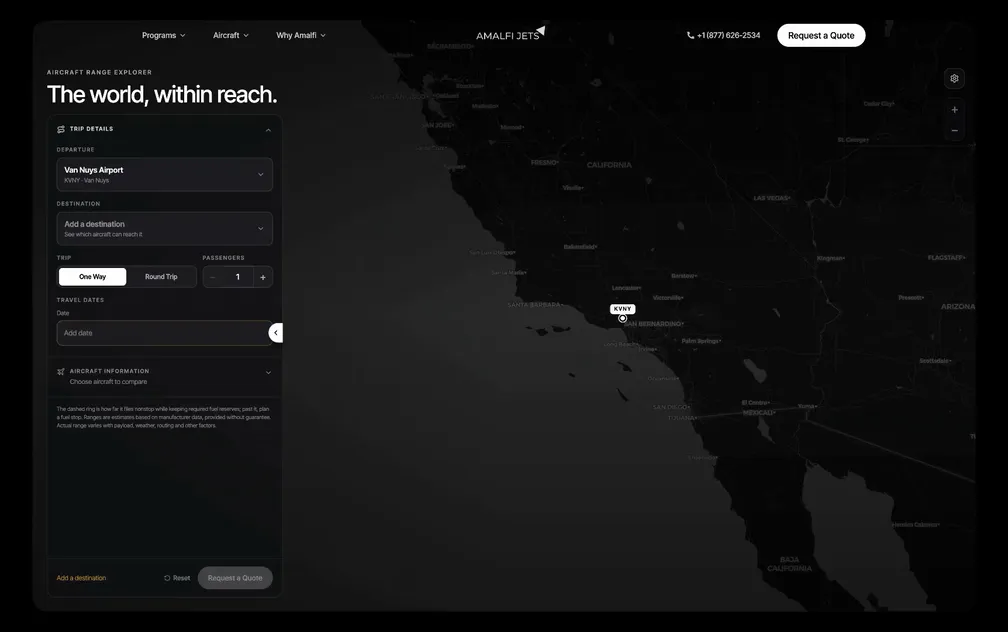
Try Range Explorer
See how far you can fly nonstop
Explore aircraft range, compare options, check flight times, and better understand which aircraft fits your trip.

Ready to fly to Toronto?
Request a charter and our team will tailor an itinerary for your next journey.
*Takes only about 40 seconds to request your quote.
