



Destination Hub
Private Jet Charter to St. Augustine

Most private arrivals for St. Augustine are planned through Northeast Florida Regional Airport (UST), keeping the day centered on a single, convenient gateway. Your aircraft, ground transfer, and departure timing can be organized around the trip rather than an airline schedule. The result is a quieter arrival into a coastal city where the bayfront, historic streets, and Atlantic beaches feel close from the moment you land.
Quick facts
Why charter a private jet to St. Augustine?
Private flying gives travelers bound for St. Augustine a simpler way to protect time, privacy, and momentum.
With Northeast Florida Regional Airport (UST) as the primary arrival point, the charter plan can be built around the real trip: a weekend in the historic district, a beach stay near the Atlantic, a family gathering, or a business schedule that does not leave room for airline connections. A single planned arrival keeps the day focused, with the aircraft, crew, and ground transportation coordinated before wheels down.
Why travelers choose to fly privately
UST keeps the experience straightforward for travelers whose time in the city is limited or highly scheduled. Instead of building a day around airline departure banks, layovers, and fixed return times, a charter can be organized around dinner reservations, hotel check-in, meeting windows, and the needs of the party traveling together.
Travelers also value the discretion of a private arrival. Luggage handling, passenger timing, and ground transfers can be arranged as part of one itinerary, reducing the number of public touchpoints between home and destination.
Flexibility once plans shift
Because coastal weekends, holidays, and family trips often move in small ways, the value of charter is not only speed. It is the ability to adjust the schedule with a dedicated aviation team watching aircraft availability, airport logistics, crew timing, and alternate options if the original plan changes.
For travelers comparing private jet charter for St. Augustine, the strongest advantage is control: arrive closer to your own calendar, depart when the trip is finished, and keep the travel day as composed as the destination itself.
“For firm December, January, and March dates, our charter desk secures UST handling first, then widens aircraft options before peak demand narrows preferred departure times.”

When is the best time to fly to St. Augustine?
The best time to visit St. Augustine depends on whether the priority is atmosphere, weather comfort, or availability.
December and January are peak months because Nights of Lights, holiday travel, and mild dry weather create strong demand for hotels, restaurants, aircraft, and ground arrangements. March also brings a busier planning environment as spring-break trips add pressure to peak-week travel.
Those months reward early decisions. Travelers with fixed school calendars, holiday dates, or coordinated family plans should secure aircraft and lodging before the preferred schedule narrows.
May, September, and October can be more flexible for travelers who want lighter crowds and better charter availability. Shoulder-season gaps often create a calmer planning window, while hurricane-season softness in early fall can improve options for those able to keep timing adaptable.
Flexibility is especially valuable during late-summer and fall travel. Build in room to adjust departure times, monitor weather, and choose alternates if the operating plan changes.
Travelers who want the city at its most festive should plan around the winter peak. Guests who prefer a quieter coastal stay may find the value months better suited to a longer, more relaxed itinerary.
Where our clients stay and go
St. Augustine draws private travelers with a compact coastal setting, Spanish-colonial texture, and an easy rhythm between history, water, and beach.
The city sits along Matanzas Bay, where the historic district meets the water in a low, sun-washed skyline of church towers, tiled roofs, palms, and old stone. Streets near the plaza lead past courtyards, galleries, restaurants, and centuries-old architecture, while the Castillo de San Marcos anchors the bayfront with the kind of presence that makes the city feel distinct before an itinerary even begins.
Morning light on the water, a walk near the Bridge of Lions, and an afternoon crossing toward Anastasia Island give the destination its coastal pace. By evening, the focus shifts back to the historic core, where dinners, private gatherings, and hotel terraces make the city feel intimate rather than sprawling.
For private travelers, the appeal is not only what there is to see. Days can be arranged with little friction: a beach morning, a guided historic walk, a boat outing, a quiet lunch, and a return to the aircraft without turning the travel day into the center of the trip.
What determines the cost of a flight to St. Augustine?
The cost of chartering to St. Augustine is shaped by the aircraft selected, the route flown, scheduling structure, airport costs, seasonality, and available empty legs.
Aircraft category and itinerary structure
Aircraft category is one of the central inputs. Cabin size, range, passenger count, luggage needs, and crew requirements all influence which aircraft are appropriate for a given trip, and each aircraft type is priced differently by the operator.
A round-trip itinerary may price differently from a one-way itinerary because aircraft and crew can remain positioned for the return in some cases, while other trips require repositioning. One-way charters can be efficient when the aircraft is already moving in the right direction, but they can also include positioning if the jet must be brought in for your departure or moved elsewhere afterward.
UST positioning, fees, and handling
UST is the primary planning point for arrivals into the city, so the charter desk evaluates aircraft availability into that airport first. Positioning matters: if the best aircraft is based elsewhere, the operator may need to fly it into place before your passengers board or reposition it after drop-off.
Airport-related costs are also part of the final quote. Landing, handling, parking, after-hours service, and other operator-assessed charges can vary by airport and trip timing, so Amalfi Jets reviews the complete routing before presenting options.
Seasonal demand and empty-leg opportunities
Demand can tighten during December, January, and March, when Nights of Lights, winter holidays, mild dry weather, and spring-break travel bring more private-flight activity into the region. During those periods, earlier planning generally gives the charter desk more aircraft choices.
May, September, and October can sometimes bring stronger availability because shoulder-season gaps and hurricane-season softness reduce pressure on aircraft and crews. Empty legs may lower the effective cost when an aircraft already needs to reposition along a compatible route, but they are never guaranteed and usually require flexibility on timing, airports, and direction of travel.
Which airports serve St. Augustine?
St. Augustine is served primarily by Northeast Florida Regional Airport (UST), with several regional alternates available when the final address, aircraft positioning, or schedule makes another airport more practical.
UST: the primary gateway
For most charter itineraries, UST is the cleanest starting point because it keeps the arrival centered on the city itself. It is the natural choice when guests are staying near the historic district, the beaches, the marina, or private residences in the immediate area.
Choosing the primary airport also simplifies coordination. The charter desk can align aircraft handling, passenger arrival, luggage movement, catering, and car service around a single plan rather than adding unnecessary ground time from a larger regional gateway.
FIN: Flagler Executive Airport
Flagler Executive Airport (FIN) can make sense when the itinerary points farther down the coast or when aircraft availability and ground plans are better served from the Flagler side of the region. It gives the charter team another executive-airport option without forcing every trip through the same arrival point.
This alternate is most useful when the traveler’s final destination is not in the historic core or when schedule flexibility allows the desk to compare handling, aircraft positioning, and ground transportation as a complete picture.
CRG: Jacksonville Executive at Craig Airport
Jacksonville Executive at Craig Airport (CRG) is a useful consideration for travelers with business or personal commitments on the Jacksonville side of Northeast Florida. Its executive-airport profile can be attractive when the trip benefits from a private-aviation setting and a northern approach to the region.
Rather than treating CRG as a substitute by default, Amalfi Jets would weigh it against UST based on where passengers actually need to be after landing, how the aircraft is positioned, and which airport creates the smoother day.
VQQ: Cecil Airport
Cecil Airport (VQQ) offers another Jacksonville-area alternative for private charter planning. It may be relevant when aircraft logistics, crew scheduling, or a traveler’s ground itinerary point toward the western side of the broader region.
This is the kind of alternate best evaluated case by case. If using VQQ reduces friction elsewhere in the trip — for example, by aligning better with aircraft positioning or a specific ground destination — the charter desk can include it in the airport comparison.
JAX: Jacksonville International Airport
Jacksonville International Airport (JAX) is the region’s major commercial gateway and may be useful when a private flight needs to connect with airline arrivals, meet passengers coming from different travel modes, or support an itinerary that begins or ends closer to Jacksonville.
For many leisure stays, the primary airport will still feel more direct. JAX becomes more compelling when the wider travel plan, not just the map, makes a larger airport environment worthwhile.
Common questions about St. Augustine charter
Which airport should I use for a charter arrival?
Most trips to St. Augustine should start with UST, the primary airport, because it keeps the arrival plan closest to the purpose of the visit and gives the charter desk a clear first handling point.
What determines the cost of chartering there?
Cost for St. Augustine is determined by aircraft category, itinerary length, one-way or round-trip structure, aircraft positioning, airport fees, seasonal demand, and empty-leg opportunities when they align.
Can Amalfi Jets use airports other than UST?
Yes, St. Augustine itineraries can also consider FIN, CRG, VQQ, or JAX when an alternate better fits aircraft availability, handling, or the final ground destination.
When should I book for peak season?
December, January, and March are the peak planning months for St. Augustine because holiday travel, Nights of Lights, mild dry weather, and spring-break demand can tighten availability.
Are there better months for flexibility?
May, September, and October can be useful for St. Augustine travelers seeking lighter crowds and broader availability, with hurricane-season flexibility especially important in early fall.
Should ground transport be arranged before landing?
For St. Augustine, ground transport should be coordinated before arrival so the aircraft schedule, passenger timing, luggage, and final address are aligned in one handling plan.
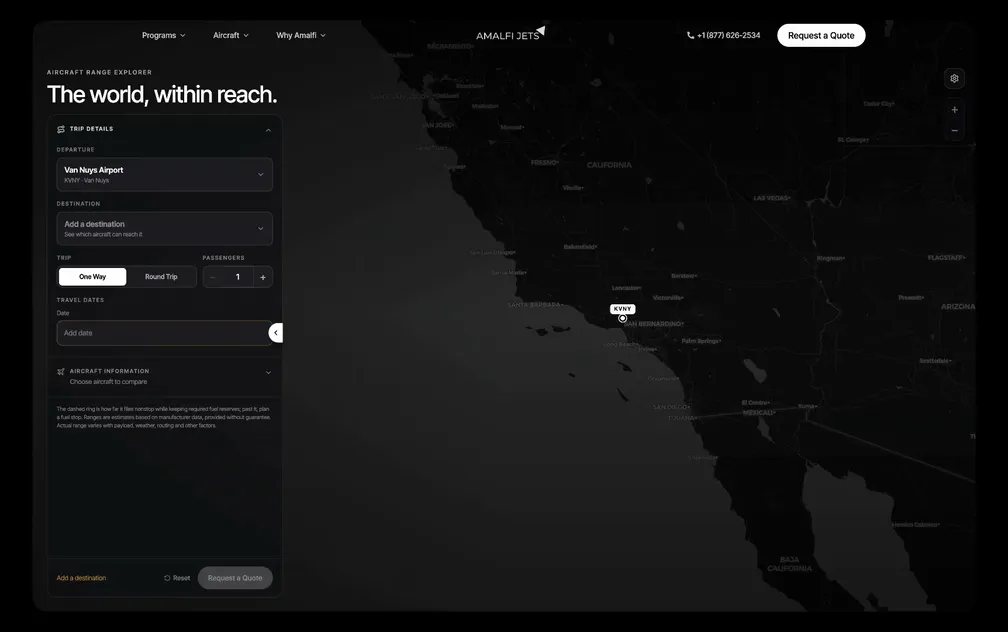
Try Range Explorer
See how far you can fly nonstop
Explore aircraft range, compare options, check flight times, and better understand which aircraft fits your trip.

Ready to fly to St. Augustine?
Request a charter and our team will tailor an itinerary for your next journey.
*Takes only about 40 seconds to request your quote.
