



Destination Hub
Private Jet Charter to Sioux Falls

Most private flights into the city use Sioux Falls Regional Airport (Joe Foss Field), giving travelers a straightforward arrival close to the area’s business, medical, university, and riverfront districts. With one primary gateway to plan around, the day stays efficient: passengers arrive on their schedule, step into a coordinated ground transfer, and move on without airline connections.
Quick facts
Why charter a private jet to Sioux Falls?
Chartering privately into Sioux Falls is about controlling the travel day rather than working around it.
FSD keeps the plan focused: one primary arrival point, one handling sequence, and one ground-transfer strategy for the city and the surrounding region. For executives, families, physicians, university visitors, and event travelers, that simplicity can matter as much as the aircraft itself.
Why travelers choose private flights here
- Schedule control: Depart when the day is ready, not when a commercial timetable allows.
- Direct routing: Avoid unnecessary connections and reduce time spent in terminals.
- Privacy on arrival: Move from aircraft to ground transportation with a quieter, more controlled transition.
- Regional flexibility: When the itinerary points beyond Sioux Falls, alternate airports can be reviewed for a shorter surface leg or a better operating plan.
The value is most visible on tightly timed trips. A morning meeting, an afternoon site visit, and an evening return can be organized as one continuous travel day, with the aircraft plan built around the calendar rather than the other way around.
“We secure your preferred arrival window and ground-transfer timing first; during June through September, firm dates booked early help widen aircraft choice before summer and event demand tightens availability.”

When is the best time to fly to Sioux Falls?
The best time to visit Sioux Falls depends on whether the priority is warm-weather energy, event-driven travel, or easier aircraft availability.
June, July, August, and September are the peak months. Summer brings outdoor weather, festivals, fairs, and fuller calendars, while September adds golf and event demand that can tighten preferred departure times. Travelers with firm dates during this stretch should plan earlier, especially for weekend arrivals or same-day round trips.
January, February, and March are typically the value months. Cold winter and early-spring conditions, combined with a lighter event calendar, usually create better availability and more flexibility for travelers who can adjust departure times.
For shoulder-period planning, the most practical approach is to protect the non-negotiable pieces first: arrival window, passenger count, baggage profile, and ground schedule. Once those are fixed, the aircraft plan can be refined around comfort, timing, and route efficiency.
Where our clients stay and go
Sioux Falls gives private travelers a Midwestern arrival with a strong sense of place: river water, pale prairie light, quartzite stone, and a compact downtown that feels purposeful rather than overbuilt.
The city takes its name from the falls of the Big Sioux River, where pink-red rock and moving water create a landmark that still anchors local identity. Around it, the downtown grid has grown into a practical mix of offices, restaurants, hotels, public art, and walkable blocks that suit short executive stays as well as longer family visits.
There is a directness to the place that works well for private travel. Meetings can be concentrated into a single day, medical and university visits can be organized without a complicated transfer plan, and regional business can extend beyond the city without losing the efficiency of a private arrival.
Mornings often feel open and bright, with the river cutting through the urban core and the horizon never far away. Even on a fast trip, the landscape registers quickly: water over stone, grain elevators in the distance, low skyline, and the quiet confidence of a city that serves a wide rural and commercial region.
For leisure travelers, the appeal is understated. Falls Park, the river greenway, local dining, golf, and South Dakota road-trip extensions give the destination enough texture for a long weekend, while the airport plan keeps the arrival and departure deliberately simple.
What determines the cost of a flight to Sioux Falls?
The cost of chartering into Sioux Falls is determined by aircraft selection, routing, airport logistics, seasonal demand, and how efficiently the aircraft can be positioned.
Aircraft category and mission profile
Aircraft choice is usually the largest driver. Cabin size, range, baggage needs, passenger count, crew requirements, and onboard preferences all affect which options are suitable for the trip. A short regional movement, a nonstop cross-country itinerary, and a multi-stop business day may call for different solutions.
One-way versus round trip structure
A round trip can be priced differently from a one-way because the aircraft, crew, and schedule may remain tied to the traveler’s itinerary. For a one-way movement, the quote may need to account for repositioning before or after the passenger flight.
FSD positioning and airport-related fees
Costs may reflect where the aircraft is based before departure, where it must go afterward, and what services are required at FSD. Handling, parking, crew logistics, passenger services, and weather-related support can all influence the final structure of a charter quote.
Seasonal demand
June through September typically brings the strongest pull from summer festivals, fairs, favorable outdoor weather, and September golf and event travel. During those periods, earlier planning gives the charter desk more room to compare aircraft and build the cleanest schedule.
Empty-leg availability
Empty legs can occasionally reduce the cost of a qualifying itinerary, but they are schedule-dependent and less flexible than a standard charter. The best opportunities appear when a traveler’s preferred timing, direction, passenger count, and airport plan align with an aircraft that already needs to move.
Which airports serve Sioux Falls?
The primary airport serving the city is Sioux Falls Regional Airport (Joe Foss Field) (FSD), with several regional alternates considered when the ground plan supports them.
FSD
FSD is the default choice for most private arrivals because it centers the trip around the city itself. For travelers whose meetings, hotel plans, medical visits, university appointments, or family schedules are in the metro area, using the primary airport keeps the handling plan direct and avoids adding an unnecessary surface leg.
Marv Skie-Lincoln County Airport (Y14)
Y14 can make sense when the traveler’s day points toward Lincoln County or the southern side of the region. The appeal is not simply avoiding the primary airport; it is matching the aircraft arrival to the final ground destination when that creates a cleaner overall itinerary. Suitability should be confirmed for the specific aircraft, passenger needs, and handling plan.
Quentin Aanenson Field Airport (LYV)
LYV is best treated as a regional alternate for itineraries that do not need to start or end in the city center. It may be worth reviewing when the passenger’s ground commitments sit closer to that airport’s service area, or when aircraft positioning creates a more efficient option. The charter desk should confirm access, services, and operator approval before presenting it as the preferred plan.
Brookings Municipal Airport (BKX)
BKX is a logical consideration for travelers whose schedule is tied to the Brookings area rather than downtown Sioux Falls. For regional business, academic, agricultural, or family travel in that direction, an alternate can reduce time on the road if the operational details align. As with any secondary field, the final recommendation depends on aircraft suitability, handling arrangements, and passenger transfer logistics.
Chan Gurney Airport (YKN)
YKN may be useful when the southern regional itinerary is the true destination and the city is only part of the broader travel plan. It can also be reviewed as a contingency option if the preferred schedule, aircraft positioning, or ground route favors an alternate. Before it is selected, the charter team confirms the practical details that matter to a private arrival: handling, access, passenger movement, and the aircraft operator’s requirements.
Common questions about Sioux Falls charter
What airport should I use when flying privately into Sioux Falls?
Most travelers use Sioux Falls Regional Airport (Joe Foss Field), known by the code FSD, because it is the primary gateway for the city and keeps the arrival plan straightforward.
Can I use an alternate airport instead of FSD?
Yes, Sioux Falls travelers may consider Y14, LYV, BKX, or YKN when the ground destination, aircraft positioning, and handling arrangements make an alternate more practical.
What determines the cost of chartering into the city?
The cost of chartering into Sioux Falls depends on aircraft category, trip structure, repositioning, airport fees, seasonal demand, and whether an empty-leg opportunity fits the schedule.
When should I book for summer travel?
For Sioux Falls trips in June, July, August, or September, earlier booking is wise because festivals, fairs, outdoor-weather travel, and September golf or event demand can reduce preferred aircraft availability.
Are winter trips usually easier to arrange?
Sioux Falls trips in January, February, and March often have better availability because colder weather and a lighter event calendar can make scheduling more flexible.
How does Amalfi Jets choose between FSD and the secondary airports?
For Sioux Falls, the charter team compares the passenger’s final destination, aircraft requirements, ground-transfer plan, and airport handling details before recommending the most efficient arrival point.
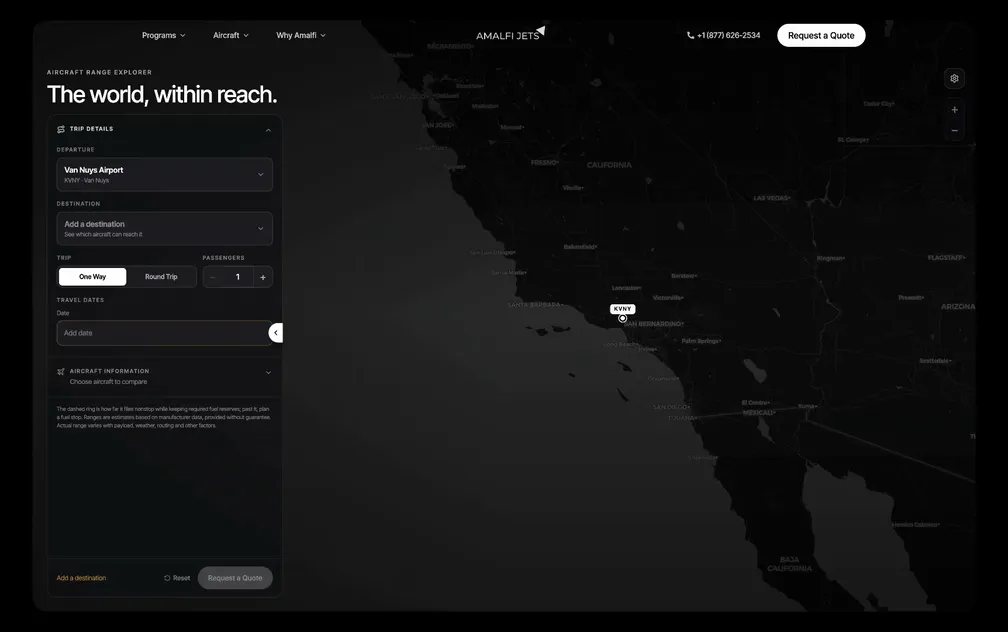
Try Range Explorer
See how far you can fly nonstop
Explore aircraft range, compare options, check flight times, and better understand which aircraft fits your trip.
Ready to fly to Sioux Falls?
Request a charter and our team will tailor an itinerary for your next journey.
*Takes only about 40 seconds to request your quote.
