



Destination Hub
Private Jet Charter to Sao Paulo
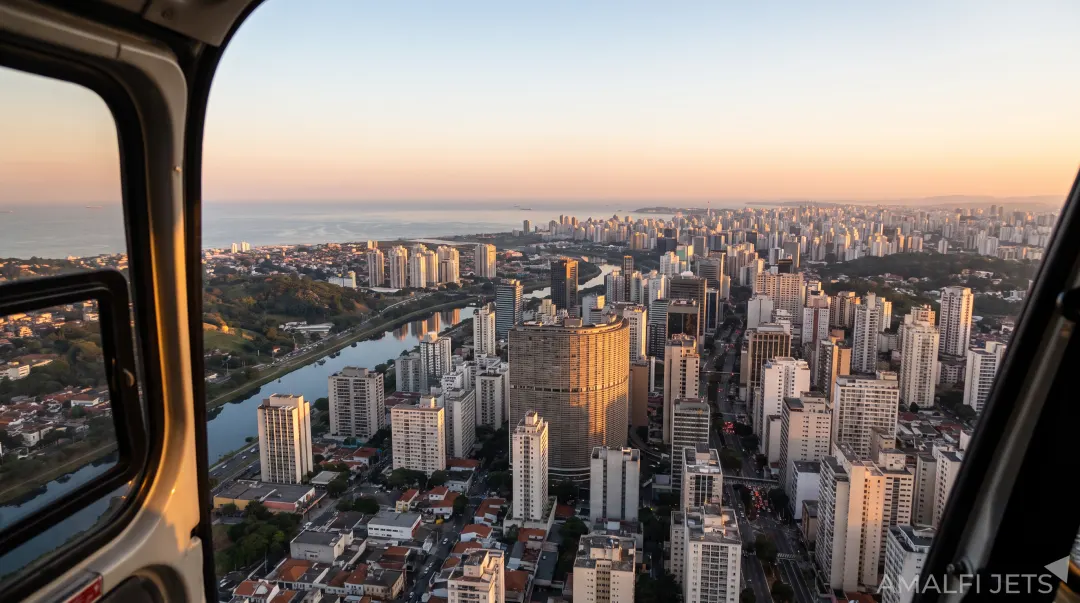
Most private flights into Sao Paulo begin at Campo de Marte Airport (RTE), where the arrival can be shaped around the traveler rather than an airline timetable. From the ramp, the city’s layered skyline, business districts, and evening reservations are handled as one coordinated movement. The result is a calmer charter day: direct arrival, discreet handling, and a schedule that stays close to your own.
Quick facts
Why charter a private jet to Sao Paulo?
Chartering privately into Sao Paulo is about preserving time in a city where the calendar often matters as much as the destination. Campo de Marte Airport (RTE) serves as the primary gateway for this page, giving travelers a focused arrival plan without the connections, fixed departure banks, or public-terminal pace of scheduled aviation.
A schedule built around the traveler
Private aviation is valuable here because it turns the flight into part of the itinerary, not an interruption. Meetings can be arranged first, aircraft timing second, and the ground plan can be organized around where the day actually begins.
For executive travelers, that flexibility is often the reason to charter. A morning boardroom, a late lunch in Jardins, a site visit outside the core, and an evening departure can sit inside one managed travel day when the aircraft is positioned around the passenger’s schedule.
Simpler airport decisions
RTE gives the charter desk a clear primary plan, while Congonhas Airport, Sao Paulo Catarina Executive Airport, Jundiai Airport, and Sao Paulo-Guarulhos International Airport create useful alternatives when the trip calls for a different ground route or operating plan.
Each airport choice is weighed against the itinerary: where the passengers are staying, which side of the region they need to reach, how firm the departure time is, and whether an alternate improves the overall day. A strong charter plan is not just about landing near the city; it is about landing where the rest of the journey becomes easier.
“For peak months, our charter desk secures preferred airport handling and aircraft availability first, then refines ground timing. Firm dates confirmed early usually widen the aircraft options, especially around Carnival, Fashion Week, and the Grand Prix.”

When is the best time to fly to Sao Paulo?
The best time to visit Sao Paulo depends on whether the trip is tied to major demand weeks or a quieter window. February, April, September, and November call for earlier planning, while January, July, and December can offer more flexibility when corporate travel softens.
Peak-demand months
February often draws additional movement around Carnival, when leisure and hospitality calendars tighten. April and September can bring heavier pressure during trade-show periods and Fashion Week, particularly for travelers who need specific aircraft timing, preferred accommodations, or coordinated ground movements.
November is shaped by the F1 Grand Prix, which can compress availability well beyond the race weekend itself. Travelers with fixed dates should treat that period as a peak aviation window and confirm the aircraft plan before the schedule becomes crowded.
Value-oriented timing
January, July, and December can be useful months for travelers whose plans are not tied to the busiest corporate calendar. Summer patterns, school holidays, and year-end breaks may soften business demand, giving the charter desk more room to compare aircraft options and timing.
Flexibility remains valuable in every season. A traveler who can adjust departure time, consider an alternate airport, or confirm dates early will usually have a cleaner planning process than one working against a narrow window at the last moment.
Where our clients stay and go
Sao Paulo is a city of scale and rhythm, set on an inland plateau where broad avenues, river corridors, and dense skylines give the arrival a distinctly urban gravity. It is not a resort city that reveals itself all at once; it works in layers, moving from glass towers to shaded parks, from late lunches to galleries, from business appointments to dining rooms that run deep into the night.
The city in motion
Avenida Paulista gives the city one of its defining axes: cultural institutions, offices, hotels, bookstores, and restaurants stacked along a ridge of constant movement. Around Jardins, the pace becomes more polished, with designer storefronts, discreet hotels, and dining rooms that suit private travelers who want service without spectacle.
Ibirapuera Park changes the tempo. Its lawns, lakes, and modernist cultural buildings offer open sky inside the city’s dense fabric, making it one of the most useful pauses between meetings or before an evening departure.
Why private travelers come
The draw is not a single postcard view. It is access to Brazil’s financial, fashion, culinary, art, and media circles in one metropolitan setting. A well-planned charter trip can move from a morning meeting to a museum visit, a private dinner, or a flight out the same evening without handing the day over to an airline schedule.
Neighborhoods give the city its texture. Pinheiros and Vila Madalena bring galleries, bars, and street art into the itinerary; Liberdade adds one of the city’s most recognizable cultural identities; the central historic core still carries the architecture and institutions that shaped its rise. For travelers who know what they came to do, the city rewards precision.
What determines the cost of a flight to Sao Paulo?
The cost of chartering into Sao Paulo is determined by the aircraft selected, the route structure, airport-related expenses, seasonal demand, and the availability of repositioning opportunities. A quote is therefore built around the trip itself, not a fixed public fare.
Aircraft category and itinerary shape
Cabin category is one of the largest variables because it influences aircraft availability, crew planning, onboard service expectations, and the way the trip is scheduled. The right fit depends on passenger count, luggage profile, timing, and the level of cabin comfort requested.
Routing also matters. A one-way trip may require aircraft positioning before or after the passenger leg, while a round trip can sometimes keep the same aircraft and crew aligned with the traveler’s schedule. Multi-stop itineraries add another layer because each segment affects crew duty planning, airport arrangements, and total aircraft time.
RTE positioning and airport expenses
Campo de Marte Airport (RTE) is the primary airport for this destination page, so pricing considers how the aircraft and crew are positioned around that arrival or departure. Airport fees, handling, parking, permits, and related operating requirements are reviewed as part of the charter quotation.
When an alternate airport is preferable, the quote may change because the aircraft, handler, crew timing, and ground plan may change with it. The lowest-friction airport operationally is not always the same as the most convenient address on the ground, which is why the charter desk evaluates both together.
Demand, peak weeks, and empty legs
Seasonal demand can affect aircraft choice and lead time. February, April, September, and November tend to be busier because Carnival, trade-show weeks, Fashion Week, and the F1 Grand Prix place more pressure on aircraft and airport planning.
Empty-leg availability can improve value when an existing aircraft movement matches the requested route and timing. Those opportunities are highly specific, often time-sensitive, and less flexible than a fully tailored charter, but they can be worth reviewing when the traveler’s schedule allows.
Which airports serve Sao Paulo?
Sao Paulo is served by one primary airport for this page and four useful alternates, giving private travelers several ways to match the aircraft plan to the ground itinerary. The best choice depends on where passengers need to be, how firm the schedule is, and which airport arrangement supports the cleanest arrival or departure.
Campo de Marte Airport (RTE)
RTE is the primary airport for this destination page and the first airport the charter desk evaluates for a city-focused arrival. It works well when the priority is a straightforward private-flight plan with one central operating point, one handling brief, and a ground movement organized directly around the traveler’s schedule.
Congonhas Airport (CGH)
Congonhas Airport can make sense when the traveler’s meetings, hotel, or onward movement align better with its side of the city. It is also a practical alternate to review when the preferred timing at RTE needs comparison against another established airport option.
Sao Paulo Catarina Executive Airport (JHF)
Sao Paulo Catarina Executive Airport is a secondary option that may suit travelers who want the charter desk to evaluate an executive-focused airport setting for the mission. It can be considered when the ground itinerary sits away from the densest central pattern or when a private-flight environment is a priority.
Jundiai Airport (QDV)
Jundiai Airport is useful to review when the itinerary extends toward Jundiai or the surrounding part of the region. For travelers whose destination is not the city center, an alternate airport may reduce unnecessary ground movement and create a more direct day.
Sao Paulo-Guarulhos International Airport (GRU)
Sao Paulo-Guarulhos International Airport is the major international-name alternate in the airport set and can be relevant when the trip connects with long-haul commercial arrivals, international passenger movements, or a wider support network. It is not always the simplest choice for a private itinerary, but it can be the right one when the overall travel plan points there.
Common questions about Sao Paulo charter
Which airport should I use for a private flight into the city?
For Sao Paulo, Campo de Marte Airport (RTE) is the primary airport used on this page, with Congonhas, Catarina Executive, Jundiai, and Guarulhos considered when schedule, handling, or ground routing make an alternate preferable.
How early should I book for the busiest periods?
For Sao Paulo, firm dates in February, April, September, and November should be confirmed early because Carnival, trade-show weeks, Fashion Week, and the F1 Grand Prix can tighten aircraft choice and airport planning.
What determines the cost of chartering there?
The cost of chartering into Sao Paulo is shaped by aircraft category, routing, one-way or round-trip structure, RTE positioning, airport and handling fees, seasonal demand, and empty-leg availability.
Can I choose GRU instead of RTE?
Sao Paulo travelers can consider GRU when an international airport setting better supports the itinerary, especially when coordinating with long-haul commercial arrivals or broader passenger movements.
What happens after the aircraft lands?
After landing in Sao Paulo, the charter plan moves directly into passenger handling, luggage coordination, and the arranged ground transfer so the day continues without a public-terminal connection.
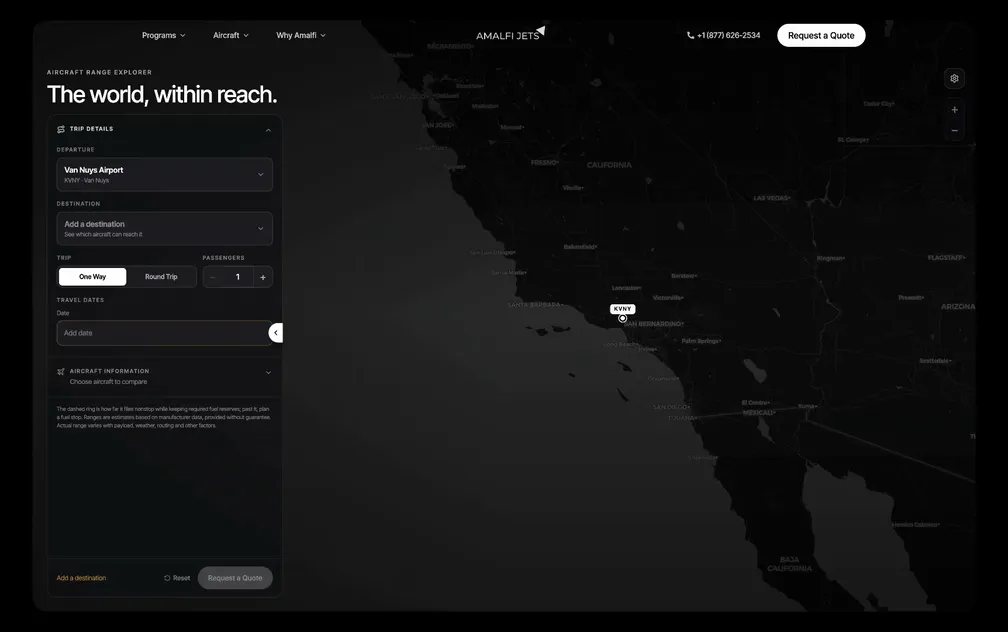
Try Range Explorer
See how far you can fly nonstop
Explore aircraft range, compare options, check flight times, and better understand which aircraft fits your trip.

Ready to fly to Sao Paulo?
Request a charter and our team will tailor an itinerary for your next journey.
*Takes only about 40 seconds to request your quote.
