



Destination Hub
Private Jet Charter to Rapid City
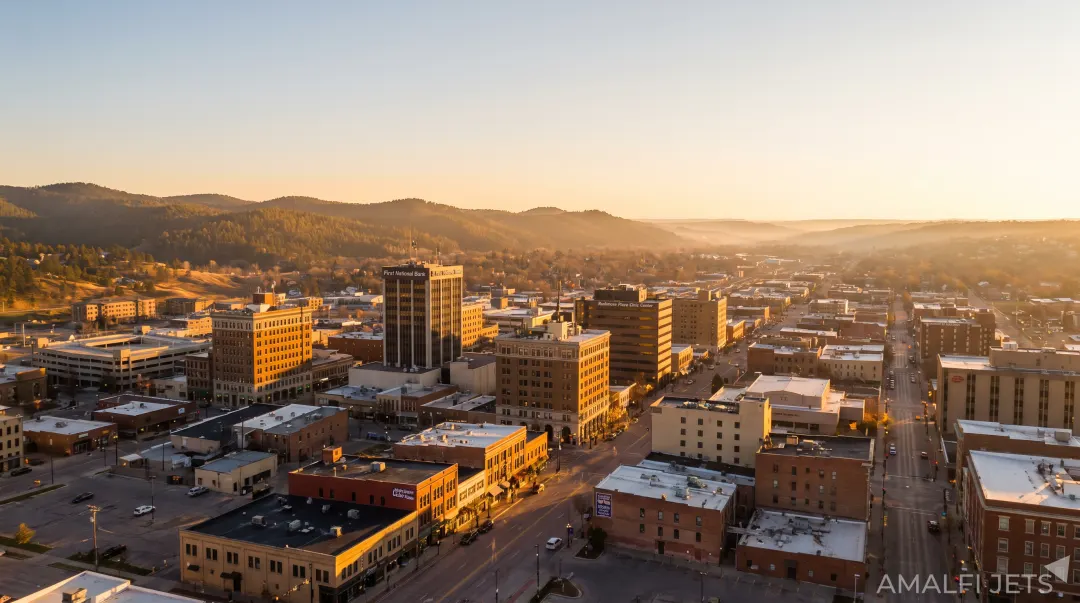
Most private flights arrive through Rapid City Regional Airport (RAP), giving charter travelers a clean gateway to the Black Hills without an airline connection. From the ramp, the day can move directly toward downtown, the pine ridges, or a wider itinerary through western South Dakota on the schedule you set.
Quick facts
Why charter a private jet to Rapid City?
Private charter is the most controlled way to reach Rapid City when the trip depends on timing, privacy, and a direct arrival into the Black Hills.
Commercial itineraries can add connections, fixed departure windows, and time spent moving through terminals. A charter flight keeps the day centered on the traveler: departure can be organized around meetings, lodge check-ins, family plans, or a multi-stop itinerary rather than an airline bank.
Why private flyers choose this gateway
- Direct access to the region: Rapid City Regional Airport (RAP) is the primary airport for the city, making it the natural first plan for most arrivals.
- A simpler travel day: Private aviation reduces time spent connecting and allows the ground schedule to begin as soon as the aircraft arrives.
- Calendar control: Firm departure times, preferred return windows, and last-minute adjustments are easier to manage when the aircraft is arranged around the trip.
- Regional flexibility: Secondary airports can be considered when a traveler’s final destination sits closer to another part of the Black Hills.
For travelers moving between Mount Rushmore, the Badlands, ranch properties, lodges, and downtown meetings, the value is not only the flight itself. It is the ability to keep the entire itinerary intact, from aircraft selection to ground transfer timing.
“For peak summer dates, our charter desk secures aircraft options and ground timing first, then evaluates whether RAP or a regional alternate best fits the final stop. Early firm dates widen choice.”

When is the best time to fly to Rapid City?
The best time to visit Rapid City depends on whether the priority is summer access to the Black Hills or quieter off-season availability.
June, July, and August are the peak planning months. Demand rises as travelers build itineraries around Mount Rushmore, the Badlands, warm-weather touring in the Black Hills, and the Sturgis Rally. For fixed summer dates, charter planning should begin early so aircraft choice, crew timing, and ground arrangements can be aligned before the busiest weeks tighten.
Summer travel
The region’s long daylight and open-road touring rhythm make summer the most active season. It is the time to plan scenic drives, national park days, family travel, and multi-stop western South Dakota itineraries with the least tolerance for last-minute aircraft changes.
Value months
January, February, and November tend to see fewer leisure visitors. Cold weather shapes the experience, but the quieter calendar can improve aircraft availability and give flexible travelers more room to refine departure times.
Planning guidance
Travelers set on a summer weekend should treat the flight, lodging, and ground transport as one coordinated plan. Those open to winter or late-fall dates can often prioritize cabin preference and schedule comfort over fighting peak-season demand.
Where our clients stay and go
Rapid City gives private travelers a polished base for the Black Hills, with enough urban structure to feel efficient and enough western landscape nearby to make the trip feel expansive.
The city sits where the plains begin to rise toward dark pine hills, a transition that defines the view from nearly every itinerary. Mornings can begin with downtown coffee and a clean departure into the hills; afternoons can stretch toward granite faces, high-country roads, prairie light, and the layered formations of the Badlands.
The character of the city
Downtown has a practical, walkable center anchored by Main Street Square, public art, restaurants, and local shops. It is not a resort town pretending to be remote. Instead, it works as a refined staging point: comfortable enough for a business stay, close enough to the region’s landmarks, and grounded in the history and cultures of western South Dakota.
The surrounding landscape is the real draw. Mount Rushmore, Custer State Park, the Badlands, Deadwood, and the broader Black Hills circuit give travelers a reason to build days rather than simply arrive for a single stop. That geography rewards private aviation because the schedule can be shaped around daylight, weather, lodge transfers, and the distance between experiences.
Who it suits
Executives use the city as a direct business and regional-access point. Families choose it for a controlled start to a national-park journey. Collectors, ranch guests, event travelers, and outdoor-focused groups value the ability to arrive privately, meet a driver, and move into the Black Hills without spending the day inside commercial terminals.
The luxury here is not excess. It is precision: fewer wasted hours, a quieter arrival, and the ability to let the land set the pace once the aircraft is on the ground.
What determines the cost of a flight to Rapid City?
The cost of chartering into Rapid City is shaped by aircraft selection, routing, aircraft positioning, seasonal demand, and the availability of empty-leg opportunities.
A charter quote is built around the specific trip rather than a published fare. The same destination can price differently depending on where the aircraft begins, how long it waits, when it returns, and what level of cabin comfort is appropriate for the passengers and luggage.
What influences a charter quote
- Aircraft class: Larger cabins, longer-range aircraft, and higher service profiles generally carry different operating considerations than smaller aircraft.
- One-way vs round trip: A same-aircraft round trip may price differently than a one-way itinerary, especially if the aircraft needs to reposition before or after the flight.
- RAP positioning and airport-related fees: If the best aircraft is not already in the area, the quote may reflect movement into position as well as standard airport, handling, and overnight considerations.
- Seasonal demand: June, July, and August bring stronger demand tied to the Black Hills, Mount Rushmore, the Badlands, and Sturgis Rally travel, which can affect aircraft choice and lead time.
- Empty-leg availability: A repositioning flight may occasionally align with a requested route, but those opportunities are schedule-dependent and less flexible than a dedicated charter.
How Amalfi Jets approaches pricing
A well-built proposal starts with the itinerary, not a generic estimate. The charter desk reviews preferred departure times, passenger count, luggage profile, ground plans, and return flexibility before presenting aircraft options that fit the mission.
When dates are firm during the summer peak, earlier planning can preserve a wider aircraft set. During January, February, and November, lower leisure demand can make availability more favorable, especially for travelers with flexible timing.
Which airports serve Rapid City?
Rapid City is served primarily by RAP, with Black Hills Airport, Sturgis Municipal Airport, Custer County Airport, and Hot Springs Municipal Airport available as regional alternates when the itinerary points toward another part of the Black Hills.
Rapid City Regional Airport (RAP)
RAP is the primary airport for the city and the first option for most private arrivals. It makes sense when the traveler is staying downtown, meeting in the metro area, or using the city as the central base for Mount Rushmore, the Badlands, and the wider Black Hills.
Choosing the airport also keeps planning straightforward. The charter team can focus on the preferred arrival time, ground transfer sequence, and aircraft servicing plan rather than building the trip around a more specialized regional landing point.
Black Hills Airport (SPF)
Black Hills Airport can be useful when the final destination is oriented toward the northern Black Hills. A traveler continuing toward Spearfish, Lead, Deadwood, or nearby lodge and outdoor areas may ask the charter desk to evaluate SPF against RAP for a shorter regional transfer or a less central arrival pattern.
This is the kind of alternate that belongs in a tailored routing discussion. It may be appropriate when the trip is less about the city itself and more about reaching the northern hills efficiently.
Sturgis Municipal Airport (49B)
Sturgis Municipal Airport is most relevant when the itinerary centers on Sturgis or the surrounding northern corridor. During periods connected to Rally demand, early planning becomes especially important because aircraft availability, ramp coordination, and ground movement can tighten across the region.
For private travelers, 49B may make sense when the destination is local to Sturgis and avoiding an unnecessary drive from a larger gateway is the priority. The best choice depends on the aircraft, schedule, passenger expectations, and the operating plan confirmed for the specific trip.
Custer County Airport (CUT)
Custer County Airport may suit travelers whose plans are concentrated in the southern Black Hills. It can be considered for ranch stays, park-focused itineraries, or lodging closer to Custer than to the city.
CUT is not simply a name on an alternate list. It gives the charter desk a way to compare the value of a more direct regional arrival against the broader convenience of RAP, especially when the traveler’s first appointment or overnight stay is already south of the main urban gateway.
Hot Springs Municipal Airport (HSR)
Hot Springs Municipal Airport can be considered for trips oriented toward Hot Springs or the southern end of the region. It may be practical when the traveler’s plans start near that community rather than in the central Black Hills or downtown.
HSR is best evaluated as part of the full ground plan. If the aircraft, schedule, and local handling are a fit, it can reduce unnecessary backtracking; if not, the primary gateway may still deliver the smoothest overall travel day.
Common questions about Rapid City charter
Which airport should I use for a private flight to the city?
Rapid City is most often served through RAP, the primary airport for the city and the usual first choice for downtown stays, Black Hills itineraries, and trips that need a simple arrival plan.
Can I use a smaller regional airport instead of RAP?
Rapid City trips can sometimes be planned through SPF, 49B, CUT, or HSR when the final stop is closer to the northern or southern Black Hills, subject to aircraft, schedule, and handling suitability.
What determines the cost of chartering into the area?
Rapid City charter pricing depends on aircraft class, routing, one-way or round-trip structure, aircraft positioning, airport-related fees, seasonal demand, and whether an empty-leg opportunity aligns with the requested schedule.
When should I book for summer travel?
Rapid City sees stronger demand in June, July, and August because of Black Hills, Mount Rushmore, Badlands, and Sturgis Rally travel, so firm summer dates should be planned as early as possible.
Are January, February, and November good months for charter availability?
Rapid City is quieter for leisure travel in January, February, and November, and the colder off-season can create better aircraft availability for travelers with flexible timing.
How does Amalfi Jets decide between RAP and an alternate airport?
Rapid City airport selection starts with the traveler’s final destination, preferred aircraft, luggage needs, ground-transfer plan, and date sensitivity before the charter team recommends RAP or a regional alternate.
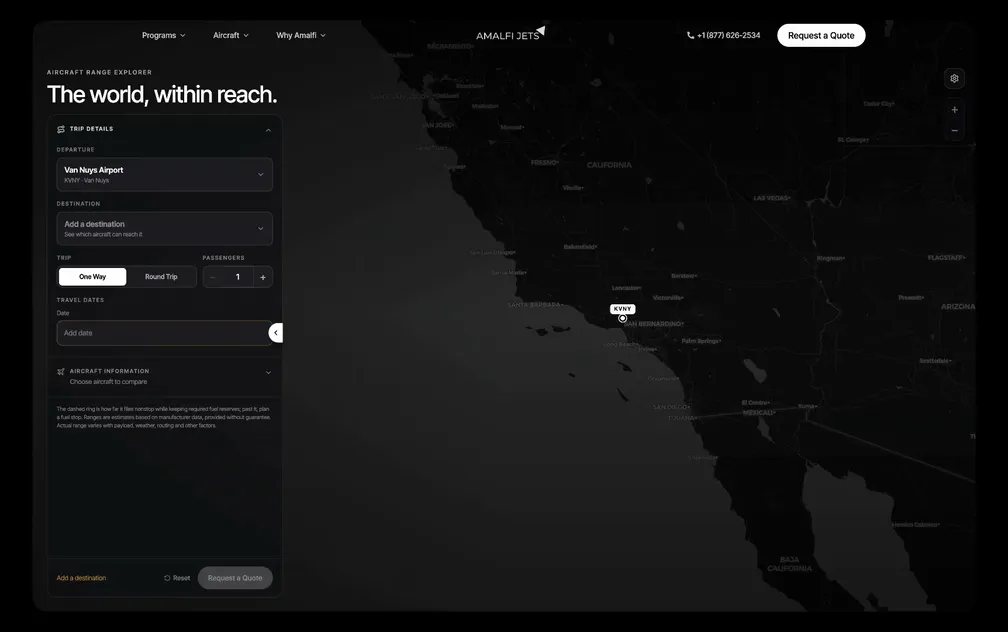
Try Range Explorer
See how far you can fly nonstop
Explore aircraft range, compare options, check flight times, and better understand which aircraft fits your trip.
Ready to fly to Rapid City?
Request a charter and our team will tailor an itinerary for your next journey.
*Takes only about 40 seconds to request your quote.
