



Destination Hub
Private Jet Charter to Raleigh/Durham
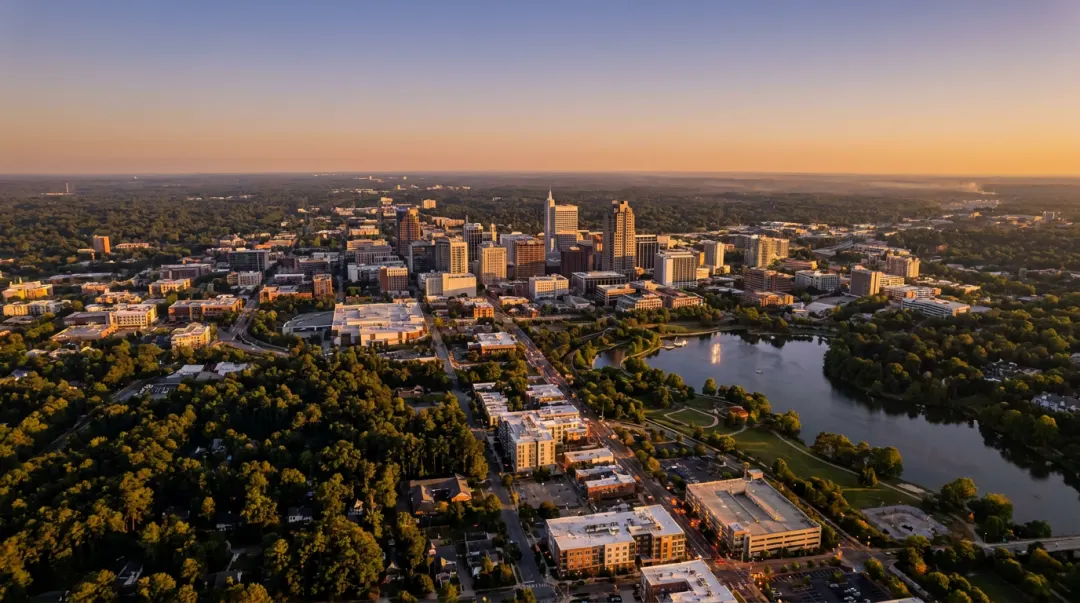
Most private flights into Raleigh/Durham arrive through Raleigh-Durham International Airport (RDU), giving travelers a clear gateway into the Triangle without the compromises of airline scheduling. From the ramp, the region opens quickly toward downtown Raleigh, Durham’s historic brick districts, Research Triangle Park, and the university corridors that shape daily life here.
Quick facts
Why charter a private jet to Raleigh/Durham?
Raleigh/Durham rewards private travelers who need a schedule built around meetings, campus dates, clinical visits, family weekends, and fast regional movement rather than fixed airline timetables.
Why travelers choose to fly privately
The Triangle is spread across business parks, universities, medical centers, government offices, and residential enclaves, so the value of a private arrival is not only the flight itself. It is the ability to land, step into ground transport, and keep the day intact.
Raleigh-Durham International Airport (RDU) is the primary gateway for the region, making it the natural first plan for most charter itineraries. A single coordinated arrival point helps simplify timing for passengers, luggage, crew, and onward cars.
Flexibility that matters on the ground
Private aviation is especially useful when an itinerary touches more than one part of the Triangle. A traveler may need a morning in Research Triangle Park, an afternoon appointment in Durham, and dinner in Raleigh; chartering keeps the day organized around the traveler rather than around a departure board.
That flexibility also helps with:
- Same-day business turns where a commercial schedule would require an overnight stay
- University travel around commencements, board meetings, move-in periods, and alumni weekends
- Family and estate travel when luggage, pets, or multiple passengers make airline logistics less efficient
- Medical and executive itineraries that require privacy, timing discipline, and fewer public touchpoints
A quieter way to enter the Triangle
The region has an understated rhythm: wooded approaches, low rolling terrain, glass office campuses, college quads, and downtown blocks that move from state government to restaurants and galleries within minutes. Arriving privately suits that character. The experience is discreet, practical, and focused on keeping the traveler’s time protected.
“We price RDU first, then compare TTA, LFN, JNX, and TDF if your final address makes an alternate smarter. Firm April, May, and October dates should be confirmed early to widen aircraft choice.”

When is the best time to fly to Raleigh/Durham?
The best time to visit Raleigh/Durham depends on whether the trip is tied to campus calendars, business travel, festivals, or a quieter value window.
Peak planning months
April and May are active because spring weather, university activity, college commencements, and regional festivals bring more travelers into the Triangle. October is another high-demand period, shaped by Research Triangle Park meetings, fall travel, and the North Carolina State Fair.
During these months, charter clients should confirm firm dates as early as possible. Preferred aircraft, ideal departure windows, and ground coordination can tighten when academic and civic calendars overlap.
Value-minded timing
January and February often bring a calmer post-holiday travel pattern, which can make scheduling more flexible for travelers whose dates are not fixed. July can also be a more practical window for some itineraries, as humid midsummer falls outside the academic peak.
That said, value is never based on the month alone. Aircraft location, crew duty planning, one-way versus round-trip structure, and short-notice demand all shape the final charter options.
Editorial guidance
For a polished trip, treat the Triangle as a region rather than a single downtown destination. Build extra care into ground planning if the itinerary crosses Raleigh, Durham, Chapel Hill, and Research Triangle Park, especially during commencement periods or fair-related October travel.
Where our clients stay and go
Raleigh/Durham draws private travelers with a mix of research, higher education, state government, medicine, and Southern city life set across the wooded North Carolina Piedmont.
A region with more than one center
This is not a single skyline city. Raleigh brings the capital presence: government buildings, museums, oak-lined streets, and a downtown that shifts from civic formality to restaurants and concert halls after business hours. Durham has a different texture, with old tobacco warehouses, restored brick, Duke’s academic influence, and a dining scene that feels inventive without needing to announce itself.
Between and around them, Research Triangle Park gives the area its business gravity. Corporate campuses and research facilities sit among pine trees and low roads, creating a geography where the most important appointment may not be downtown at all.
What private travelers come for
Executives fly in for technology, life sciences, venture meetings, board sessions, and university partnerships. Families arrive for commencements, student weekends, medical appointments, and long-planned visits that touch more than one campus. Others come for the Triangle’s softer pleasures: barbecue and chef-driven restaurants, contemporary art, college basketball culture, greenways, bookstores, and neighborhoods where the pace lowers by evening.
Raleigh/Durham also works well as a base for broader North Carolina travel. The region sits inland, with a landscape of hardwoods, creeks, and gentle terrain that gives arrivals a distinctly Piedmont feeling before the car even leaves the airport.
The mood of the place
Morning light catches glass towers in Raleigh and warm brick in Durham. By late afternoon, the roads settle into a rhythm of university traffic, research-park commuters, and dinner reservations. For travelers accustomed to larger financial capitals, the Triangle can feel refreshingly direct: serious work, strong institutions, and a social tone that remains measured.
What determines the cost of a flight to Raleigh/Durham?
The cost of chartering into Raleigh/Durham is determined by the aircraft selected, the structure of the itinerary, airport-related charges, seasonal demand, and the availability of aircraft already moving through the region.
Aircraft selection
Aircraft class is one of the main cost drivers. A larger cabin, longer range, more luggage capacity, or additional onboard amenities will generally increase the overall charter profile. The right recommendation depends on passenger count, routing, cabin expectations, baggage, pets, and how much flexibility the traveler wants on departure time.
One-way versus round trip
A round trip may price differently from a one-way because the aircraft and crew schedule can be planned around the return. A one-way can be efficient when an aircraft is already positioned near the departure point or has a compatible next assignment, but it can also involve repositioning if the aircraft must be brought in solely for the trip.
RDU positioning and fees
Raleigh-Durham International Airport (RDU) is the primary airport to evaluate, and costs can be influenced by aircraft positioning, handling, parking, crew logistics, and airport-related fees. Your charter advisor compares the practical and financial implications of using RDU against nearby regional alternatives when the schedule and passenger location make that worth exploring.
Seasonal demand
April, May, and October tend to bring firmer demand because of college commencements, spring festivals, Research Triangle Park meetings, and North Carolina State Fair travel. During those periods, preferred aircraft and departure times can narrow sooner, so firm dates are best secured early.
January, February, and July can offer more flexibility, with the post-holiday winter lull and humid midsummer sitting outside the academic peak. Even then, pricing depends on aircraft availability, routing, and crew planning rather than the calendar alone.
Empty-leg availability
Empty legs may reduce the effective cost when an aircraft is already scheduled to fly a compatible route. They are opportunistic rather than guaranteed, and the best value usually comes from travelers who can accept some flexibility on timing, airport choice, or direction of travel.
Which airports serve Raleigh/Durham?
Raleigh/Durham is served primarily by RDU, with Sanford-Lee County Regional Airport, Triangle North Executive Airport, Johnston County Airport, and Roxboro Person County Airport available as regional alternatives when the itinerary points toward a different part of the area.
Raleigh-Durham International Airport (RDU)
Raleigh-Durham International Airport is the primary airport for the Triangle and the first option most private travelers consider. It is the clearest choice when the trip centers on Raleigh, Durham, Research Triangle Park, Chapel Hill, or a mixed schedule across the region.
RDU is also useful when a traveler wants the simplest coordination plan: one main airport, clear regional recognition, and straightforward alignment with professional ground transport. For many trips, that simplicity is the strongest argument.
Sanford-Lee County Regional Airport (TTA)
Sanford-Lee County Regional Airport can make sense when the traveler’s final stop sits southwest of the core Triangle or when a smaller regional field better matches the ground itinerary. It is worth evaluating for private travelers whose plans do not require entering through the main airport environment.
A charter advisor may compare TTA against RDU when reducing surface travel to a specific residence, business site, or regional destination matters more than using the primary gateway.
Triangle North Executive Airport (LFN)
Triangle North Executive Airport is an alternate to consider for travelers whose plans pull them toward the northern side of the region. Its value is in matching the arrival point to the shape of the day, particularly when the main meeting or residence is outside the central Raleigh-Durham corridor.
For private itineraries, LFN can be part of a smarter airport discussion when timing, vehicle routing, and ease of ground movement are more important than defaulting to the largest airport.
Johnston County Airport (JNX)
Johnston County Airport may be appropriate for trips oriented east or southeast of the core Triangle. It gives the charter team another way to align the aircraft arrival with the traveler’s actual destination rather than treating the region as one fixed point.
JNX is especially worth discussing when the passenger’s ground plan avoids central Raleigh and favors a more direct approach to communities or business locations in that direction.
Roxboro Person County Airport (TDF)
Roxboro Person County Airport is the northern regional option in the airport set. It may be useful when the itinerary points toward Person County or a rural destination beyond the usual Triangle business corridor.
TDF is not a default substitute for RDU; it is a planning tool. When the final destination sits closer to that part of North Carolina, the charter desk can evaluate whether using Roxboro Person County Airport creates a cleaner day on the ground.
Common questions about Raleigh/Durham charter
What is the main airport for private flights into the Triangle?
Raleigh/Durham is primarily served by RDU, which is the natural first option for most private arrivals because it anchors the region’s main air access and keeps planning straightforward.
Can I use a smaller airport instead of RDU?
Raleigh/Durham travelers may be able to consider TTA, LFN, JNX, or TDF when the final destination sits closer to one of those regional airports or when a quieter ground plan is preferred.
What determines the cost of chartering into Raleigh/Durham?
Raleigh/Durham charter cost is shaped by aircraft class, one-way or round-trip structure, aircraft positioning, airport-related fees, seasonal demand, and any empty-leg availability that matches the route.
When should I book for spring or fall travel?
Raleigh/Durham demand is typically firmer in April, May, and October because of commencements, spring festivals, Research Triangle Park meetings, and North Carolina State Fair travel.
Which airport should I choose if my plans are north, south, or east of the city center?
Raleigh/Durham airport choice should follow the ground itinerary: LFN and TDF may suit northern plans, TTA may fit southwestern trips, and JNX may work for eastern or southeastern destinations.
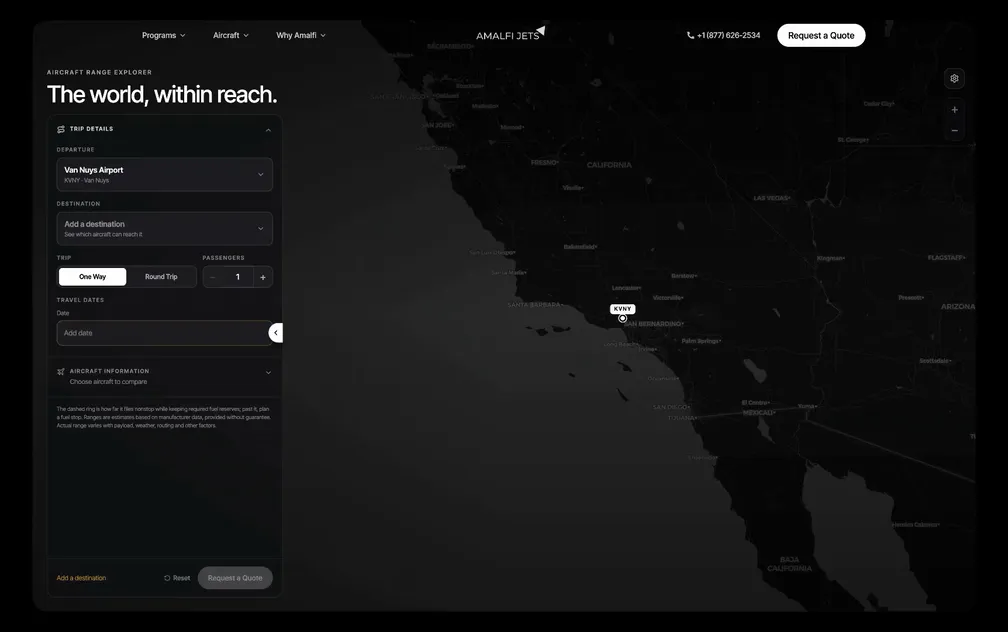
Try Range Explorer
See how far you can fly nonstop
Explore aircraft range, compare options, check flight times, and better understand which aircraft fits your trip.
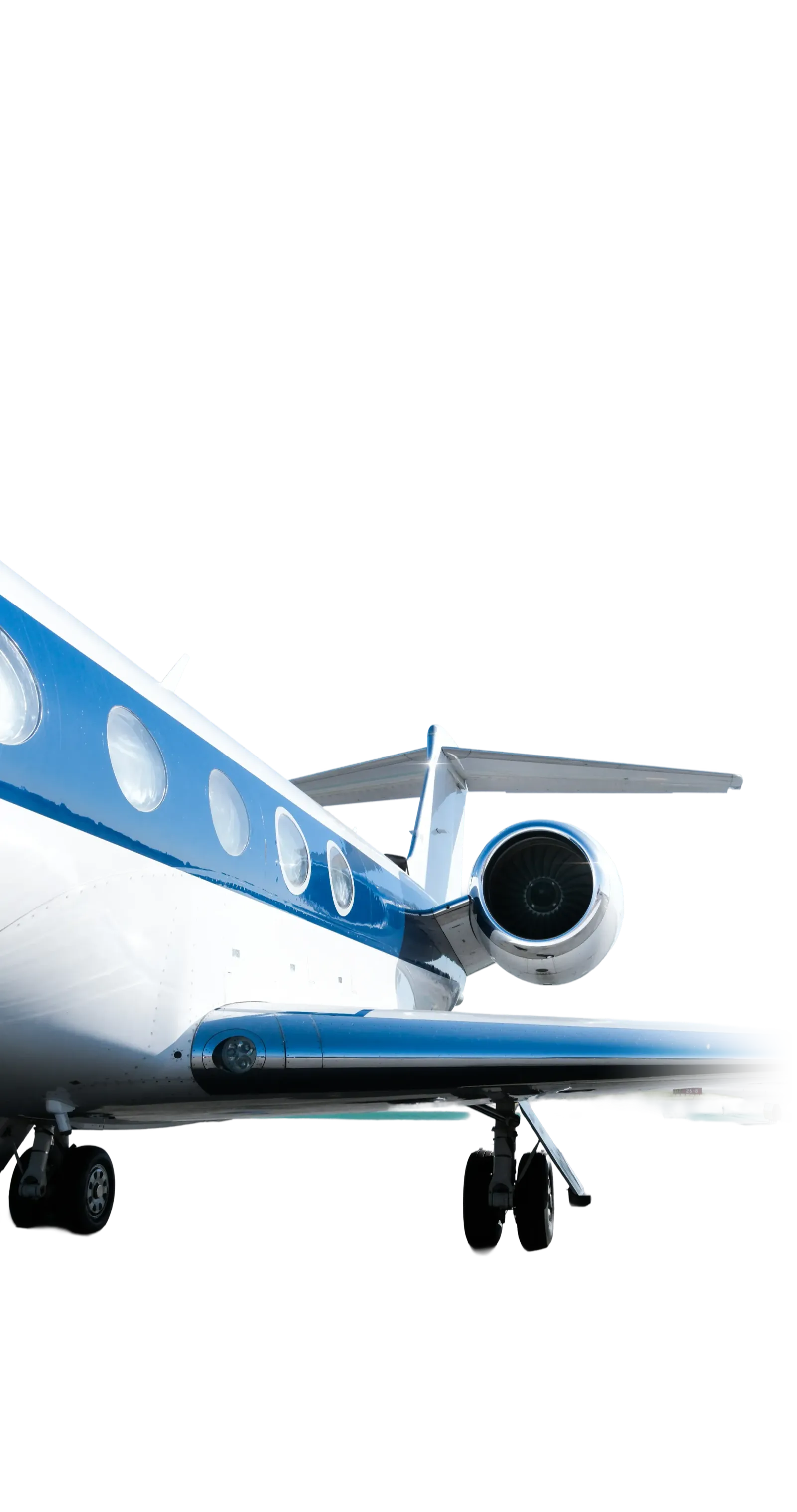
Ready to fly to Raleigh/Durham?
Request a charter and our team will tailor an itinerary for your next journey.
*Takes only about 40 seconds to request your quote.
