



Destination Hub
Private Jet Charter to Phoenix

A private arrival into Phoenix should feel calm from the first ramp greeting: direct, discreet, and planned around the part of the Valley you actually need to reach. Amalfi Jets coordinates the aircraft, ground timing, and airport selection so the desert city opens on your schedule rather than an airline timetable.
Quick facts
Why charter a private jet to Phoenix?
Chartering privately into Phoenix gives travelers control over timing, airport choice, and the pace of the day.
The Valley is spread across distinct business, resort, residential, and event corridors, so the right arrival point can matter as much as the departure time. A private itinerary lets the charter desk shape the plan around where you are staying, when you need to be on the ground, and how much privacy you want between the aircraft and the car.
Why private travelers choose the Valley by air
- Flexible airport planning: DVT, PHX, GEU, and AZA give advisors options across the metro area, allowing the arrival to be organized around the traveler’s final destination rather than a fixed airline terminal.
- Time saved on the ground: The value is not only in the flight; it is in reducing connection time, terminal dwell, and unnecessary transfers after landing.
- Schedule control: Departures can be built around a meeting, resort check-in, golf time, or event schedule instead of the limited windows of commercial service.
- Discreet movement: Private handling keeps the day contained, with fewer public touchpoints and a more direct transition from aircraft to vehicle.
A better fit for complex itineraries
Many trips into the region combine business meetings, resort stays, golf, family visits, or events across different parts of the Valley. Private charter allows those priorities to be sequenced cleanly: arrive closer to the right side of the metro area, adjust the return around the final commitment, and keep the aircraft plan aligned with the traveler’s actual calendar.
For executives, families, and principals traveling with assistants or security, that flexibility can be decisive. The aircraft becomes part of the itinerary architecture, not a separate transportation problem to solve after the schedule is already set.
“For January through March travel, our charter desk secures preferred airport handling and crew logistics first, then widens the aircraft search around your firm departure window; earlier dates generally preserve more choice during golf, auction, tournament, and spring-training weeks.”

When is the best time to fly to Phoenix?
The best time to visit Phoenix is usually January through March, when desert weather, golf travel, signature events, and spring training create the strongest demand.
January, February, and March bring the Valley into its prime travel rhythm. Mild desert days support resort stays, golf, patio dining, hiking, and outdoor entertaining, while Barrett-Jackson, the WM Phoenix Open, and Cactus League spring training add concentrated demand for aircraft, crews, airport handling, and premium accommodations.
Planning for peak season
Travelers with firm dates in the peak window should secure aircraft and airport handling early. The most desirable departure times tend to narrow first around major event weeks, and small adjustments to arrival or return timing can make a meaningful difference in aircraft choice.
Private travelers should also think beyond the flight. Ground transportation, resort arrivals, dinner reservations, and event access can all feel tighter when several high-demand weeks overlap across the Valley.
Value months
June, July, and August offer a different kind of opportunity. Extreme summer heat softens leisure demand, which can improve aircraft availability and open more room across luxury resorts for travelers comfortable with a heat-aware schedule.
During those months, the best itineraries are planned with precision: early movements, shaded arrivals, efficient transfers, and indoor or pool-centered afternoons. The desert is quieter, the light is dramatic, and the pace can feel more private when the plan respects the season.
Where our clients stay and go
Phoenix is a desert capital shaped by mountain silhouettes, clear light, and the wide-open geometry of the Sonoran landscape.
The city does not announce itself with coastal drama or old-world density. It spreads through the Valley in a pattern of palms, low roofs, resort terraces, golf corridors, canal lines, and rust-colored mountains that catch the sun differently by the hour. The effect is spacious and cinematic, especially at dawn when the desert is cool and the skyline sits under a pale wash of blue.
The character of the Valley
Greater Phoenix rewards travelers who like movement without friction. A morning can begin with a desert trail or golf round, shift into meetings near the business core, and end over dinner in a resort district or arts neighborhood. The distances make planning important, but the private-travel advantage is obvious: choose the airport and ground route that fit the actual day.
The city’s appeal is rooted in contrast. There is polished resort culture and rugged desert terrain, contemporary dining and deep Southwestern influence, high-design spas and trailheads where saguaros stand against volcanic rock. Camelback Mountain, South Mountain, Papago Park, and the surrounding ranges give the metro area a visible horizon rather than a hard urban edge.
What draws private travelers
Winter and early spring are the signature months for golf, auctions, major tournaments, and Cactus League baseball. The season brings owners, executives, collectors, athletes, families, and groups moving between resorts, private residences, clubs, and event venues across the Valley.
Summer is quieter and more deliberate. Heat becomes part of the itinerary design, but the reward is a calmer luxury landscape: easier resort access, fewer crowds, and the particular stillness of the desert after sunset.
For private travelers, Phoenix works best when it is treated as a region rather than a single point on a map. The right airport, the right ground plan, and the right timing turn the Valley from a sprawling metropolis into a precise, comfortable arrival.
What determines the cost of a flight to Phoenix?
The cost of chartering into Phoenix is determined by the aircraft selected, the routing, the trip structure, airport-related fees, seasonal demand, and aircraft availability.
Pricing is qualitative until the itinerary is reviewed because each charter is built around a specific aircraft, crew plan, departure point, timing, and airport choice. The most efficient quote is usually the one that fits the mission cleanly rather than the one forced into a generic category.
Aircraft category and cabin requirements
Aircraft class is one of the central cost drivers. Cabin size, range suitability, luggage needs, passenger count, onboard service expectations, and crew requirements all influence which aircraft are appropriate for the mission. A larger cabin may offer more comfort and flexibility, while a smaller aircraft may be suitable for a simpler regional itinerary if the trip profile supports it.
One-way versus round trip structure
A one-way charter is priced differently from a round trip because the aircraft and crew may need to reposition after drop-off or before pickup. A round trip can be more efficient when the aircraft can remain with the traveler or be scheduled logically around the return, but that depends on timing, parking, crew duty planning, and aircraft availability.
Positioning, handling, and airport fees
Aircraft positioning affects the final quote when the ideal aircraft is not already near the departure point or needs to move before or after the trip. Airport-related charges may also apply, including landing, ramp, handling, parking, and overnight considerations. The selected Valley airport can influence these components, which is why the charter desk confirms the operating plan before presenting final options.
Seasonal demand
Demand rises during the strongest desert-weather months, especially when golf travel, major auctions, tournament weeks, and spring training overlap. During those periods, desirable aircraft and preferred airport handling can be reserved earlier, and flexibility around departure times may improve the range of available options.
Summer often creates a different pricing environment. Extreme heat can reduce leisure demand and improve aircraft or resort availability, though comfort, ground timing, and passenger preferences still shape the plan.
Empty-leg availability
Empty legs can reduce cost when an aircraft already needs to move in the right direction at the right time. They are highly schedule-dependent, may offer limited flexibility, and can change as aircraft owners or operators adjust their plans. Amalfi Jets treats empty legs as an opportunity when they fit the trip, not as the foundation of a time-sensitive itinerary.
Which airports serve Phoenix?
Phoenix is served by DVT, PHX, GEU, and AZA, giving private travelers several practical ways to enter the Valley.
The best airport is rarely chosen by name alone. It depends on where the traveler is staying, the timing of the arrival, the preferred handling environment, and the part of the metro area that matters most after landing.
DVT — Deer Valley Municipal Airport
Deer Valley Municipal Airport can be useful when an itinerary points toward the northern side of the Valley. Its municipal profile makes it a logical airport to evaluate for private operations when the traveler’s plans are closer to the Deer Valley area than to the central airport corridor.
DVT is often considered when the ground plan is built around northern residences, business stops, golf, or resort access. The charter desk should confirm handling, aircraft suitability, and ramp arrangements before recommending it for a specific trip.
PHX — Sky Harbor International Airport
Sky Harbor International Airport is the recognizable central gateway for the region and can make sense when the schedule is tied to downtown, central business plans, airline coordination, or a pickup point near the urban core. For some travelers, using the principal airport keeps the ground plan straightforward.
PHX can also be the right choice when a trip involves mixed commercial and private movements, guests arriving separately, or a central meeting point. Because it is a major airport environment, private handling and timing should be arranged carefully rather than assumed.
GEU — Glendale Municipal Airport
Glendale Municipal Airport gives the west side of the Valley its own option for private arrivals. When the final destination is closer to Glendale or the western metro area, GEU may reduce unnecessary ground movement compared with routing every arrival through the center of the region.
This airport is best evaluated as part of the full surface plan: where the traveler is going, when the aircraft arrives, and how quickly passengers need to be in the car. Confirmed handling is the deciding detail, not the airport name alone.
AZA — Phoenix-Mesa Gateway Airport
Phoenix-Mesa Gateway Airport is a practical consideration for Mesa and the eastern side of the Valley. Travelers headed to east Valley residences, business commitments, resorts, or onward desert plans may find AZA worth evaluating if it shortens the ground portion of the day.
Because the region is broad, an east-side airport can be valuable even when the destination still carries a Valley address. Amalfi Jets compares airport availability, handling, ground routing, and schedule priorities before recommending AZA over a more central arrival.
Common questions about Phoenix charter
Which airport should I use for a private arrival?
Phoenix itineraries are matched to the side of the Valley you need most: DVT for northern plans, PHX for central access, GEU for the west side, and AZA for Mesa and the east Valley, subject to handling availability.
How early should I book for peak season?
For Phoenix travel in January, February, and March, earlier confirmation gives the charter desk more room to secure suitable aircraft and handling around golf, auction, tournament, and spring-training demand.
What determines the cost of chartering into the city?
The cost to charter into Phoenix depends on aircraft category, routing, one-way or round-trip structure, aircraft positioning, airport and handling fees, seasonal demand, and any viable empty-leg options.
Can I request PHX instead of a smaller Valley airport?
Yes, Phoenix travelers can request PHX when it best matches the itinerary, especially for central plans or airline coordination; the charter desk will confirm handling before recommending it.
Are summer months worth considering for private travel?
Phoenix in June, July, and August can offer improved aircraft and resort availability because extreme heat softens leisure demand, though ground plans should be built around comfort.
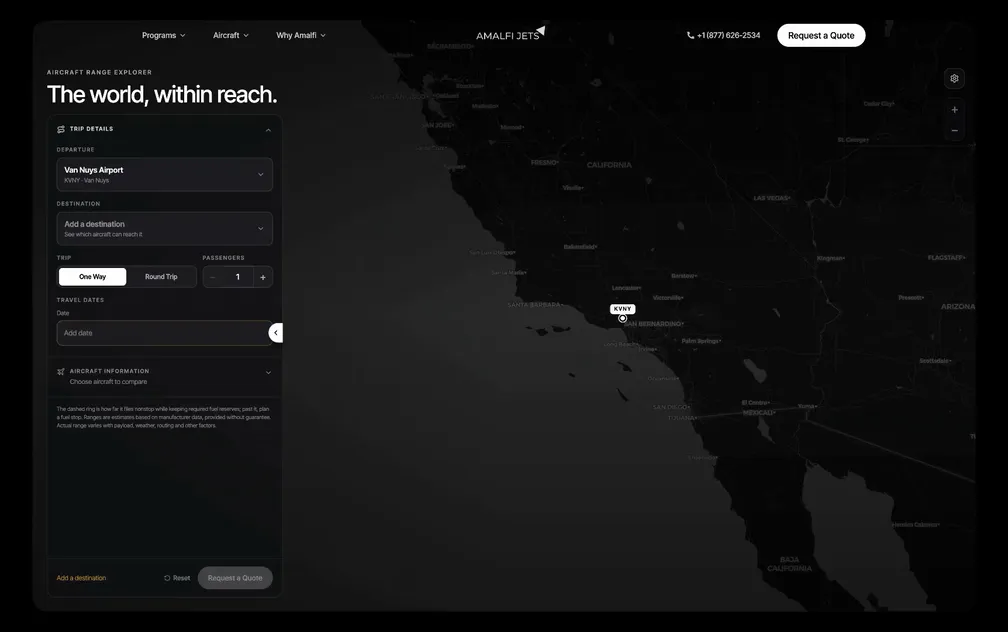
Try Range Explorer
See how far you can fly nonstop
Explore aircraft range, compare options, check flight times, and better understand which aircraft fits your trip.

Ready to fly to Phoenix?
Request a charter and our team will tailor an itinerary for your next journey.
*Takes only about 40 seconds to request your quote.
