



Destination Hub
Private Jet Charter to Omaha

Most private arrivals into Omaha use Eppley Airfield (OMA), giving the journey a clean point of entry without airline connections or public-terminal pacing. The appeal is simple: land close to the city’s business, sports, and riverfront districts, then let the day move on your schedule.
Quick facts
Why charter a private jet to Omaha?
A private flight into Omaha gives travelers control over arrival timing, ground coordination, and the pace of the entire trip.
Time belongs to the traveler
Commercial schedules often ask you to build the day around departures, connections, and airport dwell time. Chartering privately reverses that order. Your itinerary can be organized around a board meeting, a family weekend, a game day, or an onward drive, with the aircraft positioned to support the calendar rather than compete with it.
A simpler arrival through OMA
Eppley Airfield (OMA) is the primary airport for the city, which keeps planning focused and efficient. For most visitors, that means a direct aviation plan into the main gateway, coordinated ground transportation, and fewer moving parts between touchdown and the first appointment.
Flexibility when the city is busy
Peak periods can compress availability, especially around major draws such as Berkshire weekend and the College World Series. A well-planned charter gives the desk room to compare aircraft options, coordinate preferred arrival windows, and consider alternate airports when they better match the day’s ground plan.
Privacy from departure to arrival
For executives, families, and high-profile guests, the value is not only speed. A private cabin creates space to work, talk, rest, or arrive quietly, with fewer interruptions and a more discreet handoff on the ground.
For clients weighing private jet charter Omaha options, the strongest itineraries begin with a clear schedule, a preferred arrival window, and a realistic plan for event-week demand.
“Our charter desk first secures the preferred airport and handling plan, then matches aircraft to passenger count, baggage, and schedule. Firm May, June, and August dates should be set early, because Berkshire weekend and College World Series demand can narrow choice.”

When is the best time to fly to Omaha?
The best time to visit Omaha depends on whether your trip is tied to a major event, warm-weather leisure, or a quieter business calendar.
Peak months
May brings Berkshire weekend, when private travel demand can build around investor gatherings and related hospitality. June is shaped by the College World Series, which draws teams, alumni, sponsors, and families into the city. August can stay active with summer festivals, golf events, and late-season leisure travel.
For those months, earlier planning usually widens aircraft choice and improves the chance of securing preferred arrival windows. Fixed event schedules leave less room to adjust, so the most polished trips are often built well before the calendar feels urgent.
Value months
January, February, and March typically offer a quieter planning environment. Cold weather and the early-spring lull mean fewer citywide demand drivers, which can make date flexibility more useful and aircraft sourcing less compressed.
Travelers with discretionary meetings, site visits, or family trips may find those months easier to arrange. The experience is still premium; the difference is that the market tends to give the charter desk more room to maneuver.
Where our clients stay and go
Omaha is a river city with a practical rhythm, a confident business culture, and a downtown that turns its brick streets and open sky into part of the arrival.
A city shaped by the Missouri
Set along the Missouri River, the city reads differently from the air than it does on a map. Water, bridges, rail lines, office towers, and broad Midwestern light give the approach a sense of scale before the aircraft ever touches down.
Why private travelers come
Executives arrive for finance, insurance, agriculture, healthcare, and family-enterprise meetings. Investors gather around Berkshire weekend. Sports travelers and alumni fill the calendar during the College World Series, while summer brings golf, festivals, and private visits that move easily between downtown, club settings, and residential neighborhoods.
Downtown with texture
The Old Market gives the city one of its most recognizable signatures: brick warehouses, independent restaurants, galleries, and evening foot traffic close to the riverfront. It suits a charter traveler well because the day can shift from boardroom to dinner without feeling staged.
Understated, not showy
This is not a destination that needs to perform luxury loudly. Its appeal is in access, discretion, civic pride, and the ease of moving from airport to meeting to dinner with minimal friction. That is why private aviation fits the place so naturally: the city values time, directness, and a plan that works.
What determines the cost of a flight to Omaha?
The cost of chartering into Omaha is shaped by aircraft selection, routing, timing, airport logistics, and market availability.
Aircraft class and trip profile
Aircraft class is one of the main drivers because cabin size, passenger count, baggage needs, routing, and onboard service expectations all influence the aircraft that best fits the mission. A short regional movement prices differently than a longer itinerary requiring more crew time, positioning, or schedule protection.
One-way versus round trip
A one-way charter may include repositioning if the aircraft needs to fly in for pickup or continue elsewhere after drop-off. A round trip can be more efficient when the aircraft and crew remain aligned with your return, though that depends on timing, operator availability, and how long the aircraft would wait.
OMA positioning and airport charges
Eppley Airfield (OMA) is the primary gateway, so many quotes will be built around its handling, parking, and operational requirements. Final pricing can reflect airport-related fees, crew logistics, ground handling, and any positioning needed to place the right aircraft at the right time.
Seasonal demand
May, June, and August can bring firmer demand because of Berkshire weekend, the College World Series, summer festivals, and golf-related travel. During those periods, preferred aircraft and arrival windows may be claimed earlier, and flexibility can make a meaningful difference.
Empty-leg opportunities
Empty legs can occasionally reduce overall cost when an aircraft is already moving in the direction you need. They are never guaranteed, and the best fit usually comes when your schedule can accommodate the operator’s existing route and timing.
Which airports serve Omaha?
The airports that serve Omaha include OMA as the primary gateway, supported by Millard Airport (MLE), Council Bluffs Municipal Airport (CBF), Plattsmouth Municipal Airport (PMV), and Fremont Municipal Airport (FET) as regional alternatives. In private aviation, the right choice depends on the aircraft, handling plan, passenger privacy, onward drive, and where the day actually begins or ends.
Eppley Airfield (OMA)
OMA is the primary choice for most arrivals because it is the established gateway for the city and the natural starting point for a straightforward charter plan. When the schedule centers on downtown, the Old Market, riverfront hotels, major event venues, or business meetings, the airport usually gives the charter desk the cleanest operating baseline to evaluate.
MLE
MLE can make sense when the itinerary points toward the western or residential side of the metro and the charter team wants to compare a secondary-field plan against the primary airport. The value of this option is not that it replaces OMA by default, but that it gives the passenger another way to align aircraft handling with the final ground destination.
CBF
CBF gives the charter desk an eastern-side alternate to consider for trips tied to Council Bluffs or the river-crossing side of the region. For passengers whose meetings, hotels, or family plans sit closer to that side of the metro, evaluating this airport can help determine whether the ground portion of the day becomes simpler.
PMV
PMV is best viewed as a situational option for itineraries connected to Plattsmouth or communities south of the main urban core. When a traveler’s purpose is outside the central corridor, the charter desk can review whether this airport supports a more direct ground plan and whether the aircraft, handling, and passenger requirements fit the mission.
FET
FET is a regional alternate for trips oriented toward Fremont or the surrounding Nebraska-side communities. It may be relevant when the passenger’s final address is outside the central city and a smaller regional arrival point could reduce unnecessary surface travel.
How Amalfi Jets evaluates the choice
The decision is never made from an airport list alone. The charter desk reviews the passenger’s schedule, aircraft type, baggage needs, preferred privacy level, arrival window, and ground transportation before recommending OMA or a secondary field.
When event demand is high, having alternates in the planning conversation can be useful. The preferred airport remains the priority, but a well-reviewed backup can help protect the itinerary if aircraft availability, congestion, or ground logistics point to a better regional solution.
Common questions about Omaha charter
Which airport should I use when flying privately into Omaha?
Most private travelers into Omaha begin with OMA because it is the city’s primary airport and the simplest planning anchor for downtown, hotels, and major event schedules.
Can I use a smaller airport instead of OMA?
For some Omaha trips, secondary airports such as MLE, CBF, PMV, or FET may make sense when they better match the final address, expected congestion, or ground-transfer plan.
What determines the cost of chartering into Omaha?
The cost of chartering into Omaha depends on aircraft class, routing, one-way versus round trip structure, positioning, airport-related fees, seasonal demand, and empty-leg availability.
When should I book for Berkshire weekend or the College World Series?
For Omaha travel tied to Berkshire weekend or the College World Series, earlier booking is recommended because preferred aircraft and arrival windows can tighten around fixed event dates.
Is winter a good time to arrange a private flight there?
Winter can be a practical time for Omaha charter planning, especially in January, February, and March, when fewer citywide events typically create a calmer sourcing environment.
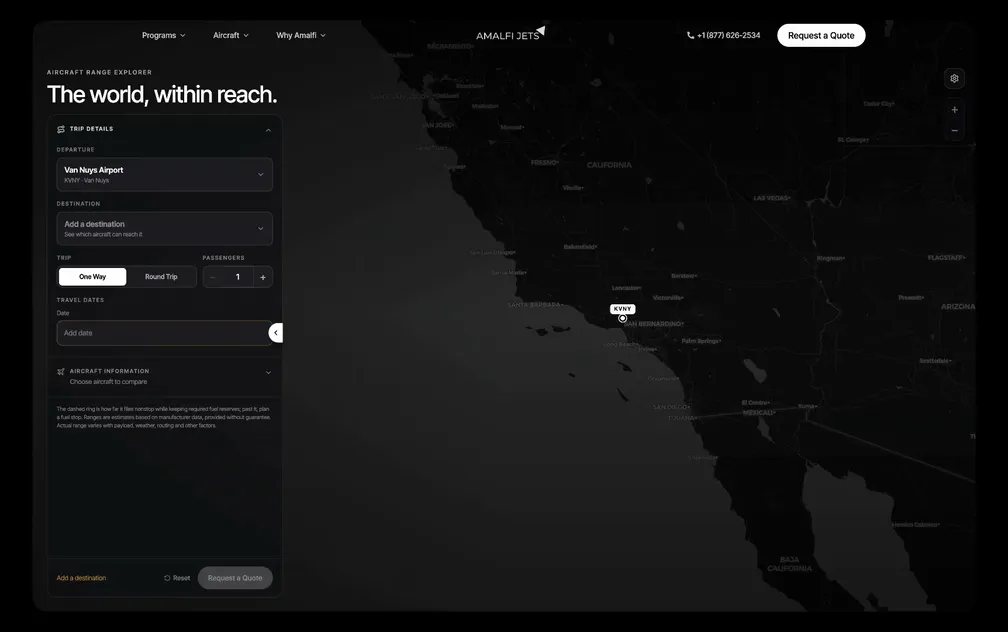
Try Range Explorer
See how far you can fly nonstop
Explore aircraft range, compare options, check flight times, and better understand which aircraft fits your trip.

Ready to fly to Omaha?
Request a charter and our team will tailor an itinerary for your next journey.
*Takes only about 40 seconds to request your quote.
