



Destination Hub
Private Jet Charter to New Orleans

Most private flights into New Orleans begin at Lakefront Airport (NEW) — a focused arrival plan, no airline connection, and a schedule built around your day. From the ramp, the city’s lakefront calm gives way to brass, Creole dining rooms, riverfront hotels, and the private rhythm that makes an arrival feel composed rather than rushed.
Quick facts
Why charter a private jet to New Orleans?
Chartering privately into New Orleans gives travelers a more controlled way to arrive, with the flight schedule, airport plan, and ground timing organized around the trip rather than a commercial timetable.
Why travelers choose NEW
Lakefront Airport (NEW) keeps the arrival plan centered on the primary private-flight gateway for the city. Your advisor can build the schedule around meetings, restaurant reservations, hotel check-in, or an evening arrival without asking the day to conform to an airline timetable.
A direct charter also reduces the friction that usually surrounds high-demand travel periods: connection risk, fixed airline departure banks, and crowded terminals. For travelers moving between the French Quarter, the CBD, Uptown, the lakefront, or private residences in the wider region, the value is often measured in calm as much as time.
Flexibility that matters on the ground
- Depart when the itinerary is ready: schedule around dinner, board meetings, performances, or a late-morning start.
- Keep the party together: executives, families, security, pets, and luggage can be planned as one itinerary.
- Adjust with discretion: when plans shift, the charter desk can evaluate timing, aircraft availability, and airport options without rebuilding the trip from an airline schedule.
Because the airport plan begins with NEW and can be compared against regional alternates when needed, the route stays practical rather than ornamental. That is the core appeal: fewer public touchpoints, fewer wasted hours, and a travel day that feels proportionate to the purpose of the visit.
“For Mardi Gras, Jazz Fest, and spring convention dates, our charter desk secures NEW handling and aircraft availability first; firm dates early in February, March, and April widen choice and reduce last-minute repositioning.”

When is the best time to fly to New Orleans?
February, March, and April are the most competitive months to visit New Orleans, with Mardi Gras, spring festivals, conventions, and Jazz Fest all contributing to stronger demand for aircraft and preferred arrival times.
Those weeks call for earlier planning, especially when the itinerary is tied to fixed hotel dates, private events, or a narrow departure window. Travelers who confirm firm dates sooner usually give the charter desk more room to compare aircraft, airport options, and schedule structure.
June, July, and August can be useful value months for flexible travelers. The summer low season is hot and humid, and demand is often softer outside major events, which can make timing and aircraft selection easier to shape around the trip.
In every season, the city rewards deliberate planning. Carnival and festival periods ask for lead time; quieter summer windows reward adaptability; shoulder dates can be especially comfortable when the calendar is chosen with both weather and local demand in mind.
Where our clients stay and go
New Orleans draws private travelers because it feels both ceremonial and lived-in: a river city of balconies, courtyards, late dinners, brass music, and business gatherings that often spill into culture rather than ending at the conference room door.
Set between the Mississippi River and Lake Pontchartrain, the city has a geography you feel as much as see. Light reflects off water and pavement, live oaks shade residential avenues, and the skyline rises behind neighborhoods where sound carries easily from a corner bar, a church, or a second-line procession.
Days tend to unfold by district. The French Quarter remains the historic anchor, all ironwork, shutters, and early-evening glow; the Central Business District and Warehouse District bring hotels, restaurants, galleries, and convention traffic into a tighter downtown orbit. Uptown and the Garden District shift the mood to broad avenues, old houses, and a slower lunch that can become the point of the day.
After dark, the appeal is not only nightlife. It is the precision of a reservation kept, a familiar hotel team ready at arrival, a private dining room prepared before guests walk in, and the ability to leave when the evening is over rather than when an airline schedule permits.
The city works well for leisure, board-level travel, family celebrations, film and music commitments, sporting weekends, and cultural seasons that draw national attention. For private flyers, its advantage is not distance alone; it is the ability to arrive composed and move directly into a place where timing matters.
What determines the cost of a flight to New Orleans?
The cost of chartering to New Orleans depends on the aircraft selected, the route structure, positioning, airport-related charges at NEW, seasonal demand, and any suitable empty-leg availability.
Aircraft category and itinerary shape
Aircraft class is one of the central variables because cabin size, range profile, baggage needs, passenger count, and onboard preferences all influence which aircraft are appropriate for the mission. A shorter regional trip and a longer cross-country itinerary may require different planning assumptions, even when the destination airport is the same.
A one-way flight is priced differently from a round trip because the aircraft and crew still need to be positioned intelligently before and after your travel. Round-trip plans can sometimes create a more efficient schedule when the aircraft can remain aligned with the return, while one-way plans may require additional repositioning.
NEW positioning, fees, and handling
Positioning into or out of NEW can affect the overall quote, especially if the preferred aircraft is not already nearby. Airport handling, parking, crew logistics, and related operating costs are evaluated by the charter desk before an itinerary is presented.
Seasonal demand also matters. February, March, and April bring Mardi Gras, spring festivals, conventions, and Jazz Fest demand, so aircraft choice and preferred timing can tighten. June, July, and August often bring softer demand outside major events, which may create more flexibility for travelers with adaptable dates.
Empty-leg opportunities
An empty leg may be available when an aircraft already needs to reposition along a compatible route. These opportunities can be attractive, but they are schedule-specific and less flexible than a dedicated charter, so they work best for travelers who can adapt departure time, airport choice, or routing.
Which airports serve New Orleans?
Private flights serving New Orleans are typically planned around NEW first, with secondary airports considered when the traveler’s final address, aircraft positioning, or regional ground plan makes an alternate more practical.
NEW: Lakefront Airport
For most itineraries, Lakefront Airport (NEW) gives the charter desk the cleanest starting point because it is the primary airport named for the city. The planning conversation usually begins here, then expands only if a secondary airport creates a better match for schedule, access, or ground movement.
The advantage is simplicity. One preferred airport, one handling plan, and one point of coordination can make the day feel smoother, especially for travelers moving between downtown hotels, private residences, restaurants, and event venues.
MSY: New Orleans International Airport
At New Orleans International Airport (MSY), the appeal is its role as the city’s broader commercial-airport option. It may be considered when a traveler’s itinerary intersects with airline passengers, mixed travel parties, commercial connections, or operational circumstances that make MSY the right fit.
This airport can also be useful when the charter desk is comparing availability across the region during peak periods. The decision is not simply about the airport name; it is about which arrival point best supports the aircraft, the schedule, and the ground plan.
ASD: Slidell Airport
Slidell Airport (ASD) can be useful when the trip is oriented toward the Slidell side of the region rather than the city center. For travelers whose meetings, homes, or lodging sit closer to that side of the map, ASD may reduce unnecessary ground movement if aircraft and handling arrangements align.
Its role is best understood as regional flexibility. When NEW is not the most practical match for the day, ASD gives the charter desk another way to shape the trip around where the traveler actually needs to be.
HDC: Hammond Municipal
Hammond Municipal (HDC) may make sense for itineraries pointed toward Hammond or the northshore-influenced corridor beyond the urban core. A traveler with business, family, or a private retreat in that part of the region may prefer an airport plan that avoids routing every movement through the city.
It is especially relevant when ground time matters more than a downtown arrival. The charter desk evaluates HDC as part of the broader regional picture, balancing aircraft availability, handling, and the final destination on the ground.
APS: Port of South Louisiana Executive Regional Airport
Port of South Louisiana Executive Regional Airport (APS) can serve travelers whose plans are tied to the river, industrial, corporate, or residential areas outside the immediate city center. The name signals its regional purpose: an executive airport option connected to the broader South Louisiana corridor.
The practical value is optionality. When a traveler’s day is not centered downtown, APS may offer a more logical surface route, provided the aircraft, timing, and handling plan support the mission.
Common questions about New Orleans charter
Which airport is best for charter flights into the city?
For New Orleans, NEW is the primary airport, so the charter plan usually starts there before comparing secondary options against your ground schedule.
Can I use an airport other than NEW?
A New Orleans itinerary may use MSY, ASD, HDC, or APS when the meeting location, hotel, aircraft positioning, or ramp plan makes an alternate more practical than NEW.
What determines the cost of chartering there?
For New Orleans, cost is shaped by aircraft category, routing, one-way versus round-trip structure, positioning, airport-related fees, seasonal demand, and any suitable empty-leg opportunity.
When should I book a spring trip?
Trips to New Orleans in February, March, and April should be planned earlier because Mardi Gras, spring festivals, conventions, and Jazz Fest tighten aircraft and handling availability.
Is summer a good value season?
June, July, and August can offer softer demand for New Orleans travel outside major events, though heat and humidity should be considered when setting arrival times and ground plans.
How does the charter desk organize the airport plan?
For New Orleans, the desk confirms preferred airport, schedule, passenger profile, luggage needs, and ground timing before presenting aircraft options that fit the mission.
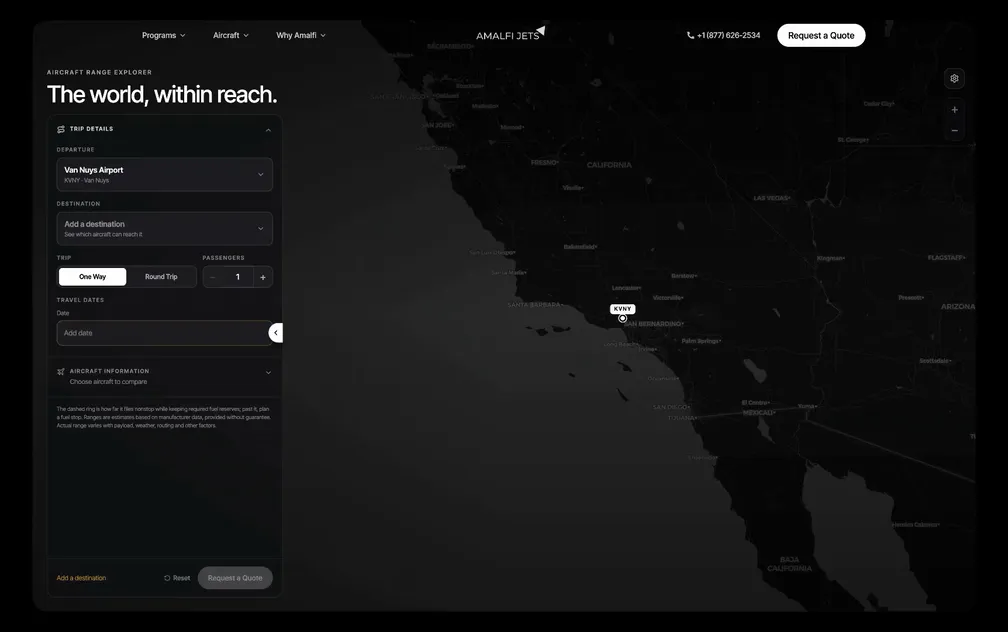
Try Range Explorer
See how far you can fly nonstop
Explore aircraft range, compare options, check flight times, and better understand which aircraft fits your trip.

Ready to fly to New Orleans?
Request a charter and our team will tailor an itinerary for your next journey.
*Takes only about 40 seconds to request your quote.
