



Destination Hub
Private Jet Charter to Mobile

Most private flights into the city begin with Mobile Regional Airport (MOB) as the primary arrival plan. That keeps the charter day clean: one coordinated landing point, ground transport waiting, and a schedule built around your meeting, estate visit, or Gulf Coast weekend.
Quick facts
Why charter a private jet to Mobile?
Private charter turns a trip to Mobile into a direct, controlled travel day rather than a sequence of airline constraints. The value is not only privacy; it is the ability to choose departure timing, streamline the arrival, and keep the itinerary aligned with the people and commitments that brought you to the Gulf Coast.
A simpler arrival through MOB
For most charter itineraries, MOB is the central planning point. Using the primary airport gives the charter desk a clear handling brief, a single ground-transfer plan, and fewer variables than a commercial connection.
Flexibility that follows the calendar
Chartering privately is especially useful when the trip has fixed anchors: a board dinner, a university event, a family gathering, or a same-day return. Departure times can be organized around the traveler rather than the airline schedule, and changes can often be handled with less friction when the aircraft, crew, and airport services are coordinated in advance.
Time saved beyond the flight
The practical advantage begins before takeoff. Travelers can avoid large-terminal routines, reduce connection risk, and arrive closer to the day’s real agenda. For principals moving with colleagues, family, luggage, or security considerations, that control can be as valuable as the flight itself.
“For January through March travel, our charter desk secures aircraft availability and airport handling first, then builds the ground plan around confirmed arrival timing. Early firm dates widen the aircraft options during peak weeks.”

When is the best time to fly to Mobile?
The best time to visit Mobile by private aircraft is often January through March, when Mardi Gras season, the Senior Bowl, and early-spring Gulf Coast events bring a stronger travel calendar. During those peak months, firm dates should be placed early so the charter desk can widen the aircraft search and protect preferred departure windows.
Carnival energy gives the city its most distinctive winter rhythm, with downtown streets, social calendars, and hospitality demand all moving at a different tempo. July, August, and September can offer more value-oriented charter conditions for nonessential trips, although the weather is hot and humid and late summer sits inside the Gulf Coast’s peak hurricane season.
Travelers with flexible plans may find the warm months easier to navigate from an availability standpoint. For fixed events, early planning matters more than season: the best aircraft choices usually appear before schedules compress.
Where our clients stay and go
Mobile rewards private travelers with a Gulf Coast setting of bay light, historic streets, and a pace that feels closer to a port city than a resort town. It is a place of water, live oaks, iron balconies, ship channels, and old neighborhood texture rather than polished spectacle.
Morning arrives soft over the bay, with the skyline set low against the horizon and the working waterfront never far from view. Downtown carries the marks of French, Spanish, British, and American chapters in its street names, architecture, and foodways, while the surrounding coast opens toward beaches, barrier islands, and the wider Gulf.
Mardi Gras gives Mobile one of its defining cultural identities. The season is social, local, and layered with tradition; it draws travelers who want the Gulf Coast’s original Carnival atmosphere without turning the trip into a large-city production.
Private travelers come for many reasons: port and industrial business, university and medical ties, family homes along the coast, winter events, and weekends that combine downtown dinners with time on the water. A good charter plan preserves that ease, bringing the traveler in close to the region and letting the city unfold on its own terms.
What determines the cost of a flight to Mobile?
The cost of chartering into Mobile is shaped by the aircraft selected, the trip structure, airport handling, seasonal demand, and aircraft availability. A quote is most accurate when the charter desk understands the passenger count, preferred departure window, luggage profile, ground plans, and how firm the schedule needs to be.
Aircraft class and itinerary design
Aircraft class affects the overall charter plan because cabin size, range profile, crew requirements, and routing all influence the operator options available for the trip. A short business hop, a family arrival with substantial luggage, and a multi-city Gulf Coast itinerary may each point to a different category of aircraft.
One-way versus round trip
A one-way itinerary is priced differently from a round trip because the aircraft may need to reposition before or after the passenger leg. If the same aircraft and crew can remain with the traveler for the return, the structure may be simpler; if not, the quote must account for where the aircraft starts and where it needs to go next.
MOB positioning, handling, and airport fees
MOB is the primary airport for the city, but each quote still depends on aircraft positioning, parking availability, handling arrangements, crew logistics, and applicable airport charges. Those items are coordinated before confirmation so the itinerary is priced around real operating conditions rather than a generic route estimate.
Seasonal demand and empty-leg availability
Demand can tighten during Mardi Gras season, Senior Bowl travel, and early-spring Gulf Coast events, especially when travelers need firm departure times. Empty-leg opportunities may reduce repositioning waste when a matching aircraft movement exists, but they are schedule-dependent and less reliable for trips that cannot flex.
Which airports serve Mobile?
Mobile is served first by MOB, with four practical alternates that may suit different parts of the Gulf Coast itinerary. Each airport should be chosen around the final destination, aircraft handling requirements, ground-transfer plan, and the traveler’s tolerance for schedule complexity.
Mobile Regional Airport (MOB)
MOB is the primary airport for private arrivals into the city, making it the natural first choice when the itinerary is centered on downtown, west-side addresses, or a straightforward arrival plan. This is typically where the charter desk begins when the priority is simplicity: confirm handling, align ground transport, and keep the day focused on the passenger rather than the routing.
Mobile Downtown Airport (BFM)
For itineraries tied to the downtown waterfront, industrial corridors, or the Brookley area, BFM can be worth evaluating as an alternate. Choose it when the ground plan benefits from a different side of the city, while allowing the charter team to confirm private handling, access, and operating details before it is selected.
HL Sonny Callahan Airport (CQF)
CQF serves the Fairhope and Eastern Shore side of the region, so it may make sense when the traveler’s destination is across the bay rather than in the city center. Consider it for Baldwin County stays, private residences, or meetings where a shorter ground movement on that side of the water is more important than using the primary airport.
Jack Edwards Airport (GUF)
GUF is the Gulf Shores-area alternate for trips that continue toward the Alabama coast. It can be useful when the itinerary is built around beach property, coastal gatherings, or a final destination south of the bay, provided the aircraft, handling plan, and local conditions are confirmed in advance.
Pensacola Regional Airport (PNS)
PNS gives the charter desk an additional regional option to the east, especially for travelers whose plans include the western Florida Panhandle or the Alabama-Florida coastal corridor. An alternate like this can be valuable when availability, weather, congestion, or the final ground destination makes a different arrival point more practical.
Common questions about Mobile charter
Which airport should I use for a private flight into the city?
Most travelers flying privately into Mobile use MOB as the primary arrival point, especially when the schedule is centered on the city, downtown, or a simple ground-transfer plan.
Can I use a smaller regional airport instead of MOB?
The charter desk can evaluate BFM, CQF, GUF, or PNS for a Mobile itinerary when an alternate airport better matches the final destination, handling needs, or regional ground plan.
How early should I book for Mardi Gras or Senior Bowl travel?
For Mobile peak periods in January, February, and March, earlier booking gives the charter desk more aircraft options and more time to secure preferred arrival and departure windows.
What determines the cost of chartering into Mobile?
Cost for Mobile charter travel depends on aircraft class, routing, one-way or round-trip structure, aircraft positioning, airport handling, seasonal demand, and whether a suitable empty leg is available.
Are July, August, and September practical months to fly privately?
July, August, and September can be practical for flexible Mobile trips, but travelers should account for heat, humidity, and peak hurricane-season planning across the Gulf Coast.
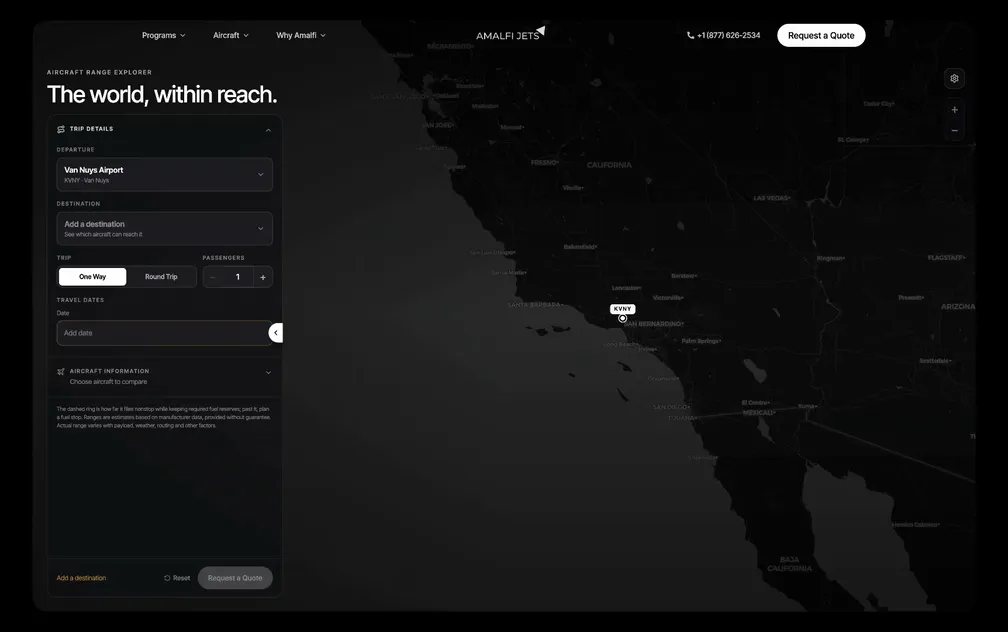
Try Range Explorer
See how far you can fly nonstop
Explore aircraft range, compare options, check flight times, and better understand which aircraft fits your trip.

Ready to fly to Mobile?
Request a charter and our team will tailor an itinerary for your next journey.
*Takes only about 40 seconds to request your quote.
