



Destination Hub
Private Jet Charter to Moab
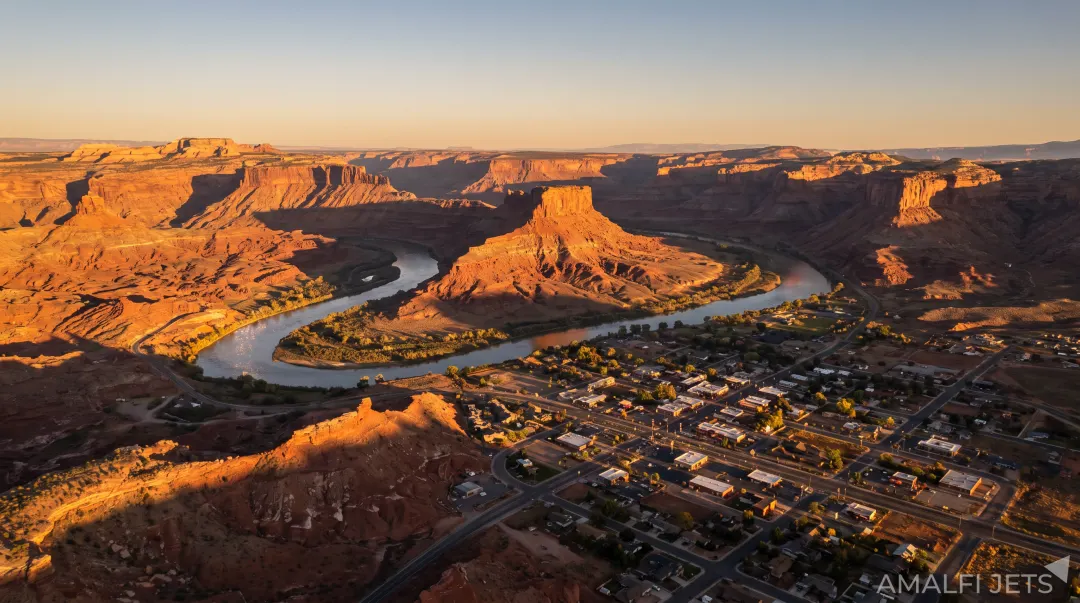
Private flights into Moab typically arrive through Canyonlands Field Airport (CNY), creating a clean handoff from aircraft to desert itinerary. From the ramp, the day can move directly toward red-rock viewpoints, private guides, river time, or a quiet lodge check-in without the compromises of airline schedules.
Quick facts
Why charter a private jet to Moab?
Chartering privately into Moab gives travelers control over timing, routing, and the pace of a high-desert trip built around limited days on the ground.
Canyonlands Field Airport (CNY) is the primary arrival point for private aviation serving the city, which keeps the flight plan straightforward and the ground plan focused. Instead of connecting through a larger hub and driving in after a commercial itinerary, travelers can organize arrival, transfer, lodging, and guide timing around a single aviation schedule.
Why private travelers choose this route
- Calendar control: Depart when the group is ready rather than shaping the trip around published airline times.
- Simpler group movement: Families, executive teams, guides, and luggage can be coordinated around one aircraft and one arrival plan.
- Efficient desert access: The airport-first approach helps preserve time for Arches, Canyonlands, the Colorado River corridor, and private excursions across the red-rock region.
- Discreet transitions: Charter travel reduces public-facing touchpoints and keeps the arrival experience contained, quiet, and coordinated.
The result is not just a shorter travel day. It is a more deliberate one, with the aircraft, ground transport, and itinerary sequenced around the way the traveler actually intends to use the destination.
“For peak spring and fall weeks, our charter desk secures the aircraft plan and CNY handling first, then aligns ground transfers and guide timing. Firm dates booked early usually preserve more aircraft choice.”

When is the best time to fly to Moab?
The best time to visit Moab depends on whether the priority is mild weather, peak outdoor energy, or a quieter desert stay with more flexibility.
Peak months
April and May bring the spring version of the high desert: longer days, comfortable outdoor conditions, and strong interest in Arches, Canyonlands, guided biking, off-road outings, and river-adjacent itineraries. September and October see a second wave of demand as summer heat eases and the red-rock landscape becomes especially appealing for active travel.
These months tend to reward early planning. Travelers set on specific lodges, guides, aircraft preferences, or event-adjacent dates should secure the aviation plan before the itinerary becomes too fixed.
Value months
December, January, and February are quieter across the desert, with colder days, fewer major demand drivers, and generally better availability. The pace is more private, the light can be crisp, and the trip can feel less crowded for travelers who are comfortable building the day around winter conditions.
A winter visit calls for practical scheduling. Shorter daylight windows, colder mornings, and weather variability make it useful to keep transfers, guide starts, and aircraft timing aligned rather than overly compressed.
Where our clients stay and go
Moab is a red-rock base camp with a polished edge: compact, active, and surrounded by some of the most recognizable desert scenery in the American West.
The town sits in a landscape shaped by sandstone, river corridors, open sky, and long bands of changing light. Mornings can feel almost theatrical as the cliffs brighten from purple to copper, while evenings draw attention back to the silhouettes of mesas and fins against a wide Utah horizon.
What draws private travelers
Arches National Park and Canyonlands National Park give the region much of its identity, but the appeal extends beyond the park gates. Travelers come for guided hikes, private photography days, mountain biking on slickrock, off-road drives, river outings on the Colorado, and lodge-based itineraries that balance adventure with comfort.
The atmosphere is informal rather than resort-polished, which is part of its strength. A well-planned stay can move from a sunrise overlook to a chef-arranged dinner, from a canyon drive to a quiet terrace, without losing the sense that the desert remains the main event.
The character of the stay
This is a destination where timing matters. Midday light can be bold, trailheads can fill in popular periods, and the best experiences often start early or end late. Private aviation pairs naturally with that rhythm because the travel day can be built around the landscape instead of consuming the hours meant for it.
What determines the cost of a flight to Moab?
The cost of chartering into Moab is shaped by the aircraft selected, the itinerary structure, CNY logistics, seasonal demand, and the availability of compatible empty-leg opportunities.
Aircraft and itinerary design
Aircraft class is one of the largest qualitative drivers because cabin size, range planning, passenger count, luggage volume, and onboard preferences all influence which options fit the mission. A nonstop routing, a multi-stop itinerary, and a same-day return can each create a different operational profile.
A one-way trip is priced differently from a round trip because the aircraft and crew may need to reposition before or after the passenger flight. When the schedule allows the aircraft to remain with the traveler, the quote may be structured differently than a mission requiring separate positioning segments.
CNY planning and local handling
CNY positioning, landing-related charges, handling arrangements, crew logistics, and ground timing all factor into the final quote. The charter desk reviews the full trip rather than treating the flight as an isolated point-to-point movement, because the quality of the arrival depends on both the aircraft and the plan around it.
Seasonal demand and empty legs
April, May, September, and October can bring stronger demand tied to mild desert weather, park travel, mountain biking, and Jeep-focused events. During these periods, earlier firm dates usually help preserve a wider field of aircraft and preferred departure times.
Empty-leg availability can create value when an aircraft already needs to move along a compatible route. Those opportunities are highly schedule-dependent, so they work best for travelers with some flexibility on departure time, airport pairing, or travel date.
Which airports serve Moab?
Moab is served primarily by Canyonlands Field Airport (CNY), with Grand Junction Airport (GJT), Blanding Municipal Airport (BDG), Cortez Municipal Airport (CEZ), and Carbon County Airport (PUC) available as regional alternatives when the wider itinerary calls for them.
Canyonlands Field Airport (CNY)
CNY is the primary choice for travelers whose plans center on the city, Arches, Canyonlands, and the surrounding red-rock corridor. Using the main local airport keeps the aviation plan direct and helps the ground team coordinate transfers, guides, luggage movement, and arrival timing around one clear point of entry.
This option makes the most sense when the stay is focused on the immediate area and the priority is a clean handoff from aircraft to hotel, ranch, private residence, or trail-based itinerary. The charter desk confirms handling details and arrival timing before presenting the recommended aircraft plan.
Grand Junction Airport (GJT)
GJT can be useful when the trip is tied to western Colorado, a broader road itinerary, or aircraft and scheduling considerations that make a larger regional gateway attractive. It may also suit travelers combining desert time with other stops before or after the Utah portion of the journey.
Choosing this airport is less about replacing CNY and more about matching the aviation plan to the full map. For some groups, starting or ending through Grand Junction can align better with a multi-destination itinerary, ground routing, or crew and aircraft availability.
Blanding Municipal Airport (BDG)
BDG may be considered when the southern side of the region is part of the plan. For travelers whose itinerary extends beyond the main town corridor, it can give the charter team another point to evaluate rather than forcing every movement through the same arrival airport.
This alternate is most relevant when ground time matters in a specific direction. The desk reviews routing, handling feasibility, passenger needs, and the final destination on the ground before recommending it.
Cortez Municipal Airport (CEZ)
CEZ can make sense for itineraries that pair southeast Utah with southwest Colorado or the Four Corners area. It gives travelers another regional option when the trip is not limited to one base and the arrival airport should support a wider route.
Private travelers might choose it when the best aircraft schedule, ground sequence, or endpoint sits outside the central desert plan. As with any alternate, the value comes from how well the airport fits the whole itinerary, not from the airport name alone.
Carbon County Airport (PUC)
PUC provides another regional point for consideration, particularly when an itinerary approaches the area from a different direction or benefits from an alternate aviation plan. It can be part of the discussion when CNY is not the most efficient match for aircraft positioning, schedule, or ground movement.
For private flights, the right choice is determined by more than proximity. Handling, aircraft availability, passenger preferences, and the onward drive all shape which airport delivers the smoothest overall travel day.
Common questions about Moab charter
Which airport should I use for a private flight into the area?
For most trips centered on Moab, Canyonlands Field Airport (CNY) is the primary airport and the first option our charter team evaluates for a direct arrival plan.
When should I book for spring or fall travel?
Demand around Moab is strongest in April, May, September, and October, so firm travel dates should be secured early to protect preferred aircraft options and departure times.
What determines the cost of chartering there?
The cost to reach Moab depends on aircraft class, one-way versus round-trip structure, CNY positioning and handling, seasonal demand, crew logistics, and any compatible empty-leg availability.
Can I use a regional alternate instead of CNY?
Yes, Moab trips can also be planned through Grand Junction, Blanding, Cortez, or Carbon County when the aircraft schedule, ground route, or wider regional itinerary makes an alternate more practical.
Is winter a good time to fly in privately?
Winter in Moab can be quieter, with colder days, fewer major demand drivers, and better availability, making it appealing for travelers who prefer a slower desert pace.
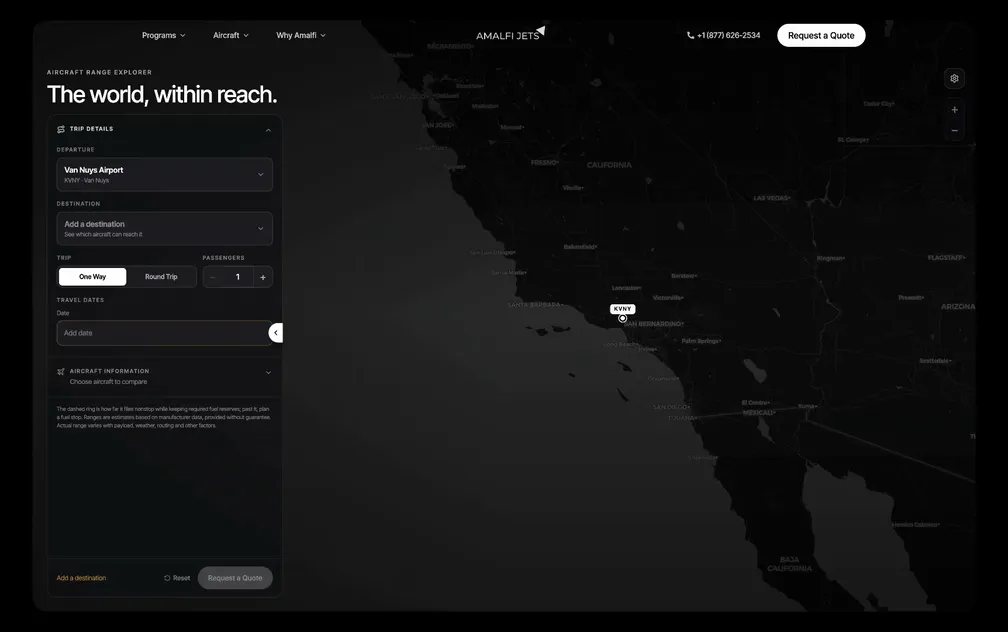
Try Range Explorer
See how far you can fly nonstop
Explore aircraft range, compare options, check flight times, and better understand which aircraft fits your trip.

Ready to fly to Moab?
Request a charter and our team will tailor an itinerary for your next journey.
*Takes only about 40 seconds to request your quote.
