



Destination Hub
Private Jet Charter to Minneapolis

Most private flights into Minneapolis are planned around Flying Cloud Airport (FCM), a straightforward arrival point for a day that should feel controlled from the first descent. Your schedule can move around meetings, lake weekends, and evening plans without the friction of airline connections.
Quick facts
Why charter a private jet to Minneapolis?
Chartering privately into Minneapolis gives travelers control over timing, routing, and ground plans from a single preferred arrival airport.
Time shaped around the traveler
A private itinerary begins with your calendar, not a published schedule. Meetings can start earlier, departures can wait for the final guest, and the return leg can be planned around dinner, game time, or a late-afternoon close.
A cleaner airport experience
Flying Cloud Airport (FCM) is the primary airport for the city, allowing the charter plan to concentrate on one preferred gateway before alternates are considered. That simplifies coordination for handling, luggage, ground transportation, and any same-day schedule changes.
Flexibility across the Twin Cities
Private aviation is especially useful in a region where business, residences, arenas, universities, and lake-country departures can pull travelers in different directions. If the ground plan points elsewhere, the charter desk can review STP, ANE, MIC, or MSP and choose the airport that best supports the day.
Fewer lost hours
Connections, boarding windows, and commercial delays can turn a direct business trip into a full-day commitment. A well-planned charter compresses the travel day, protects privacy, and keeps the aircraft aligned with the people actually traveling.
“For firm summer dates, our charter desk secures FCM handling and aircraft availability first, then holds suitable alternates such as STP or MSP if routing, parking, or ground plans point elsewhere.”

When is the best time to fly to Minneapolis?
The best time to visit Minneapolis depends on whether the trip is built around warm-weather demand or quieter availability.
June, July, August, and September are the peak months for private-flight demand. Summer lake travel, festival calendars, the Minnesota State Fair, and early fall event traffic can tighten aircraft availability and make early planning especially valuable for fixed dates.
January, February, March, and April tend to offer softer leisure demand after the holidays and through the cold early-spring stretch. Travelers with flexible timing may find better aircraft choice during this period, particularly when the itinerary is not tied to a major meeting, sporting date, or family calendar.
For the smoothest charter experience, treat firm summer and early fall plans as priority bookings. Value-season trips can often be arranged with more latitude, though preferred aircraft and departure times are still best secured before the calendar hardens.
Where our clients stay and go
Minneapolis draws private travelers with water, culture, and a polished Midwestern ease that feels more intimate than its skyline suggests.
The city is defined by contrast: glass towers above the river, quiet residential streets near lakes, and a creative scene that moves easily between museums, theaters, restaurants, music rooms, and design-forward hotels. Light changes quickly over the water, and in summer the Chain of Lakes gives the day a different rhythm from the downtown core.
Business travelers come for a serious corporate city with a practical temperament. Leisure guests often build the trip around lake weekends, family gatherings, arts programming, shopping, or a broader Twin Cities stay that stretches into St. Paul and beyond.
There is a northern clarity to the place. Mornings can feel efficient and bright, afternoons spill toward parks and waterfront paths, and evenings often settle into dining rooms where the mood is relaxed without being casual. For private travelers, that balance is part of the appeal: the trip can be productive, social, and quietly restorative without needing to announce itself.
What determines the cost of a flight to Minneapolis?
The cost of chartering into Minneapolis is shaped by the aircraft selected, the itinerary structure, airport-related planning at FCM, seasonal demand, and available repositioning opportunities.
Aircraft selection
Aircraft category is one of the central cost drivers. Cabin size, range needs, baggage volume, passenger count, and onboard service expectations all influence which aircraft are appropriate for the mission.
Trip structure
A one-way itinerary is priced differently from a round trip because the aircraft and crew still need to be positioned efficiently. Waiting time, overnight crew planning, and the gap between arrival and return can all affect the final charter plan.
FCM planning and airport-related fees
Flying Cloud Airport is the primary airport for the city, so the first cost review typically considers aircraft positioning, handling, parking, crew timing, and airport fees at FCM. If another field better suits the ground plan, the charter desk can compare the operational fit before confirming.
Seasonal demand
June, July, August, and September tend to bring stronger demand tied to summer lake travel, festivals, the Minnesota State Fair, and early fall event traffic. During these periods, earlier booking can preserve a wider aircraft selection.
Empty-leg availability
Empty legs can sometimes reduce repositioning inefficiency when an aircraft is already moving in the right direction. They remain highly schedule-dependent, so they are best treated as an opportunity rather than the foundation of a firm trip.
Which airports serve Minneapolis?
Minneapolis is primarily served for charter planning by Flying Cloud Airport (FCM), with STP, ANE, MIC, and MSP available as alternate gateways when the itinerary calls for a different approach.
Flying Cloud Airport (FCM)
Because it is the designated primary airport, FCM is the natural first check for most trips. The charter plan can focus handling, aircraft parking, departure timing, luggage coordination, and ground transportation around a single preferred field before any alternate is considered.
St. Paul Downtown Airport (STP)
STP can be useful when the day is anchored on the St. Paul side of the Twin Cities. For travelers moving between meetings, residences, or hospitality plans east of the river, it may create a cleaner ground itinerary than forcing every movement through the primary field.
Anoka County Blaine Airport (ANE)
ANE is worth reviewing when the schedule pulls toward the northern part of the metro area. It can also serve as a practical alternate when aircraft availability, ramp planning, or ground-routing considerations point away from FCM.
Crystal Airport (MIC)
MIC may make sense for itineraries centered around the northwest side of the region. A charter advisor can compare it against the primary airport when a shorter ground movement matters more than defaulting to the usual arrival plan.
St. Paul International Airport (MSP)
MSP can be considered when the trip involves airline connections, broader international logistics, or a need to coordinate with travelers arriving on scheduled service. Because larger-airport activity can affect the experience, private-terminal arrangements and timing should be reviewed early.
The best choice is not simply the closest name on a map. It is the airport that supports the aircraft, the handling plan, the ground schedule, and the traveler’s preferred pace with the least friction.
Routes to & from Minneapolis
Common questions about Minneapolis charter
Which airport should I use for a private flight into the city?
For Minneapolis, FCM is the primary planning airport, with STP, ANE, MIC, and MSP reviewed when ground location, availability, or connection needs make an alternate more practical.
What determines the cost of chartering into Minneapolis?
For Minneapolis, pricing depends on aircraft category, trip structure, crew timing, airport fees, positioning, seasonal demand, and whether an empty-leg opportunity aligns with your schedule.
When should I book a summer charter?
Summer demand in Minneapolis is strongest from June through September, so firm lake weekends, festival periods, State Fair travel, and early fall events are best arranged as early as possible.
Can I use MSP instead of FCM?
MSP can be considered for Minneapolis when airline connections or international-style logistics are part of the plan, while FCM remains the primary airport for most charter planning.
Are empty legs available for this route?
Empty legs may appear into or out of Minneapolis when another aircraft is repositioning, but they are schedule-sensitive and rarely as flexible as a standard charter.
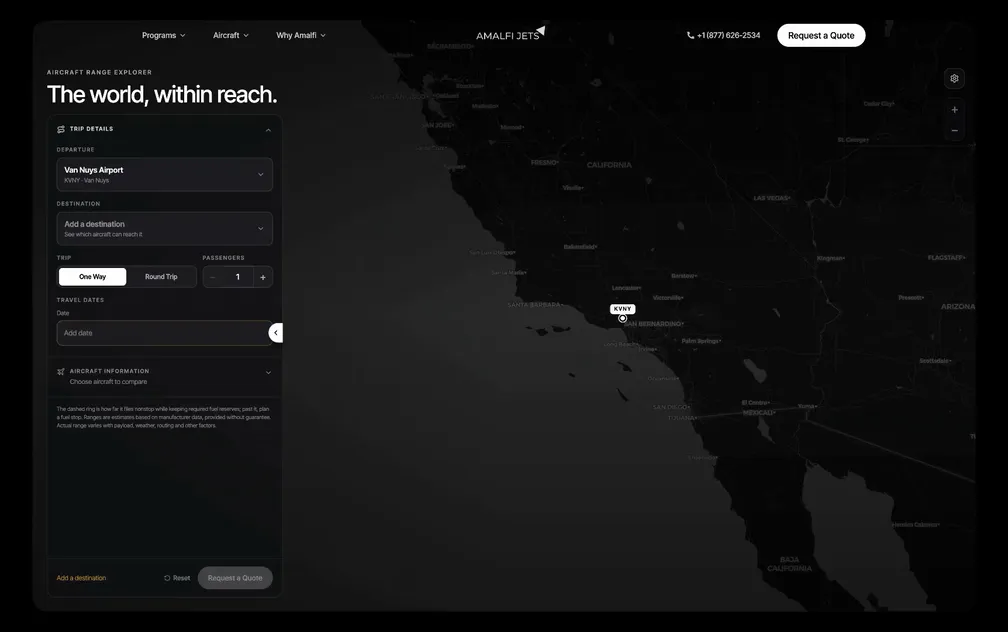
Try Range Explorer
See how far you can fly nonstop
Explore aircraft range, compare options, check flight times, and better understand which aircraft fits your trip.

Ready to fly to Minneapolis?
Request a charter and our team will tailor an itinerary for your next journey.
*Takes only about 40 seconds to request your quote.
