




Destination Hub
Private Jet Charter to Madison

Most private flights into Madison arrive through Dane County Regional Airport, keeping the journey direct, discreet, and built around a single, well-defined arrival plan. From MSN, the day can move on your schedule rather than an airline connection, with ground transportation coordinated to meet the aircraft.
Quick facts
Why charter a private jet to Madison?
Chartering privately into Madison gives travelers control over timing, routing, and the pace of arrival in Wisconsin’s capital.
A simpler arrival through MSN
Dane County Regional Airport is the primary gateway for private arrivals, which helps keep the plan focused: one airport, one ground-transfer brief, and a schedule shaped around the traveler’s calendar.
That matters when the itinerary is built around a board meeting, campus engagement, game weekend, medical appointment, or family visit. Private aviation removes the connection logic of airline travel and lets the day begin closer to the final agenda.
Flexibility when plans move
For university weekends, fall demand, or time-sensitive business travel, a charter itinerary can be adjusted around preferred departure windows, passenger changes, and same-day timing shifts.
You also gain the ability to evaluate alternate airports when the broader region makes sense for the trip. Middleton Municipal Airport, Southern Wisconsin Regional Airport, Dodge County Airport, and Waukesha County Airport can be considered when the final destination sits outside the city center or when an alternate ground plan creates a smoother day.
Time saved on both ends
A private flight reduces the amount of time spent in terminals, lines, and connection buffers. Instead of building the trip around published schedules, the charter desk organizes aircraft availability, airport handling, and ground transportation as one coordinated movement.
“For firm August, September, or October dates, our charter desk secures the airport strategy and aircraft availability first. Early planning widens options around Epic UGM, UW football weekends, and campus move-in.”

When is the best time to fly to Madison?
The strongest travel months for Madison are August, September, and October, when major business, university, and fall-event demand converge.
August can be especially active as campus move-in overlaps with late-summer travel and Epic UGM demand. September and October add university football weekends, fall color, alumni travel, and a busy civic calendar, so travelers with fixed dates should begin aircraft planning early.
January, February, and March often bring better value conditions for flexible travelers. Cold post-holiday winter and early spring typically create softer leisure demand, which can widen aircraft choice and improve scheduling options when the itinerary is not tied to a major event.
For travelers with flexible plans, Madison is often easiest to arrange when departure windows are open and arrival timing can move slightly around aircraft availability.
Moving early remains the best strategy for firm dates during peak months, particularly when multiple passengers, specific cabin preferences, or coordinated ground transportation are part of the brief.
Where our clients stay and go
Madison rewards private travelers with a city experience shaped by water, government, research, and a deeply local sense of place.
The city sits on an isthmus between Lake Mendota and Lake Monona, where the Wisconsin State Capitol anchors the skyline and the light changes quickly over the water. On clear mornings, the dome rises above a low, walkable downtown; by evening, the lakes catch the last color of the day.
On the isthmus, business and culture sit close together. State Street connects the Capitol Square with the university district, carrying a steady rhythm of cafés, bookstores, galleries, students, visiting executives, and weekend travelers.
UW–Madison gives the area much of its intellectual energy, drawing families, alumni, researchers, medical visitors, and corporate partners throughout the year. The university’s presence is felt in the lakefront paths, the campus architecture, and the surge of red on football weekends.
Its appeal is not about spectacle. The city works because it feels composed: compact enough for a precise itinerary, interesting enough for an unhurried stay, and distinctive enough that the arrival feels tied to place rather than simply another stop.
What determines the cost of a flight to Madison?
The cost of chartering into Madison depends on the aircraft selected, the route structure, aircraft positioning, airport-related fees, seasonal demand, and empty-leg availability.
- Aircraft category: Larger cabins, longer-range aircraft, and higher-demand models generally carry different operating profiles than smaller aircraft.
- Trip structure: A round trip with the aircraft waiting may price differently from a one-way itinerary that requires repositioning.
- MSN positioning and fees: Availability at the primary airport, crew logistics, handling arrangements, and airport-related charges all shape the final quote.
- Seasonal demand: August, September, and October can tighten availability around Epic UGM, university football weekends, campus move-in, and fall events.
- Empty-leg opportunities: Empty legs can improve value when an aircraft’s existing repositioning path aligns with your preferred timing, but they are schedule-dependent and less flexible than a dedicated charter.
The most efficient quote usually comes from a clear passenger count, firm travel windows, preferred cabin style, and a realistic ground schedule on arrival.
Which airports serve Madison?
Madison is served by MSN as its primary airport, with several regional alternates that may suit a private itinerary depending on final destination, timing, and handling needs.
Dane County Regional Airport (MSN)
MSN is the first airport strategy for most private arrivals because it is the designated primary gateway for the city. For travelers staying downtown, visiting the university, attending a state-government meeting, or building a tight same-day schedule, keeping the plan centered here usually makes the trip simpler to coordinate.
The airport is also the natural starting point for ground transportation planning. Once arrival and departure windows are set, the charter desk can align aircraft timing, passenger handling, and onward movement without adding an unnecessary regional transfer.
Middleton Municipal Airport (C29)
C29 can be considered when the west side or Middleton area is the practical focus of the trip. It may appeal to travelers whose meetings, residences, or accommodations sit away from the city center and who prefer the airport discussion to start closer to that side of the region.
As with any alternate, suitability depends on the aircraft, the schedule, and confirmed handling arrangements. The value is not in choosing a secondary airport for its own sake, but in matching the arrival point to the traveler’s actual ground plan.
Southern Wisconsin Regional Airport (JVL)
JVL can support itineraries that extend into southern Wisconsin rather than stopping in the capital core. For passengers combining the city with regional business, private property visits, or multiple ground stops, it gives the advisor team another airport to evaluate.
This kind of alternate can be useful when a shorter drive to the final stop matters more than arriving at the primary airport. The charter desk would compare the full route, not just the name of the airport, before recommending it.
Dodge County Airport (UNU)
UNU offers another planning option when the trip points toward Dodge County or the northern side of the broader region. It is most relevant when the traveler’s destination sits away from downtown and the ground itinerary would be cleaner from that direction.
Because secondary airports vary by aircraft and operating requirements, the decision should be made after confirming the full passenger count, baggage, schedule, and handling needs. In the right case, a regional airport can remove unnecessary road time.
Waukesha County Airport (UES)
UES may make sense when the journey connects the capital region with Waukesha County or other eastern Wisconsin commitments. It can be a practical alternative for travelers whose plans do not center on the city itself and who want the arrival airport aligned with the rest of the day.
For complex itineraries, the best airport is often the one that reduces friction on the ground. Amalfi Jets can compare MSN with the regional alternates and recommend the plan that best supports the traveler’s schedule.
Common questions about Madison charter
Which airport should I use for a private flight into the city?
Most private flights to Madison use Dane County Regional Airport (MSN), the primary airport for the city and the clearest starting point for a coordinated ground plan.
When do alternate airports make sense?
For Madison trips, an alternate airport may be worth considering when the final destination is closer to Middleton, southern Wisconsin, Dodge County, or Waukesha County than it is to MSN.
What determines the cost of chartering into the area?
Cost for Madison charter travel is shaped by aircraft category, routing, round-trip versus one-way structure, positioning at MSN, seasonal demand, and empty-leg availability when timing aligns.
When should I book for peak fall travel?
Travelers flying to Madison in August, September, or October should plan early because Epic UGM, campus move-in, football weekends, and fall events can tighten aircraft availability.
Can the charter desk compare MSN with the secondary airports?
Yes, for Madison itineraries the desk can evaluate MSN alongside C29, JVL, UNU, and UES based on the traveler’s schedule, aircraft suitability, handling needs, and ground route.
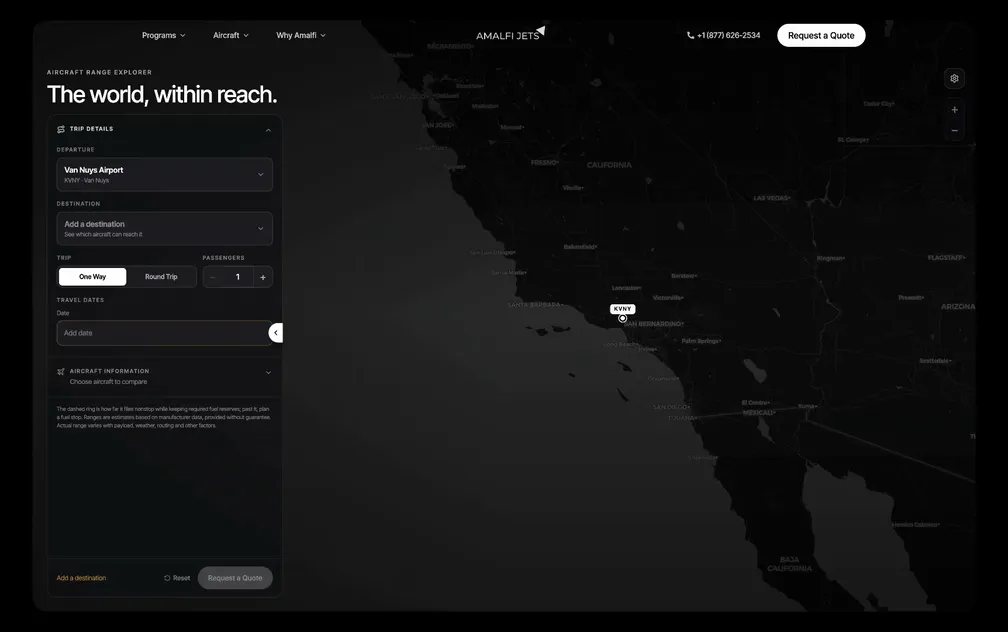
Try Range Explorer
See how far you can fly nonstop
Explore aircraft range, compare options, check flight times, and better understand which aircraft fits your trip.

Ready to fly to Madison?
Request a charter and our team will tailor an itinerary for your next journey.
*Takes only about 40 seconds to request your quote.
