



Destination Hub
Private Jet Charter to Lisbon

Most private flights into Lisbon arrive through Lisbon Airport (LIS), where the charter day can be planned around your aircraft rather than an airline timetable. From touchdown, Amalfi Jets coordinates the handling, timing, and onward movement so the first impression of Portugal’s capital feels composed, direct, and discreet.
Quick facts
Why charter a private jet to Lisbon?
Private charter into Lisbon gives travelers control over arrival time, routing, and the rhythm of the day from the first planning call.
Why private travelers choose the city
Commercial schedules can make a simple trip feel rigid. Chartering privately allows a traveler to set the departure window, choose a preferred aircraft category with an advisor, and build the journey around meetings, villa access, yacht movements, family schedules, or a weekend on the coast.
Because LIS is the primary airport for the city, the operating plan stays focused: confirm aircraft availability, coordinate ground handling, align passenger documentation, and organize the departure or arrival sequence around the traveler’s priorities.
Time saved where it matters
The value of a private flight is not only the time in the air. It is the ability to avoid unnecessary connections, reduce schedule friction, and preserve the hours around the trip.
- Direct timing: depart when the aircraft, crew, and passengers are ready.
- Flexible routing: add or remove stops as the itinerary evolves.
- Private coordination: keep luggage, ground transport, and passenger movements aligned.
- Responsive planning: adjust around weather, slot availability, crew duty, and airport conditions.
For travelers moving between the historic center, the Cascais coast, business appointments, or a private residence, the advantage is practical: fewer dependencies and a cleaner travel day.
“For peak summer weeks, our charter desk secures aircraft availability and preferred airport timing first, then confirms handling and ground transport. Early firm dates usually widen aircraft choice.”

When is the best time to fly to Lisbon?
The best time to visit Lisbon depends on whether the trip is built around summer energy, coastal leisure, or quieter access to the city.
Peak months
June, July, and August are the busiest months for private leisure demand. Summer brings travelers pairing the capital with the Cascais coast, late dinners, terraces by the river, and cultural calendars that add pressure to aircraft and hotel availability.
Festas de Lisboa gives June a distinctly local rhythm, while July music festivals can create concentrated demand around specific dates. For travelers with fixed plans in these months, earlier confirmation usually widens aircraft choice and improves the chance of securing preferred arrival windows.
Value months
January, February, and March offer a calmer version of the city. Weather is cooler and rain is more likely, yet the tradeoff can be valuable: quieter streets, easier restaurant planning, and better availability across both aircraft and hotels.
These months suit travelers who want the food, art, architecture, and Atlantic light without the fuller summer calendar. Flexible dates are especially useful, since the charter desk can compare aircraft positioning and airport timing before the itinerary is locked.
Where our clients stay and go
Lisbon draws private travelers with Atlantic light, riverfront geography, layered neighborhoods, and a pace that rewards unhurried arrival.
A capital shaped by water and hills
The city rises from the Tagus River in pale stone, tile, and terracotta, with viewpoints opening suddenly over rooftops and water. Arrival feels cinematic without needing to be staged: aircraft to car, car to hotel, then the first glimpse of the river beyond a row of tiled facades.
Its setting gives the trip natural range. One day can move from a morning meeting near the business districts to lunch in Chiado, an afternoon in Belém, and an evening in Alfama where the streets tighten and the music feels close to the walls.
What private travelers come for
Portugal’s capital works well for travelers who want culture without theatrical excess. The appeal is in the details: azulejo tiles catching the afternoon sun, limestone pavements underfoot, seafood restaurants along the water, galleries and design shops tucked into restored buildings, and hotels that understand privacy without overstatement.
For leisure itineraries, the Cascais coast adds an easy change of mood. Sea air, marina life, beaches, and private residences can sit naturally alongside a city stay, which is why summer weeks often combine urban dining with coastal downtime.
A polished base for wider Portugal
The destination also functions as a refined base for broader travel. Travelers may continue north toward Porto, south toward the Algarve, or inland through wine country and historic towns, using the charter schedule to keep the trip personal rather than procedural.
That flexibility is the luxury: not rushing the city, not surrendering the day to connections, and not having the itinerary dictated by someone else’s timetable.
What determines the cost of a flight to Lisbon?
The cost of chartering into Lisbon is determined by the aircraft selected, the structure of the itinerary, airport-related charges, seasonal demand, and whether suitable empty-leg opportunities exist.
Aircraft selection
Aircraft category is one of the largest qualitative drivers of pricing. Cabin size, range profile, luggage needs, passenger count, and onboard service expectations all shape which aircraft are appropriate for a given mission.
A short regional movement, a transatlantic arrival, and a multi-city European itinerary may each require a different charter solution. Amalfi Jets evaluates the mission first, then presents options that fit the schedule and comfort standard.
One-way versus round trip
A one-way charter can require aircraft positioning before pickup, after drop-off, or both. A round trip may allow the same aircraft and crew to remain tied to the itinerary, depending on timing, aircraft availability, and operating limitations.
When dates are flexible, advisors can compare structures and determine whether holding an aircraft, repositioning it, or sourcing another option produces the better operational plan.
LIS positioning and airport fees
Flying through LIS may involve charges related to landing, parking, handling, security, passenger services, and other airport or regulatory requirements. These vary by aircraft, schedule, route, and the final handling plan.
Positioning is also important. If the best aircraft is not already near the departure point or the arrival airport, the quote may reflect the movement required to place it for the trip.
Seasonal demand
Summer travel changes the market. June, July, and August bring stronger leisure demand, coastal itineraries toward Cascais, Festas de Lisboa, and July music-festival travel, all of which can tighten aircraft availability and preferred timing.
January, February, and March are generally quieter for winter-to-early-spring trips, with cooler, rainier conditions and more room to compare aircraft and hotel options.
Empty-leg availability
Empty legs can reduce cost when an aircraft already needs to move in the same direction as your trip. They are highly specific: route, date, timing, passenger count, and baggage must align.
Because empty legs can change quickly, they are best treated as an opportunity rather than a foundation for a firm itinerary.
Which airports serve Lisbon?
Lisbon is primarily served by LIS, with Cascais, Beja, Faro, and Porto airports considered when the wider itinerary calls for a different operating plan.
Lisbon Airport (LIS)
LIS is the primary airport for the capital and the first option to evaluate for most private arrivals. It keeps the plan centered on the city itself, which is useful for hotel stays, business appointments, cultural weekends, and onward ground movements within the metropolitan area.
For a private traveler, the main advantage is simplicity. A single primary gateway lets the charter desk coordinate handling, passenger timing, luggage movement, and ground transport around one operating plan.
Cascais Airport (CAT)
Cascais Airport is the alternate to discuss when the journey is focused on the Cascais coast rather than the urban center. For travelers staying near the coast, boarding a yacht, joining a villa party, or building a summer leisure itinerary around the Atlantic side of the region, CAT may be worth evaluating.
The charter desk would confirm handling arrangements, schedule suitability, and aircraft availability before recommending it. Its value is not that it replaces the primary gateway for every trip, but that it can align better with certain coastal plans.
Beja Airport (BYJ)
Beja Airport may enter the conversation when the itinerary extends beyond the capital and the operating team is comparing alternatives for positioning, availability, or regional access. It is not the default choice for a city stay, but it can be reviewed when the wider Portugal plan makes an inland or less congested option relevant.
For private flyers, BYJ is best treated as a strategic alternate. The decision depends on the aircraft, schedule, passenger destination after landing, and the feasibility of ground transfer from that point.
Aeroporto de Faro (FAO)
FAO is most relevant when the trip includes southern Portugal or the Algarve. If a traveler is combining the capital with a coastal stay farther south, using Faro for one end of the itinerary may reduce unnecessary backtracking.
This airport can make sense for a split itinerary: arrive for city time, continue privately or by ground as planned, then depart from the airport that better matches the final stop. Amalfi Jets would compare routing, aircraft positioning, and ground logistics before advising on that structure.
Oporto-Francisco S Carneiro Airport (OPO)
OPO is the airport to consider when northern Portugal is part of the journey. Travelers pairing the capital with Porto, the Douro region, or business in the north may find that an open-jaw plan is cleaner than returning to the original arrival airport.
For a private itinerary, the benefit is flexibility across Portugal rather than a fixed round-trip pattern. The best airport is the one that supports the actual movement of the traveler, the aircraft, and the schedule.
Routes to & from Lisbon
Common questions about Lisbon charter
Which airport do private jets use for the city?
Lisbon private flights most often use LIS, the primary airport for the capital, with alternates considered when the itinerary points toward the coast or another region of Portugal.
What determines the cost of chartering into the city?
Lisbon charter pricing depends on aircraft category, itinerary structure, positioning, airport-related charges, seasonal demand, and whether a suitable empty leg matches the requested route and timing.
When should I book for summer travel?
Lisbon demand is strongest in June, July, and August, so fixed summer dates should be confirmed early to preserve aircraft choice and better arrival-window options.
Can I use Cascais Airport instead of LIS?
Lisbon itineraries focused on the Cascais coast may justify reviewing CAT, provided the aircraft, handling plan, passenger timing, and onward ground movement all support that choice.
Are Faro or Porto useful for a private itinerary?
Lisbon can pair naturally with FAO for southern Portugal or OPO for northern travel, especially when an open-jaw itinerary avoids unnecessary backtracking.
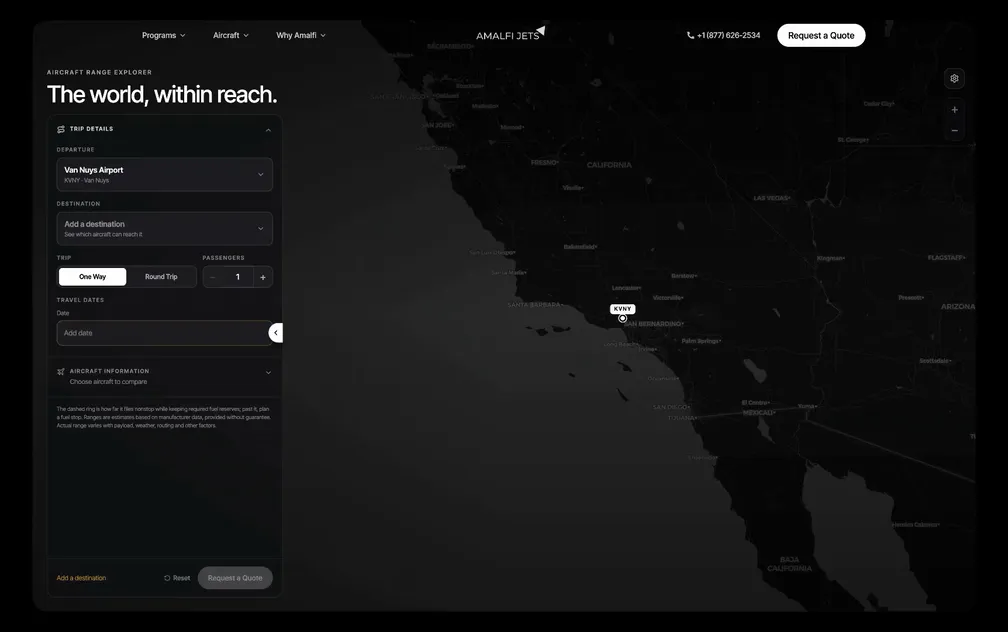
Try Range Explorer
See how far you can fly nonstop
Explore aircraft range, compare options, check flight times, and better understand which aircraft fits your trip.

Ready to fly to Lisbon?
Request a charter and our team will tailor an itinerary for your next journey.
*Takes only about 40 seconds to request your quote.
