



Destination Hub
Private Jet Charter to Las Vegas

A private arrival into Las Vegas is at its cleanest through Harry Reid International Airport (LAS): close to the resort corridor, direct in execution, and built around your schedule. Touch down, move from aircraft to ground transport with the handling plan already set, and let the desert skyline do the rest.
Quick facts
Why charter a private jet to Las Vegas?
Private charter is the most controlled way to fly into Las Vegas because it puts arrival timing, ground coordination, and routing around your calendar rather than an airline schedule.
Designed around the actual day
For travelers arriving for meetings, entertainment, design fairs, sporting weekends, or a tightly sequenced resort stay, the value is not only privacy. It is the ability to decide when the day begins, how much time is left between commitments, and when the return flight should leave.
A simpler arrival pattern
A charter flight into LAS keeps the plan direct: one aircraft, one arrival time, one ground sequence. That matters in a city where a few hours can hold a board dinner, a show, a client meeting, and a late departure.
- Schedule control: Depart when the aircraft, passengers, and ground plan are ready.
- Connection-free routing: Avoid the time and exposure of airline hubs whenever a direct charter plan is available.
- Privacy on the move: Keep conversations, documents, and family travel contained from departure lounge to arrival.
- Shorter dwell time: Reduce the waiting that often builds into commercial travel.
Where the time savings show
The result is a trip that feels less fragmented. Meetings can run long without automatically breaking the flight plan, a return can be arranged after a late dinner, and luggage, catering, and ground transport can be coordinated as one itinerary rather than several separate tasks.
“For Las Vegas we book LAS first, coordinate handling around Harry Reid International Airport, and keep VGT and HND available when a secondary airport better supports the itinerary. For Las Vegas seasonal demand, confirm dates early so the charter desk can protect aircraft choice.”

When is the best time to fly to Las Vegas?
The best time to visit Las Vegas by private jet depends on whether your priority is atmosphere, access, or aircraft choice.
January is one of the busiest private-travel windows, driven in part by CES and the convention calendar. March brings another lift in demand as March Madness turns the city into a sports and hospitality hub. November can tighten availability again as SEMA, Formula One activity, and major event traffic place pressure on preferred aircraft and arrival times.
For travelers who can choose softer dates, June, July, and August may offer better aircraft availability. Extreme desert heat changes the rhythm of the city, and lighter midweek convention flow can make schedules easier to shape.
The most comfortable strategy is to book early when dates are fixed, especially around peak demand periods. Travelers with flexible departure times, alternate day options, or open return windows often have a wider range of aircraft and itinerary structures to consider.
Where our clients stay and go
Las Vegas draws private travelers because it compresses dining, entertainment, design, meetings, and desert escape into a single high-energy destination.
Morning light lands hard on the Mojave, cutting the mountains into sharp silhouettes before the glass towers begin to glow. By night, the Strip becomes a corridor of marquees, fountains, restaurants, theaters, and hotel lobbies built for arrival.
The city is direct by nature. People come for decisive reasons: a convention, a title fight, a residency, a product launch, a chef’s table, a weekend with friends, or a quiet suite above the lights. Private travel fits that tempo because the schedule can be shaped around the purpose of the trip rather than the other way around.
Many visitors never need to move far from the resort corridor, yet the surrounding desert gives the destination its edge. Others build time for Red Rock scenery, golf, spa days, or a slower morning after a late night. That contrast is part of the appeal: polished interiors, dry desert air, reflected water, neon color, and the sense that the next appointment can be as formal or as private as the traveler wants it to be.
What determines the cost of a flight to Las Vegas?
The cost of a charter to Las Vegas is shaped by the aircraft selected, the itinerary structure, local airport considerations, seasonal demand, and repositioning opportunities.
Aircraft selection
Aircraft class is one of the primary variables. Cabin size, passenger count, baggage requirements, onboard service expectations, and routing needs all influence which aircraft are presented for a given mission. A larger cabin, a longer routing profile, or more specialized service requests can change the overall charter picture.
One-way versus round trip structure
Routing matters as much as destination. A one-way flight may require the aircraft to reposition before or after the trip, while a round trip may allow the same aircraft and crew to remain aligned with your return. The most efficient structure depends on the schedule, aircraft availability, and how firm the return timing is.
LAS positioning and airport-related variables
LAS is the primary arrival point, so local operating conditions, ramp planning, handling arrangements, parking availability, and applicable airport or service fees can affect the final quote. None of these factors should be viewed in isolation; the charter desk weighs them against aircraft location, timing, and the passenger itinerary.
Seasonal demand
January, March, and November can bring stronger charter demand as CES, March Madness, SEMA, Formula One activity, and major convention traffic draw high volumes of private travelers. During these periods, earlier planning generally gives access to a broader aircraft set and more favorable scheduling choices.
Empty-leg availability
Empty legs can sometimes create value when an aircraft is already scheduled to fly a compatible route. They are opportunistic rather than guaranteed, and the best fit usually comes when the passenger has some flexibility around departure time, airport pairing, or travel date.
Which airports serve Las Vegas?
For Las Vegas, private arrivals center on LAS, with VGT as a regional general-aviation option and HND relevant only when an itinerary extends to Tokyo.
LAS
This is the primary airport for the destination and the natural first plan for most private arrivals. Harry Reid International Airport (LAS) keeps the itinerary close to the resort corridor, major hotels, convention venues, and the city’s core hospitality circuit.
It is usually the right choice when the objective is a direct arrival, a coordinated ground transfer, and minimal complexity after landing. Choose LAS when the schedule is anchored to the Strip, a major event, a casino resort, or a convention program.
VGT
Because North Las Vegas Airport (VGT) is a general-aviation airport, it can be useful when the trip is oriented toward the northern side of the region or when a private traveler wants the charter desk to evaluate an alternate field.
VGT may also make sense when congestion, parking, or timing at the primary airport encourages a comparison. The decision is not automatic; it should be weighed against ground routing, passenger location, aircraft availability, and the handling plan for the day.
HND
HND, listed as Haneda/Tokyo International Airport, should not be treated as a local Nevada alternate. It belongs in the conversation only when the broader itinerary includes Tokyo as an origin, stop, or onward destination.
For that kind of international charter sequence, HND is a separate planning point rather than a way to shorten the drive to a resort or avoid local congestion. The charter desk should evaluate it as part of a multi-city itinerary, with private handling, customs planning, schedule structure, and crew logistics considered in the context of the Tokyo leg.
Routes to & from Las Vegas
Common questions about Las Vegas charter
Which airport is best for a private arrival?
Most travelers use LAS for Las Vegas because it is the primary airport and keeps the arrival plan direct for stays on or near the resort corridor.
What determines the cost of chartering into the city?
The cost of chartering into Las Vegas depends on aircraft category, routing, one-way versus round trip structure, airport positioning, seasonal demand, and any empty-leg opportunities that align with your timing.
Can I use VGT instead of LAS?
VGT can make sense for Las Vegas trips oriented toward the northern side of the region or when a general-aviation alternate is preferable to the main airport.
Is HND an alternate airport for this destination?
HND is not a local Las Vegas-area airport; it is relevant only if your broader private itinerary includes Tokyo, so the charter desk should treat it as a separate international leg.
When should I book peak-season travel?
For Las Vegas, book earlier for January, March, and November travel because CES, March Madness, SEMA, Formula One, and major convention demand can reduce preferred aircraft choice.
Are summer trips easier to arrange?
June, July, and August can be more flexible for Las Vegas private travel because desert heat and lighter midweek convention flow often improve availability.
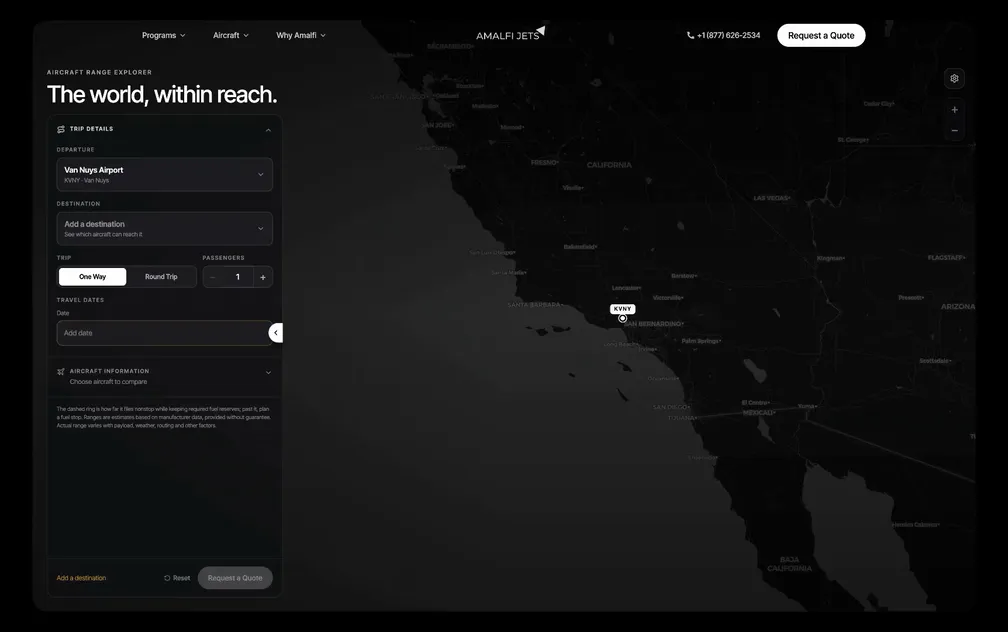
Try Range Explorer
See how far you can fly nonstop
Explore aircraft range, compare options, check flight times, and better understand which aircraft fits your trip.

Ready to fly to Las Vegas?
Request a charter and our team will tailor an itinerary for your next journey.
*Takes only about 40 seconds to request your quote.
