



Destination Hub
Private Jet Charter to Florence

Private arrivals into the city are most simply organized through Florence Peretola Airport (FLR), with the day built around your aircraft rather than an airline timetable. From touchdown, the itinerary can move directly toward a hotel on the Arno, a private residence in the hills, or a waiting transfer into wine country.
Quick facts
Why charter a private jet to Florence?
Chartering privately into Florence gives travelers control over arrival time, routing, and the pace of the day. Instead of building the trip around fixed airline schedules, your flight plan can align with hotel check-in, a villa handover, a gallery appointment, or a dinner reservation already set in the diary.
Why private travel works well here
A privately arranged arrival keeps the journey focused on the destination rather than the connection. FLR serves as the primary gateway, allowing the charter plan, ground transfer, and passenger handling to be coordinated as one movement.
For many clients, the value is not only privacy in the cabin. It is the ability to depart when the meeting ends, arrive without unnecessary connections, and keep luggage, companions, and onward plans under one coordinated brief.
Time saved without rushing the trip
A tailored flight plan can reduce friction at both ends of the journey. The charter desk can organize departure slots, arrival handling, ground transportation, and alternate airport planning before the aircraft is confirmed, so the day feels measured rather than improvised.
That flexibility matters on itineraries that combine the historic center with Tuscany beyond the city. A single trip may include museum visits, business meetings, a countryside lunch, and an evening return, and private aviation keeps those pieces closer to the traveler’s own schedule.
“For peak May, June, September, and October trips, our desk secures preferred FLR handling and aircraft options first; firm dates widen choice before wedding, wine, and fashion demand compresses availability.”

When is the best time to fly to Florence?
The best time to visit Florence depends on whether the trip is built around culture, a celebration, wine country, or quieter access. The most requested periods are often spring and fall, while winter can be attractive for travelers who value space and availability.
Peak travel periods
May and June bring warm-weather cultural travel, countryside dining, villa weddings, and strong demand around the Tuscan social calendar. September and October are equally compelling, with harvest-season wine travel, comfortable touring days, and continued interest in private residences outside the city.
Pitti Uomo also adds a fashion-driven layer of demand during its periods, drawing an international audience and tightening preferred aircraft and hotel options. For fixed dates in those windows, early planning gives the charter desk more room to compare aircraft and schedule choices.
Quieter-value periods
January, February, and November suit travelers who prefer cooler weather, fewer leisure crowds, and better availability across aircraft and hotels. The experience is more inward: galleries, restaurants, private tours, and evenings that begin early under the city lights.
Those months can also work well for business travel or planning visits when the exact departure time matters more than peak-season atmosphere. Flexible travelers may find the widest choice when they avoid the most compressed wedding, wine, and fashion weeks.
Where our clients stay and go
Florence rewards private travelers with a compact historic center, a river-lit skyline, and quick transitions from museum doors to Tuscan countryside. The city’s scale is part of its appeal: the itinerary can move from a palazzo breakfast to the Uffizi, across the Arno to artisan workshops, and onward to a villa dinner without losing the day to transit.
The first impression is architectural rather than theatrical. Brunelleschi’s dome rises above terracotta roofs, the Ponte Vecchio narrows the river crossing into a corridor of gold-lit windows, and the hills frame the city in a way that keeps Tuscany present even from the center.
A city shaped by art and ritual
Private travelers come for the Renaissance, but they often return for the rhythm. Morning light touches pale stone facades before the streets fill, church bells carry across small piazzas, and the evening passeggiata turns the riverbanks into a quiet stage.
Museums and churches remain central to the visit, yet the most memorable moments are not always behind a ticketed door. A private guide can slow the pace around Santa Croce, San Lorenzo, or the Oltrarno, where workshops and small dining rooms keep the city grounded in craft.
The Tuscan extension
A well-planned stay rarely ends at the ring road. Wine estates, hill towns, private villas, and countryside lunches are part of the reason travelers choose this gateway, especially in spring and fall.
That dual character makes the destination especially suited to private aviation. The arrival can be efficient and discreet, while the days themselves unfold at a slower, more deliberate pace — art in the morning, vineyards in the afternoon, and dinner back under the dome-lit skyline.
What determines the cost of a flight to Florence?
The cost of chartering into Florence is shaped by the aircraft selected, the routing, airport planning, seasonal demand, and aircraft availability at the time of request. A precise quote depends on the full itinerary, not just the city pair.
Aircraft selection
Aircraft class is one of the main cost drivers. Cabin size, baggage needs, passenger count, range, onboard service expectations, and preferred departure airport all influence which aircraft are appropriate for the trip.
A larger cabin may be chosen for comfort, luggage, or a longer routing. A more compact aircraft may suit a shorter regional itinerary when the passenger count and baggage profile allow it. The right choice is the aircraft that fits the mission cleanly, not simply the largest option available.
One-way or round trip structure
A one-way itinerary is priced differently from a round trip because the aircraft may need to reposition before or after the passenger flight. If the same aircraft can remain with the client for a return, the economics may differ from a single-sector movement with separate positioning.
Schedule certainty also matters. Firm dates allow the charter desk to compare more aircraft solutions, while open-ended plans may require a more flexible operating strategy.
FLR positioning and airport fees
Flights planned through FLR can include airport-related charges, handling, crew logistics, and positioning requirements. If the aircraft is not already in the right place for departure, positioning may be part of the quote.
The charter desk reviews those elements before presenting an option, so the proposal reflects the full operating plan rather than the passenger flight alone.
Seasonal demand
May, June, September, and October tend to attract stronger demand, driven by spring and fall culture trips, villa weddings, Tuscan wine travel, and Pitti Uomo activity. During those periods, aircraft choice can narrow sooner and preferred schedules may require earlier commitment.
January, February, and November often bring cooler weather and fewer leisure crowds, which can improve aircraft and hotel availability. Travelers with flexible dates may find more room to shape the itinerary around their preferred cabin, departure time, or overnight plan.
Empty-leg availability
Empty legs can occasionally reduce the cost of a suitable itinerary, but they are opportunistic. They depend on an aircraft already needing to move along a compatible route, at a compatible time, with passenger needs that match the aircraft.
Because empty legs can change quickly, they are best treated as a useful possibility rather than the foundation of a firm trip plan.
Which airports serve Florence?
The practical airport plan starts with Florence Peretola Airport (FLR), with Ampugnano Airport (SAY), Pisa Airport (PSA), and Aeroporto Guglielmo Marconi (BLQ) considered when the wider route points beyond the primary gateway. The right choice depends on the final address, aircraft plan, preferred schedule, and ground-transfer logic.
FLR: the primary city gateway
FLR is the first airport to evaluate for a city-focused itinerary. It keeps the arrival plan centered on hotels, meetings, residences, and cultural plans within the main destination, which is why many charter requests begin there.
A traveler would typically choose this airport when the schedule is built around the historic center or a nearby private address. Before confirming, the charter desk aligns aircraft suitability, handling, timing, and ground transportation as part of one operating plan.
SAY: a Tuscan-interior alternative
Ampugnano Airport (SAY) can make sense when the trip is less about arriving in the city itself and more about reaching a private address elsewhere in Tuscany. For villa stays, countryside gatherings, or itineraries that do not need to begin downtown, it may be worth evaluating alongside FLR.
Its usefulness depends on the ground plan. If the traveler’s first appointment, estate, or overnight address sits closer to SAY, an alternate-airport strategy may reduce unnecessary backtracking.
PSA: useful for a Pisa-side routing
Pisa Airport (PSA) is a logical alternate when the itinerary favors that side of the region. It may be considered when aircraft availability, passenger timing, or the onward drive makes PSA more practical than forcing every plan through the primary airport.
This option is especially relevant when the trip combines multiple Tuscan stops. In that case, the best airport is the one that supports the whole journey, not just the name of the destination city.
BLQ: a broader regional option
BLQ gives the charter desk another way to solve the itinerary when the preferred aircraft, schedule, or ground route does not align cleanly with FLR. It is not the default for a city-first arrival, but it can be useful when a broader regional routing is more efficient.
A traveler may consider this airport when avoiding congestion, widening aircraft choice, or shortening the drive to a different part of the trip matters more than landing closest to the center. The charter team compares the total door-to-door plan before recommending it.
Common questions about Florence charter
Which airport should I use for a private arrival?
For Florence, FLR is the primary airport to evaluate when the itinerary is centered on the city, with SAY, PSA, and BLQ reviewed if the wider Tuscan route makes an alternate more practical.
Can I use a different airport if my villa is outside the city?
Yes, Florence itineraries that continue to a countryside residence may be better served by an alternate airport if it creates a cleaner ground-transfer plan.
What determines the cost of chartering into the city?
For Florence, pricing depends on aircraft class, routing, one-way or round trip structure, positioning, airport fees, seasonal demand, and whether a suitable empty leg is available.
When should I book for spring or fall travel?
For Florence, May, June, September, and October should be planned early because culture trips, villa weddings, wine travel, and Pitti Uomo demand can tighten aircraft choice.
Are January, February, and November good months to visit?
For Florence, those months can work well for travelers who prefer cooler weather, fewer leisure crowds, and better aircraft and hotel availability.
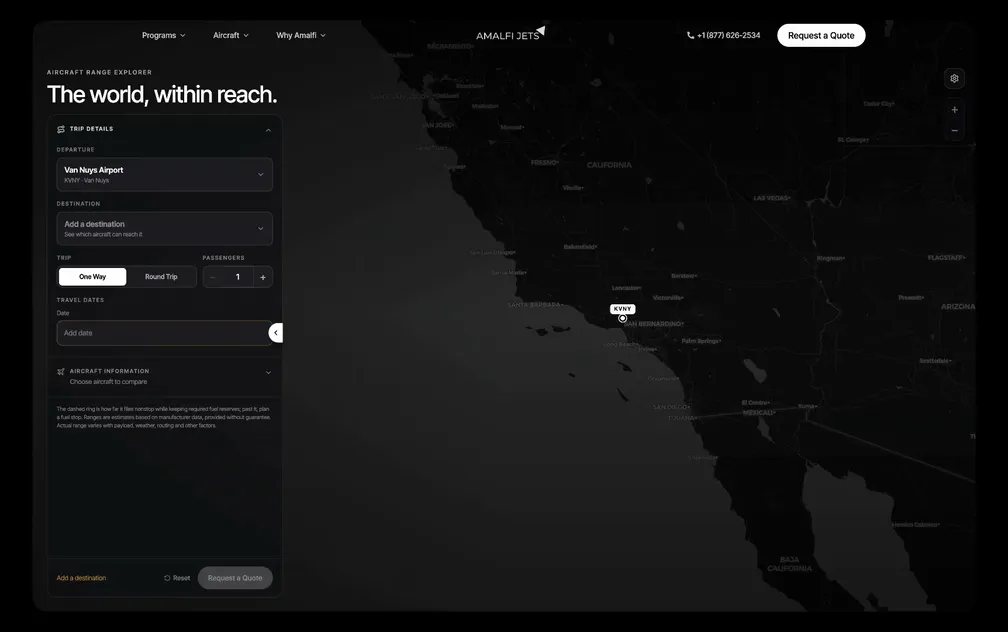
Try Range Explorer
See how far you can fly nonstop
Explore aircraft range, compare options, check flight times, and better understand which aircraft fits your trip.

Ready to fly to Florence?
Request a charter and our team will tailor an itinerary for your next journey.
*Takes only about 40 seconds to request your quote.
