



Destination Hub
Private Jet Charter to Flagstaff
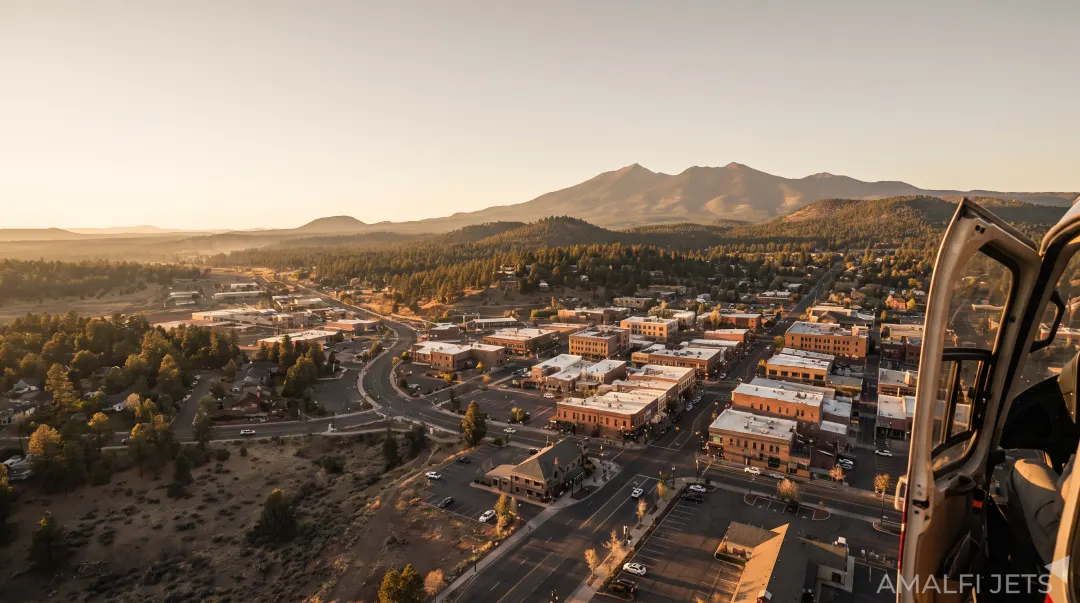
Arriving into Flagstaff by private aircraft keeps the journey centered on Pulliam Field (FLG), with the day organized around your timing rather than an airline schedule. From the ramp, pine country, high-desert light, and the road toward the Grand Canyon feel close at hand, so the first hour can be purposeful instead of procedural.
Quick facts
Why charter a private jet to Flagstaff?
Private travelers choose Flagstaff when they want mountain access, Grand Canyon reach, and a schedule that does not depend on airline routings. The city works especially well for travelers who need to connect a business day, a resort stay, a canyon itinerary, or a private residence visit without building the trip around commercial departure banks.
A cleaner arrival day
Pulliam Field (FLG) gives the itinerary a clear primary gateway. Instead of routing through a larger hub, changing terminals, and waiting on fixed schedules, a charter plan can be timed around the traveler’s calendar, preferred arrival window, and ground transportation.
That control matters in northern Arizona, where the value of the trip often lies beyond the airport itself. A private arrival can be coordinated with drivers, hosts, guides, luggage needs, and onward plans before the aircraft lands.
Flexible timing for mountain and canyon travel
Airline schedules are built for networks; private flights are built around intent. A morning departure can preserve an afternoon outdoors, while a later return can protect a final meeting, dinner, or sunset plan.
This flexibility is particularly useful for travelers pairing the city with the Grand Canyon, Sedona, Prescott, or other regional stops. If plans shift, the charter desk can assess aircraft availability, airport handling, and ground logistics as one coordinated itinerary.
Time saved beyond the flight
The time advantage is not only in the air. Private aviation reduces the friction around check-in, connections, baggage flow, and schedule compromise, which can be the difference between arriving rested and arriving late to the purpose of the trip.
For families, executive teams, and travelers carrying specialized gear, that simplicity can be as important as speed. The aircraft, ground transfer, and arrival plan are organized as a single experience rather than separate pieces to manage on the day of travel.
“For summer peak weeks, our charter desk first secures FLG handling and aircraft availability, then weighs SDX, PRC, GCN, or INW if the ground itinerary points elsewhere. Firm dates early widen aircraft choice.”

When is the best time to fly to Flagstaff?
The best time to visit Flagstaff depends on whether the trip is built around cool mountain air, Grand Canyon touring, or a quieter shoulder-season stay. Private travelers should match the travel window to the experience they want, then secure aircraft and ground arrangements around the dates that matter most.
Peak travel months
June, July, and August are the peak summer months. Cooler mountain conditions, Grand Canyon itineraries, local festivals, and heat-escape travel from Phoenix all contribute to stronger demand.
Those summer weeks reward early planning. Preferred departure times, aircraft selection, airport handling, and premium ground arrangements are easier to coordinate when dates are set in advance.
Value-oriented months
April, May, and November can be especially appealing for travelers who want a quieter rhythm. These months sit between ski-season demand, summer crowds, and holiday travel, creating a more measured pace for many itineraries.
Shoulder-season trips can also work well for travelers who value flexibility. With fewer peak-period pressures, the charter desk may have more room to compare aircraft options, alternate airports, and refined ground plans.
Planning guidance
For fixed family vacations, executive retreats, and Grand Canyon-focused trips, plan as soon as dates are firm. For travelers with a flexible calendar, shifting departure times or considering regional alternates can create a more efficient charter plan.
Weather, daylight, and ground itinerary details should all be considered together. The flight is only one part of the experience; the strongest itineraries align arrival timing with the road, the hotel, and the first commitment after landing.
Where our clients stay and go
Flagstaff rewards travelers who want the American Southwest with altitude, pine forest, dark skies, and an easy pivot between town and canyon country. It feels different from the desert cities to the south: cooler, higher, and edged by volcanic landforms, rail history, and the long shadow of the San Francisco Peaks.
Downtown carries the texture of a mountain town shaped by Route 66, railroad heritage, university energy, and travelers moving through northern Arizona. Brick storefronts, coffeehouses, galleries, and casual dining rooms give the city a lived-in character rather than a resort-only polish.
Mountain air and canyon reach
The appeal of Flagstaff is often the way it connects experiences that do not feel interchangeable. A traveler can wake to ponderosa pines, spend the day oriented toward the Grand Canyon, and return to a town where the evening cools quickly under clear skies.
Lowell Observatory gives the destination a celestial identity, while the surrounding landscape keeps the itinerary grounded in geology and open space. The result is a place where luxury is less about spectacle and more about access, privacy, and time used well.
A base for purposeful travel
Private travelers come here for family journeys, milestone canyon trips, discreet retreats, outdoor weekends, and regional touring across northern Arizona. The city suits itineraries that need both comfort and movement: arrive efficiently, settle in, then let the road, guide, or host take over.
That is the quiet advantage of choosing this mountain gateway. It can support a refined stay without losing the sense that the landscape is the main event.
What determines the cost of a flight to Flagstaff?
The cost of chartering into Flagstaff is shaped by the aircraft selected, itinerary structure, airport-related expenses, seasonal demand, and the live availability of aircraft. A tailored quote reflects the exact route, traveler count, timing, and service requirements rather than a generic fare.
Aircraft selection
Aircraft class is one of the primary cost drivers. The right choice depends on passenger count, luggage profile, cabin preference, range needs, and the overall purpose of the trip.
A short regional movement, a nonstop cross-country itinerary, and a multi-leg journey each place different demands on aircraft selection. The charter desk evaluates the mission first, then recommends suitable options available for the requested schedule.
One-way versus round trip
Itinerary structure changes the economics of a charter. A round trip may allow the same aircraft and crew to remain aligned with the traveler’s schedule, while a one-way trip can require additional aircraft positioning before or after the passenger leg.
Timing also matters. A trip with a tight return window, an extended stay, or multiple regional stops may be priced differently because the aircraft, crew, and operational plan are used in different ways.
FLG positioning, handling, and airport-related expenses
Flights into FLG may include positioning considerations depending on where the selected aircraft is based before departure and where it needs to go afterward. Handling, parking, crew logistics, and other airport-related items are also reviewed as part of the quote.
These elements are not one-size-fits-all. They are confirmed around the actual aircraft, itinerary, date, and ground plan, which is why a live quote is essential.
Seasonal demand
Demand rises during the cool summer months, especially when travelers use northern Arizona as an escape from hotter desert cities or as a base for Grand Canyon travel. During these periods, desirable departure times and aircraft options can tighten.
April, May, and November can offer more scheduling flexibility because they sit between heavier ski-season, summer, and holiday patterns. Travelers with firm dates still benefit from planning early, particularly for weekends and family travel windows.
Empty-leg availability
Empty-leg opportunities can sometimes reduce the overall cost when an aircraft already needs to reposition along a compatible route. Availability is highly specific to date, direction, aircraft, and timing.
Because empty legs are created by another aircraft movement, they are less flexible than a dedicated charter. They can be valuable when the traveler’s schedule is adaptable, but they should not be treated as a guaranteed planning strategy for an important arrival.
Which airports serve Flagstaff?
Pulliam Field (FLG) is the primary airport for Flagstaff, with Sedona Airport (SDX), Prescott Regional Airport (PRC), Grand Canyon National Park Airport (GCN), and Winslow Lindbergh Regional Airport (INW) serving as practical regional alternates. The right choice depends on the traveler’s final destination, handling requirements, schedule, and how the ground itinerary is arranged.
FLG
As the primary airport, FLG is typically the first planning point for a direct arrival into the city. It keeps the itinerary simple when the traveler’s lodging, meeting, residence, or guide pickup is centered in the local area.
Private travelers often prefer the most direct airport plan when time on the ground matters. The charter desk can coordinate arrival timing, handling, passenger transfer, and luggage flow around a single gateway before considering alternates.
SDX
SDX can make sense when the trip is oriented toward Sedona rather than a stay in the mountain city itself. For travelers building a northern Arizona itinerary around red-rock scenery, wellness retreats, private residences, or resort stays in that area, it may be worth comparing against FLG.
This alternate is not simply a backup; it can be a better geographic fit when the first destination after landing is south of the city. The decision should be made with the ground route, passenger schedule, and aircraft handling plan considered together.
PRC
PRC is useful to review when the itinerary points toward Prescott or the broader central Arizona high country. It may also provide a sensible alternate when aircraft availability, ground logistics, or passenger plans make a different regional airport more efficient.
For complex trips, PRC gives the charter desk another way to shape the journey around where the traveler actually needs to be. That can be valuable when the destination is regional rather than strictly downtown-focused.
GCN
GCN is the airport to evaluate when Grand Canyon National Park is the clear center of the trip. For travelers whose schedule is built around canyon access, guided touring, or lodging near the park, this alternate may reduce unnecessary ground movement compared with routing through the city first.
Its role is itinerary-specific. The charter desk reviews the aircraft plan, passenger needs, local handling, and ground transfer before recommending it as the arrival point.
INW
INW may be considered when the traveler’s plans point toward Winslow or the eastern side of the region. It adds flexibility for itineraries that are not best served by a single-city arrival.
This can matter for private travelers with ranch, heritage, industrial, or road-based commitments across northern Arizona. When geography rather than habit should decide the airport, INW gives the planning team another option to test.
Choosing between them
A private airport decision should start with the first meaningful stop after landing. If the traveler is heading into the city, FLG is the natural planning point; if the trip is built around Sedona, Prescott, the Grand Canyon, or Winslow, one of the alternates may create a cleaner day.
At any airport, private-arrival suitability is confirmed through handling availability, ramp arrangements, and the ground plan before an aircraft is released. The best recommendation is the one that protects the schedule from the runway to the final destination.
Common questions about Flagstaff charter
Which airport should I use when flying privately into Flagstaff?
Flagstaff is primarily served by FLG, which is usually the first airport to evaluate when the traveler’s plans are centered in the city, with SDX, PRC, GCN, and INW considered when the wider regional itinerary points elsewhere.
Can I use Sedona, Prescott, Grand Canyon, or Winslow instead of FLG?
Flagstaff itineraries can be planned through regional alternates when the ground destination makes them more practical, especially if the trip is centered on Sedona, Prescott, the Grand Canyon, or Winslow rather than the city itself.
What determines the cost of chartering into Flagstaff?
Flagstaff charter cost depends on aircraft selection, one-way or round-trip structure, aircraft positioning, FLG-related handling and fees, seasonal demand, and whether a compatible empty leg is available for the requested timing.
When is demand highest for private flights to the area?
Flagstaff sees stronger demand in June, July, and August because travelers use the cooler mountain setting for summer escapes, Grand Canyon trips, festivals, and relief from Phoenix heat.
Are April, May, and November good months to consider?
Flagstaff can be especially appealing in April, May, and November, when the pace is often quieter between ski-season travel, summer crowds, and holiday demand.
How early should I request a charter quote?
Flagstaff trips with firm dates should be requested as soon as the schedule is known, because early planning gives the charter desk more room to compare aircraft, confirm handling, and refine the ground plan.
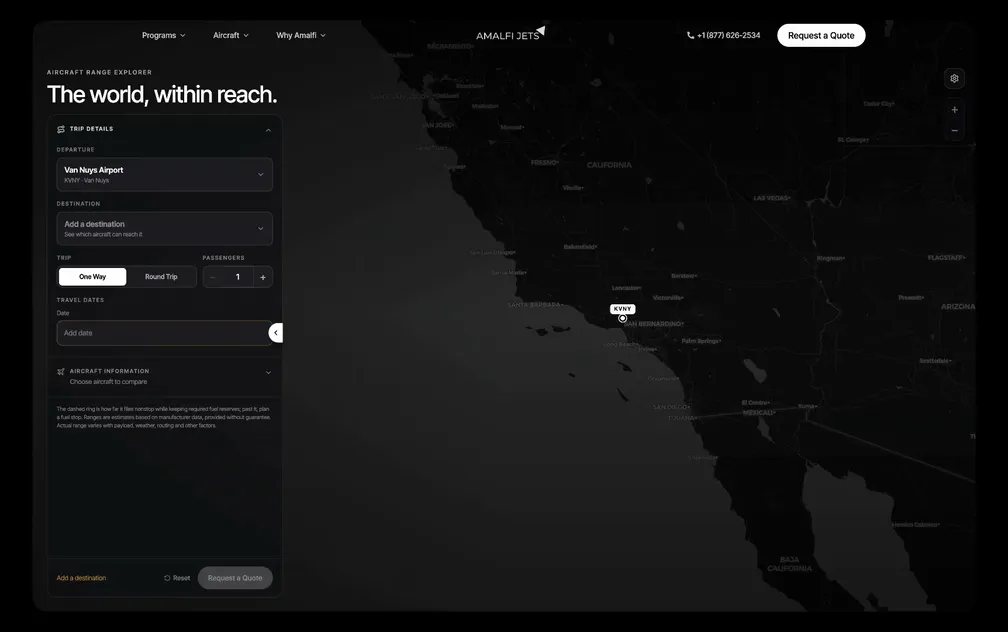
Try Range Explorer
See how far you can fly nonstop
Explore aircraft range, compare options, check flight times, and better understand which aircraft fits your trip.

Ready to fly to Flagstaff?
Request a charter and our team will tailor an itinerary for your next journey.
*Takes only about 40 seconds to request your quote.
