



Destination Hub
Private Jet Charter to College Station

Most private arrivals use College Station Airport (CLL), keeping the day centered on one clear gateway for campus visits, business meetings, and fall weekends in Aggieland. Amalfi Jets coordinates the aircraft, ground timing, and departure window around your calendar, so the trip feels composed from touchdown to takeoff.
Quick facts
Why charter a private jet to College Station?
Private aviation is the most direct way to control an itinerary into Aggieland, especially when campus calendars and business meetings leave little room for airline connections.
Why fly privately
A charter itinerary lets you set the pace before the trip begins. Departure times can be built around a board meeting, a kickoff weekend, a campus tour, or a family visit rather than fixed airline inventory and connection banks.
Arriving through CLL keeps the aviation plan close to the purpose of the trip. Travelers can step from aircraft to ground transportation with fewer handoffs, then move directly toward Texas A&M, Northgate, Bryan, or local accommodations.
Time, privacy, and control
The value is not only the flight itself. It is the ability to preserve the day: fewer lines, fewer schedule compromises, and a departure window that can be adjusted as plans evolve.
Private travel also gives families, executives, alumni groups, and university guests a quieter setting in the air. Conversations stay inside the cabin, baggage travels with the party, and the return leg can be arranged around the actual end of the visit instead of the last available commercial departure.
“For fall weekends, our charter desk secures CLL handling and ground timing first, then protects backup options at CFD or TME when demand tightens. Firm dates early in the search widen aircraft choice.”

When is the best time to fly to College Station?
The best time to visit College Station depends on whether you want the full fall Aggie atmosphere or a quieter, more flexible arrival window.
Peak fall travel
September, October, and November are the most active months for private arrivals. Texas A&M home football weekends, tailgates, Ring Day, and fall campus events compress demand into specific dates, so travelers with firm plans should begin the charter search early.
During these weeks, the most valuable asset is flexibility. A slightly earlier arrival, later departure, or alternate airport plan can help preserve choice when aircraft and local handling are in high demand.
Value-minded timing
January, February, and July tend to be more forgiving for scheduling. The football offseason brings fewer campus-driven spikes, and midsummer demand is often softer outside tournament weeks.
Quieter periods are well suited to university visits, family trips, regional business, and itineraries that may still be taking shape. Aircraft choice can be broader, and the planning conversation can focus more on cabin preference and timing rather than peak-week compression.
Where our clients stay and go
College Station draws private travelers with the energy of Texas A&M, the ease of a compact Brazos Valley itinerary, and a pace that feels distinctly Central Texas.
A city built around arrival
The landscape opens wide on approach: low horizons, campus landmarks, and the soft light of the Brazos Valley. The city’s rhythm is tied to the university, but it is not one-note; academic life, research, athletics, alumni gatherings, and regional business all move through the same streets.
In town, the experience is close and purposeful. A traveler can land, meet family near campus, continue to a dinner in Bryan, or settle into a weekend near Northgate without turning the day into a transfer exercise.
Aggieland character
Tradition gives the destination its texture. Fall brings maroon crowds, long tailgate tables, and the steady pull of home football weekends, while quieter months reveal a more local version of the place: shaded neighborhoods, casual restaurants, and an easy connection between campus and community.
Private travelers often come for something specific — a game, a Ring Day celebration, a campus decision, a donor meeting, a family weekend — and the city rewards that kind of focused trip. It is at its best when the logistics stay simple and the schedule leaves room for the reason you came.
What determines the cost of a flight to College Station?
The cost of chartering into College Station is shaped by the aircraft selected, the itinerary structure, airport plan, season, and real-time fleet availability.
Aircraft category and route
Aircraft class is one of the central variables. Cabin size, luggage needs, passenger count, nonstop routing, and preferred onboard experience all influence which aircraft your advisor presents for review.
Routing matters as well. A shorter regional flight and a longer cross-country itinerary create different operating profiles, and the final quote reflects the aircraft, crew, fuel planning, and schedule required for that specific trip.
One-way or round trip
A one-way itinerary may require aircraft repositioning before or after your flight. A round trip can be more efficient when the aircraft and crew remain aligned with your return, but that depends on timing, airport availability, and operator scheduling.
CLL planning and airport-related costs
CLL positioning, handling arrangements, landing-related charges, parking, crew logistics, and ground coordination can all influence the final charter proposal. Amalfi Jets reviews these items before presenting options, so the quote reflects the actual operating plan rather than a generic route estimate.
Seasonal demand and empty legs
September, October, and November often bring stronger demand around Texas A&M home football weekends, tailgates, Ring Day, and fall campus activity. Firmer dates during that period benefit from earlier planning.
January, February, and July can offer more flexibility outside the football season and away from midsummer tournament spikes. Empty-leg availability may reduce repositioning needs when a matching aircraft is already moving in the right direction, but those opportunities are timing-specific and cannot be relied on for fixed schedules.
Which airports serve College Station?
College Station is served by CLL as the primary arrival point, with CFD, 11R, UTS, and TME available as alternates when routing, ground plans, or peak-week demand call for another option.
College Station Airport (CLL)
CLL is the natural first plan for travelers whose schedule centers on Texas A&M, Northgate, meetings in town, or a short handoff to local ground transportation. Its appeal is straightforward: fewer moving parts between landing and the reason for the trip.
For peak fall weekends, confirming the airport plan early helps the charter desk coordinate handling, ground transportation, and departure timing before demand tightens around campus activity.
Coulter Field (CFD)
Coulter Field can be useful when the ground itinerary leans toward Bryan, the northern side of the metro area, or a more general-aviation-focused arrival. It may also be considered when CLL demand is compressed and an alternate field gives the trip a cleaner operating path.
The choice is practical rather than ceremonial. If the traveler’s first meeting, residence, or accommodation sits better with a Bryan-side arrival, CFD may reduce unnecessary backtracking on the ground.
Brenham Municipal Airport (11R)
Brenham Municipal Airport can serve travelers approaching the broader Brazos Valley from the southwest side of the region or pairing the trip with business or family plans outside the immediate campus core. It is best treated as a strategic alternate rather than the default arrival for campus-centered weekends.
An advisor may evaluate 11R when the aircraft schedule, ground route, or regional itinerary makes Brenham a sensible point of entry.
Huntsville Municipal Airport (UTS)
Huntsville Municipal Airport gives another option east of the primary plan, especially for itineraries that involve Walker County, the Interstate 45 corridor, or destinations beyond the immediate Bryan-area orbit. It can also support a routing strategy when the most direct campus airport is less favorable for a particular schedule.
For a traveler whose day continues away from Aggieland after arrival, UTS may help align the landing point with the next leg of the ground itinerary.
Houston Executive Airport (TME)
Houston Executive Airport is the Houston-area alternate in the set, most relevant when a trip combines Aggieland with Greater Houston plans or when a traveler wants to stage the aircraft near the city before or after visiting campus. It may also be considered when peak-week pressure makes a larger regional strategy more useful.
TME is not the closest emotional gateway to game day, but it can be the right operational piece when the itinerary spans more than one Texas destination.
Common questions about College Station charter
Which airport should I use for a charter flight into Aggieland?
Most itineraries into College Station use CLL because it keeps the arrival plan close to Texas A&M, Northgate, local hotels, and business meetings.
What determines the cost of chartering into College Station?
Cost is shaped by route, aircraft category requested, aircraft positioning, one-way or round-trip structure, airport fees, seasonal demand, and any empty-leg match for College Station.
Can I use an alternate airport if CLL is busy?
CFD, 11R, UTS, and TME may be considered for College Station when peak demand, ground routing, or a broader regional itinerary makes an alternate more practical.
When should I book for a Texas A&M football weekend?
September, October, and November are typically the firmest months for College Station, so early planning gives the charter desk more room to secure aircraft, handling, and ground timing.
Is a same-day round trip practical for a campus visit or meeting?
A same-day trip to College Station can be arranged when aircraft availability, crew timing, airport handling, and the ground schedule align with the traveler’s preferred departure window.
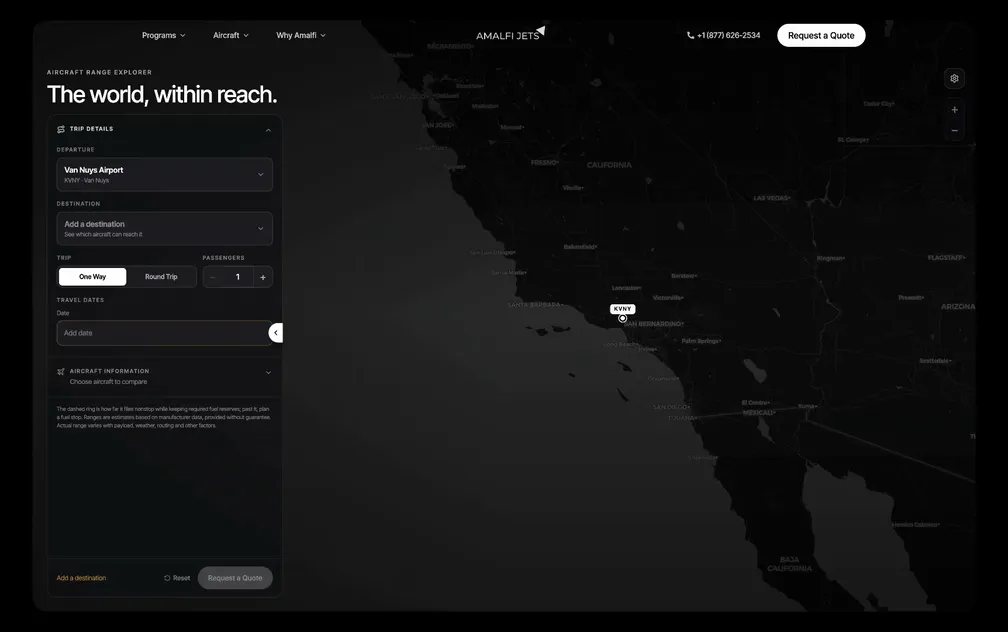
Try Range Explorer
See how far you can fly nonstop
Explore aircraft range, compare options, check flight times, and better understand which aircraft fits your trip.

Ready to fly to College Station?
Request a charter and our team will tailor an itinerary for your next journey.
*Takes only about 40 seconds to request your quote.
