



Destination Hub
Private Jet Charter to Cincinnati

Most private flights into Cincinnati are planned through Lunken Field Airport, giving the day a clear arrival point and a simple ground handoff. From the ramp, the rhythm stays deliberately quiet: your aircraft, your timing, and a schedule shaped around the meeting, weekend, or riverfront evening ahead.
Quick facts
Why charter a private jet to Cincinnati?
Chartering privately into Cincinnati is about keeping control of the day from departure to ground transfer.
For travelers with fixed meetings, family commitments, game weekends, or a tight regional itinerary, a private flight removes the connection logic of airline travel. The trip can be built around the time you need to be on the ground, not the time a published schedule happens to arrive.
Why private travelers choose this route
- A primary gateway: LUK is the lead airport for private arrivals, keeping the handling plan focused and straightforward.
- Schedule control: Depart when the party is ready, adjust around meetings, and avoid building the day around commercial-airline buffers.
- Regional flexibility: CVG, HAO, I69, and MWO give the charter desk alternate ways to align the aircraft with the final ground plan.
- Time saved on both ends: Private aviation can reduce friction before departure and after landing, especially when the itinerary has little room for delay.
Travelers often use a charter itinerary for board meetings, private events, university visits, sports weekends, medical travel, and family trips across southwest Ohio and northern Kentucky. A single aircraft movement can also connect multiple cities in one day when the agenda would be inefficient by airline.
A quieter way to arrive
If the purpose of the trip is business, the value is focus: arrive closer to the hour you intend, with fewer public touchpoints. For leisure, it is comfort and discretion — a smoother beginning to a weekend built around restaurants, riverfront hotels, museums, neighborhoods, or stadium plans.
“For peak May, September, and October dates, our charter desk secures the preferred airport plan first, then widens the aircraft search around your exact timing. Early firm dates improve aircraft choice.”

When is the best time to fly to Cincinnati?
The best months to plan Cincinnati travel depend on the purpose of the trip, with May, September, and October carrying the strongest demand.
May brings Flying Pig weekend, when race-related travel can tighten aircraft and hotel availability. September is shaped by Oktoberfest Zinzinnati, and October often combines Bengals football with a heavier fall business calendar. For firm dates in those months, it is wise to begin aircraft planning early.
January and February can be more favorable for travelers who prioritize availability over atmosphere, as post-holiday winter tends to soften leisure demand. August can also present value because humid late summer usually brings less leisure pressure before autumn calendars return.
Flexible travelers should compare a few departure windows rather than locking into the first convenient hour. A small shift in timing can improve aircraft choice, ground coordination, and empty-leg potential, particularly outside the highest-demand weekends.
Where our clients stay and go
Cincinnati rewards private travelers with a city that feels both metropolitan and grounded in the contours of the Ohio River.
Morning light tends to catch the bridges first, then the downtown towers, then the hills that frame the basin. The river gives the city its orientation: business districts, stadium energy, hotels, and parks all gather close to the water before the streets rise into older neighborhoods.
Over-the-Rhine adds texture north of downtown, with restored brick, dining rooms, bars, and a sense of movement that feels lived-in rather than staged. The city is also known for its German heritage, riverfront sports culture, historic markets, museums, and the kind of neighborhood-by-neighborhood identity that rewards an extra evening on the ground.
Evenings can be formal or easy: a private dinner, a suite-level game plan, a walk near the river, or a quiet return to the hotel after meetings. For travelers moving through the Midwest, the appeal is practical as much as cultural — a strong urban stop with a distinctive setting and a manageable rhythm.
What determines the cost of a flight to Cincinnati?
The cost of chartering into Cincinnati is determined by the aircraft, routing, timing, airport plan, and live market availability.
Aircraft class is usually the largest variable. A short regional flight, a longer nonstop itinerary, and a larger cabin request each shape the aircraft options presented by the charter desk. Passenger count, luggage volume, cabin preference, and schedule complexity all influence which aircraft are appropriate for the mission.
Routing and trip structure
A one-way itinerary is priced differently from a round trip because the aircraft may need to reposition before or after your flight. Round trips can sometimes create a more efficient use of the aircraft, especially when the return timing is firm and the same aircraft can remain aligned with the itinerary.
Airport plan and positioning
LUK is the primary airport for private arrivals, and its positioning, handling, and airport-related fees are part of the final quote. If the schedule, aircraft availability, or ground plan points toward CVG, HAO, I69, or MWO, the quote may reflect a different operational setup.
Seasonal demand
Seasonal pressure matters. May, September, and October draw more demand from Flying Pig weekend, Oktoberfest Zinzinnati, Bengals football, and fall business travel, so earlier planning can widen the aircraft options available. January, February, and August may bring softer leisure traffic and stronger availability, though live aircraft supply still drives the final proposal.
Empty-leg opportunities
Empty legs can reduce overall cost when an aircraft already needs to move along a compatible route, but they are opportunistic rather than guaranteed. Best-fit empty legs depend on date flexibility, route alignment, passenger requirements, and how much schedule certainty the traveler needs.
Which airports serve Cincinnati?
Cincinnati is served for private aviation by LUK as the primary airport, with CVG, HAO, I69, and MWO available as regional alternatives when the itinerary calls for a different approach.
Lunken Field Airport (LUK)
LUK is the principal choice for private flights into the city because it gives the charter desk a clear, focused arrival point for aircraft handling and ground coordination. For travelers whose meetings, hotels, or events center on the urban core, beginning the plan here often keeps the day simple.
This airport is the first option Amalfi Jets will typically evaluate for a private itinerary, then confirm suitability against the aircraft, schedule, passenger needs, and any same-day movement after landing.
Cincinnati Northern Kentucky International Airport (CVG)
CVG can make sense when the broader Northern Kentucky side of the region is more convenient for the passenger’s ground plan or when operational conditions favor a larger commercial airport environment. It is also useful to consider when commercial-airport infrastructure aligns better with a particular itinerary.
For private travelers, the decision is less about the name on the ticket and more about the last mile after landing. If the day continues south of the river or involves airline-adjacent logistics, CVG may be the more sensible alternate.
Butler County Regional Airport (HAO)
HAO is a practical consideration when the trip points toward Butler County rather than downtown. Choosing it can reduce unnecessary ground movement if the passenger’s meetings, residence, campus visit, or event is already oriented to that part of the region.
The charter desk would evaluate HAO when a traveler wants to keep the aircraft plan aligned with the final address, not simply default to the most familiar airport code.
Clermont County Airport (I69)
I69 may be appropriate for itineraries tied to Clermont County or the eastern side of the metro area. For private flyers, an alternate airport can be valuable when it shortens the surface portion of the trip or gives the crew a better operational path for the requested schedule.
Its role is best understood as regional precision: useful when the destination after landing sits closer to that corridor than to the central city.
Middletown Regional Airport/Hook Field (MWO)
MWO is worth reviewing when the passenger’s plans are in the Middletown area or farther along that regional axis. It gives the charter team another way to match the aircraft movement with the traveler’s actual ground destination.
For multi-stop business days or visits outside the urban core, this kind of alternate can keep the itinerary more efficient by avoiding a default arrival that adds unnecessary driving.
Routes to & from Cincinnati
Common questions about Cincinnati charter
Which airport should I use for a private flight into Cincinnati?
Most private arrivals into Cincinnati are planned through LUK, with CVG, HAO, I69, and MWO considered when the ground itinerary, aircraft availability, or regional destination makes an alternate more practical.
Is LUK always the best choice?
LUK is the primary airport for Cincinnati private arrivals, but the best choice depends on where the traveler is going after landing, the aircraft available, and any handling or timing considerations for that specific trip.
What determines the cost of chartering into Cincinnati?
The cost of chartering into Cincinnati depends on aircraft category, routing, round-trip structure, LUK positioning and fees, seasonal demand, and available empty-leg opportunities.
When should I book for peak travel periods?
Travelers flying into Cincinnati in May, September, or October should book earlier than usual because Flying Pig weekend, Oktoberfest Zinzinnati, Bengals football, and fall business travel can tighten aircraft availability.
Can I use a regional alternate instead of LUK?
For Cincinnati trips, CVG, HAO, I69, and MWO may be considered when an alternate better matches the passenger’s final destination, preferred schedule, or aircraft availability.
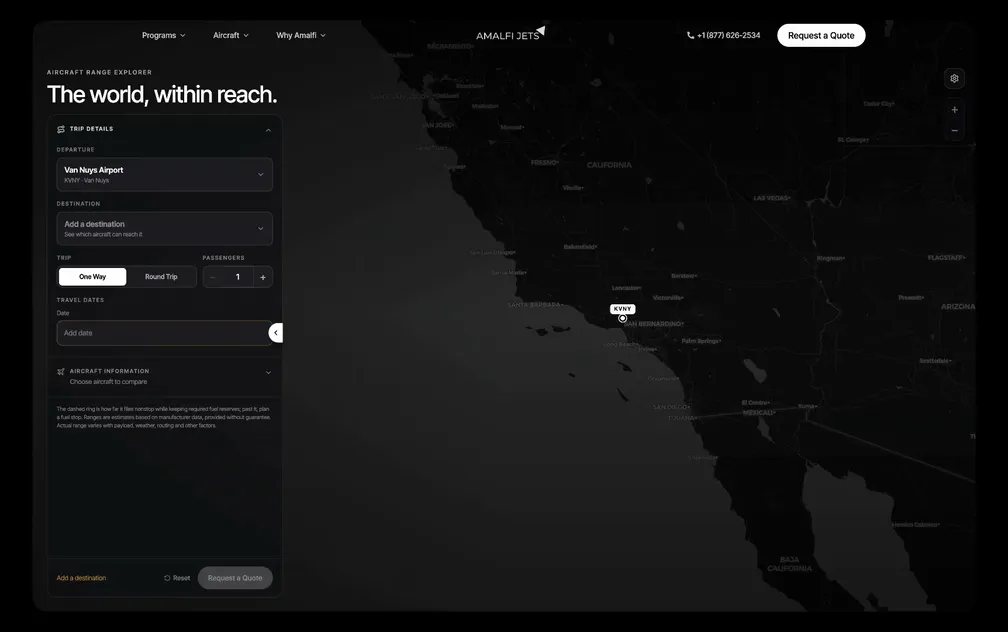
Try Range Explorer
See how far you can fly nonstop
Explore aircraft range, compare options, check flight times, and better understand which aircraft fits your trip.

Ready to fly to Cincinnati?
Request a charter and our team will tailor an itinerary for your next journey.
*Takes only about 40 seconds to request your quote.
