



Destination Hub
Private Jet Charter to Budapest

Arriving by private aircraft through Budapest Ferihegy International Airport puts Hungary’s capital on your timetable, not the airline’s. The day can be shaped around a board meeting, a Danube-side check-in, or a late departure after dinner, with Amalfi Jets coordinating the route, aircraft, and arrival details in one discreet plan.
Quick facts
Why charter a private jet to Budapest?
Private flyers choose Budapest for control: a direct arrival into Hungary’s capital, a schedule built around their calendar, and a smoother transition from aircraft to city. Instead of protecting an airline connection or adapting to fixed departure banks, your itinerary can be organized around the meeting, hotel check-in, event, or onward ground plan.
Time on your side
BUD keeps the travel day straightforward for most private arrivals. Your charter team can align departure timing, passenger details, catering preferences, and ground transportation before the aircraft leaves, reducing the friction that often comes with commercial travel.
Flexibility beyond the ticket
A private jet charter to Budapest is most valuable when plans are precise but not static. Door-close timing, same-day returns, multi-city routings, and short-notice schedule changes can be considered as part of the same trip design, subject to aircraft availability and operating approvals.
A quieter arrival
The advantage is not only speed. It is the ability to arrive composed, move directly into the next part of the day, and keep the itinerary private from first call to final transfer.
“Our charter desk secures BUD handling and preferred departure windows first, then compares alternates only if the ground plan supports it. Firm dates in July, August, and December should be placed early to widen aircraft choice.”

When is the best time to fly to Budapest?
The best time to visit Budapest depends on the purpose of the trip: summer favors events and river travel, December is atmospheric and busy, and the colder shoulder months can be easier to plan. Travelers with firm dates should secure aircraft and hotel arrangements early when demand is tied to major citywide draws.
July and August are peak months, helped by the Hungarian Grand Prix, Sziget Festival, and the appeal of warm-weather travel along the Danube. Those weeks reward early decisions, especially for travelers who need a specific cabin size, departure window, or same-day return. (hungaroring.hu)
December brings a different rhythm as Christmas markets, illuminated bridges, and winter dining pull visitors into the center. Aircraft availability can narrow around weekends and holiday-adjacent stays, so a flexible departure time may improve options.
January, February, and November are the value-minded periods. Colder weather brings lighter crowds, softer hotel demand, and generally better aircraft availability, making them practical months for private travelers who prioritize discretion, access, and calmer city pacing.
Where our clients stay and go
Budapest is a capital shaped by water, hills, and grand urban theater, making it one of Central Europe’s most visually memorable private-travel destinations. From the aircraft window to the hotel arrival, the city reads in layers: the Danube, the bridges, the castle ridge, the domes and facades of Pest, and the warm glow that settles over the river at dusk. (whc.unesco.org)
The Danube gives the city its axis. On one side, Buda rises into hills and historic terraces; on the other, Pest opens into boulevards, cafés, civic buildings, and the formal sweep of Andrássy Avenue, an area recognized within the city’s UNESCO-listed historic landscape. (whc.unesco.org)
Thermal baths, music, design, and dining give the stay its texture. After a morning meeting or museum appointment, the day can drift toward a bathhouse, a private river cruise, a tasting menu, or a walk through lamplit streets where Belle Époque architecture meets contemporary hotel life.
For private travelers, Budapest works because it can be both ceremonial and efficient. Galleries, embassies, business districts, historic neighborhoods, and Danube-facing hotels sit within a compact enough urban experience that a short stay can still feel complete.
What determines the cost of a flight to Budapest?
The cost of chartering into Budapest depends on the aircraft, itinerary structure, airport planning at BUD, seasonal demand, and the availability of suitable empty-leg opportunities. For an accurate quote, the charter desk evaluates the full trip rather than treating the flight as a fixed fare.
What shapes the quote
- Aircraft category: Cabin size, range, luggage needs, passenger count, and onboard service expectations all influence which aircraft are appropriate.
- One-way or round trip: A round trip may keep the same aircraft and crew with you, while a one-way request can require repositioning before or after the passenger flight.
- BUD positioning and airport costs: Handling, parking, crew logistics, and airport-related charges are reviewed as part of the operating plan.
- Seasonal demand: July, August, and December can tighten availability because of the Hungarian Grand Prix, Sziget Festival, summer Danube travel, and Christmas market demand.
- Empty-leg availability: Empty legs can be efficient when timing, routing, and aircraft type happen to match the trip, but they are less flexible than a dedicated charter.
A well-built quote should make the tradeoffs clear: convenience, cabin standard, timing control, and total trip reliability are weighed together before the aircraft is recommended.
Which airports serve Budapest?
The city is served by Budapest Ferihegy International Airport (BUD) as the primary gateway, with Tokol Airport (LHTL), Gyor-Per Airport (QGY), M.R. Stefanik Airport (BTS), and Debrecen International Airport (DEB) available for alternate planning. In practice, the right choice depends on the final ground destination, aircraft handling suitability, schedule pressure, and how much flexibility the trip allows.
BUD
BUD is the natural first option for most private arrivals because it is the named primary airport for the capital. Choose it when the itinerary is centered on the city, when hotel transfers need to be simple, or when the aircraft plan benefits from using the main international gateway.
Private-terminal suitability, handling arrangements, parking, and passenger processing should be confirmed for the specific aircraft and travel date. That early check is especially useful during peak periods, when preferred timings can become harder to protect.
Tokol Airport (LHTL)
Tokol Airport is best treated as a situational alternate rather than a default arrival point. It may enter the discussion when the ground program is oriented toward Tokol or the surrounding area, or when the charter desk wants to compare options outside the main airport plan.
Because suitability can vary by aircraft, date, and service requirements, LHTL should be vetted before it is presented as the operating airport. The value of considering it is not glamour; it is optionality.
Gyor-Per Airport (QGY)
Gyor-Per Airport can be useful when the trip is not purely city-center focused and the traveler’s schedule points toward Gyor or western Hungary. For some regional itineraries, an alternate airport may reduce the amount of unnecessary backtracking on the ground.
QGY should be assessed for handling, passenger flow, and operational fit before confirmation. If the aircraft, timing, and onward drive align, it can support a more regional interpretation of the trip.
M.R. Stefanik Airport (BTS)
M.R. Stefanik Airport is relevant when the journey has a broader regional pattern and the traveler is weighing a cross-border or northwest-facing plan. It can be considered when the aircraft itinerary and ground movements make an alternate gateway more logical than returning to the main capital airport.
BTS is not a substitute to choose casually. The charter desk should compare handling suitability, permissions, passenger convenience, and transfer logistics before recommending it.
Debrecen International Airport (DEB)
Debrecen International Airport can make sense when the agenda extends toward Debrecen or the eastern side of Hungary. Rather than forcing every traveler through the capital, DEB gives planners another point to evaluate for regional access.
The question is practical: does the airport support the aircraft, the timing, and the onward movement better than BUD for that particular trip? If the answer is yes, it can simplify the broader itinerary.
A thoughtful airport plan starts with the destination on the ground, then works backward to the ramp. Amalfi Jets evaluates the main gateway and alternates together so the chosen airport supports the full travel day, not just the flight segment.
Routes to & from Budapest
Common questions about Budapest charter
Which airport do private jets use for Budapest?
Most private flights to Budapest use BUD, the primary airport for the city, because it keeps the arrival plan straightforward for travelers staying or meeting in the capital.
Can Amalfi Jets arrange alternate airports near the city?
Budapest can also be planned with Tokol Airport, Gyor-Per Airport, M.R. Stefanik Airport, or Debrecen International Airport when aircraft suitability and the ground itinerary make an alternate sensible.
What determines the cost of chartering into the city?
For Budapest, charter cost is shaped by aircraft category, routing, one-way or round-trip structure, BUD positioning, airport-related fees, seasonal demand, and any suitable empty-leg availability.
When should I book for peak travel periods?
For Budapest peak months, earlier booking is wise for July, August, and December because events, summer Danube travel, and Christmas market demand can reduce preferred aircraft and timing options.
When would an alternate airport be better than BUD?
An alternate can make sense for Budapest when the traveler’s final destination sits closer to another listed airport, when congestion affects preferred timing, or when operations confirm a better overall plan.
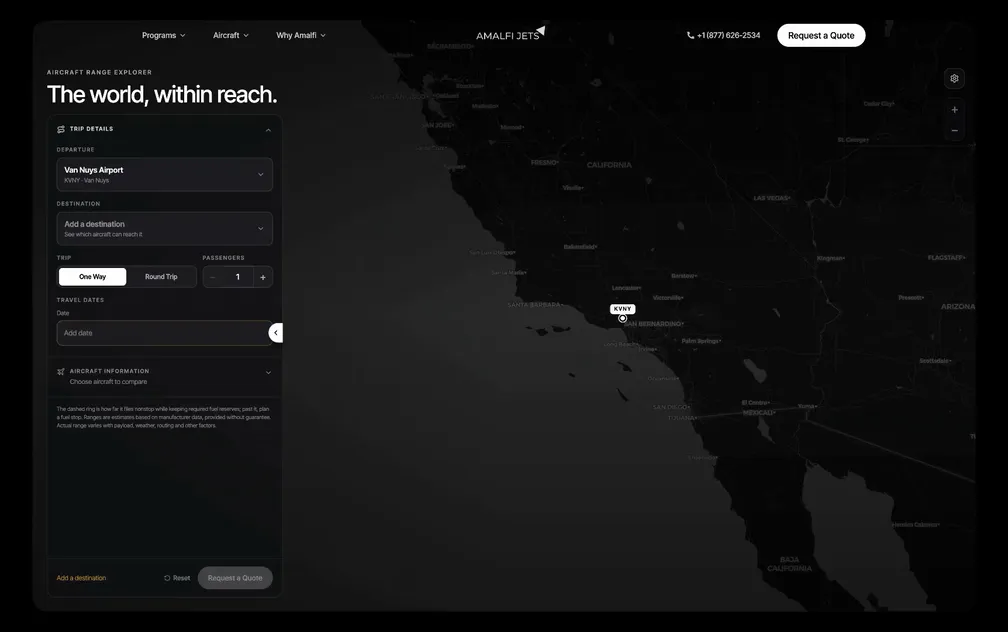
Try Range Explorer
See how far you can fly nonstop
Explore aircraft range, compare options, check flight times, and better understand which aircraft fits your trip.

Ready to fly to Budapest?
Request a charter and our team will tailor an itinerary for your next journey.
*Takes only about 40 seconds to request your quote.
