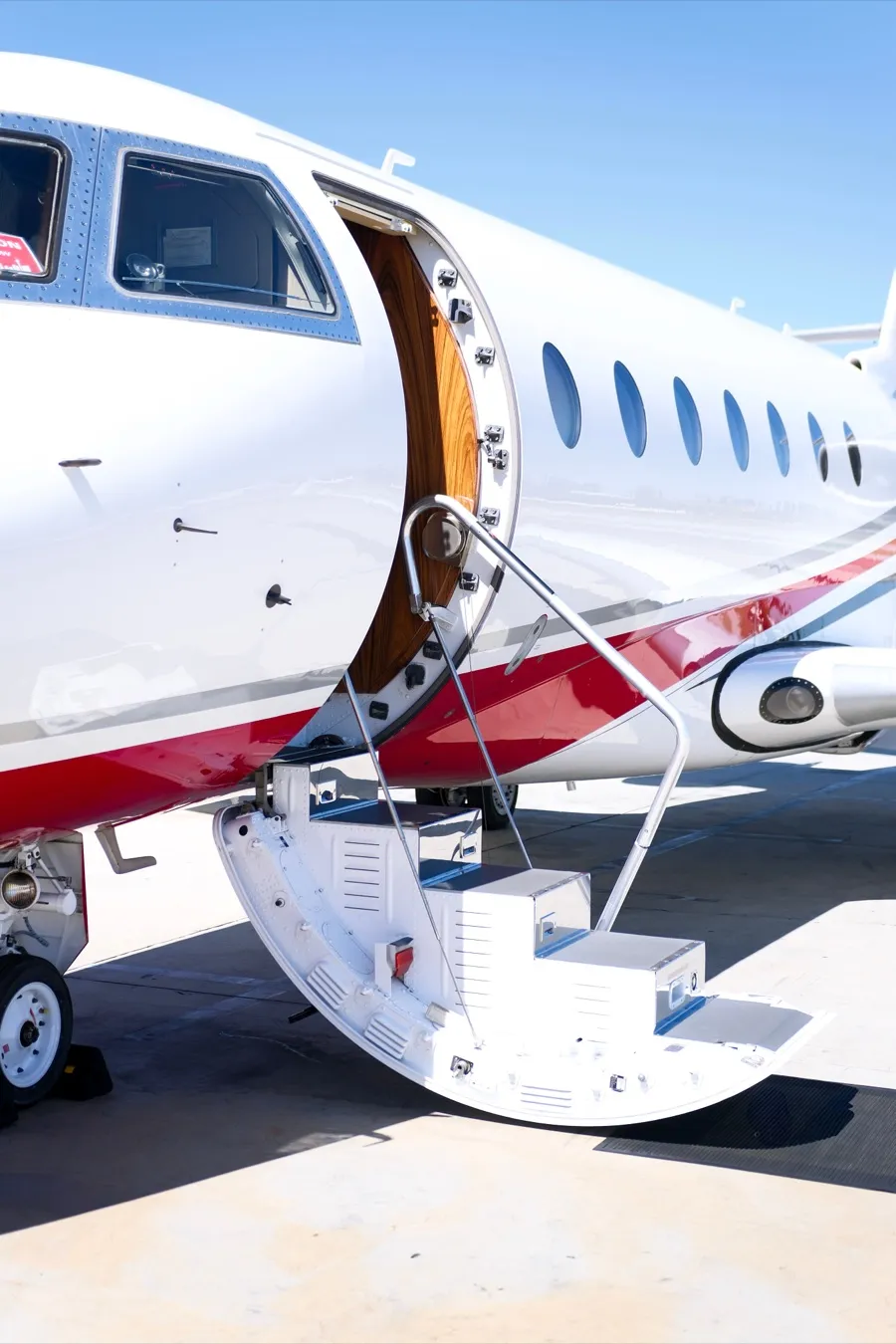





The Warren Buffett private jet story begins with an apparent contradiction. An investor known for frugality and skepticism about corporate aircraft eventually bought a plane, called it “The Indefensible,” and came to appreciate private aviation as a practical business tool.
The reversal matters because it shifts the conversation from the aircraft to the work it enables. For executives considering private travel, Buffett’s experience raises a useful question. We must ask when transportation becomes an investment in time, access, and the ability to accomplish more within a demanding schedule.
At Amalfi Jets, that question starts with the itinerary. As a charter broker, we help travelers consider aircraft options against the requirements of a particular journey, rather than treating another person’s travel choices as a prescription.
Warren Buffett Private Jet: Why He Changed His Mind
Buffett’s resistance to corporate aircraft was more than a passing reservation. He had criticized them for years, making his eventual purchase a visible departure from his own position.
His aircraft history includes the purchase of a used Falcon 20 in 1986. Before making that decision, he reportedly asked businessman Walter Scott Jr. how he could justify buying a plane. This question captures the tension between his financial instincts and the convenience he was beginning to value.
Buffett later sold the Falcon 20 and bought another used aircraft in 1989. The significance is not an assumed progression toward a particular model, but the fact that experience with private flying did not send him back to his original objections.
“The Indefensible” was an unusually candid name for the purchase. It acknowledged that Buffett had adopted something he once criticized, while leaving room for experience to challenge his earlier judgment.
For a business traveler, the relevant lesson is not that skepticism was misplaced. It is that transportation deserves the same disciplined evaluation as any other expense, including an examination of what it allows you to do.
From “The Indefensible” to “The Indispensable”
Buffett described his change of mind with characteristic humor in his 1992 shareholder letter, noting that his dogma was eventually run over by his karma. The remark followed his acknowledgment that he had argued passionately against corporate jets for years.
The story later became associated with the more approving nickname “The Indispensable.” That shift is best understood as a change in his assessment of private aviation, not as a definitive identification of a particular aircraft model.
There is an important distinction between abandoning discipline and revising a judgment. Buffett’s experience does not establish that an expensive convenience becomes sensible simply because someone enjoys it. Instead, it illustrates why actual usefulness belongs in the calculation.
For your own travel, the comparable question is specific rather than philosophical. Does a proposed itinerary benefit enough from departure flexibility, privacy, or airport access to make private charter an appropriate choice?
Warren Buffett Aircraft History and the Citation X Question
Readers often ask what aircraft Warren Buffett has used throughout his career. His historical arrangements include a used Falcon 20 and later fractional interests in a Hawker 1000 and a Cessna V Ultra, rather than a single airplane that explains his entire relationship with private aviation.
Berkshire Hathaway’s 1999 annual report described his family’s one-quarter interest in a Hawker 1000 beginning in 1995. It also detailed the subsequent acquisition of a one-sixteenth interest in a Cessna V Ultra. This illustrates a different approach to aircraft access from his earlier outright purchase.
The Cessna Citation X is another model readers may encounter when exploring this subject. Its connection to Buffett should be treated cautiously, as the public record does not establish his personal ownership of a Citation X, a particular aircraft registration, or his current use of that model.
The Citation X and Cessna V Ultra should not be treated as interchangeable names. A historical reference to one does not establish ownership or use of the other, and neither should be presented as his current aircraft without a clear basis.
The Buffett private jet story is therefore more useful as a history of changing travel arrangements than as the biography of one airplane. Outright ownership, fractional access, and charter answer different needs, even when public discussion compresses them into the same phrase.
Berkshire Hathaway Private Jet: Personal Travel or Corporate Business?
A search for the Berkshire Hathaway private jet can lead to two different subjects. These include his personal travel and the company's aviation business interests. Those subjects overlap in the broader story, but they are not interchangeable evidence of personal aircraft ownership.
The 1999 annual report discussed Executive Jet Aviation as an aviation services business and explained fractional ownership. That corporate context should not be read as proof that Berkshire operated a single personal aircraft for Buffett. Furthermore, it does not suggest that he personally owned every model associated with the business.
His family’s fractional arrangements describe a way of accessing aircraft. The company’s aviation interests describe a commercial activity. Keeping those categories separate prevents a business history from becoming an unsupported account of personal travel.
The same distinction matters when evaluating options today. Amalfi Jets is a charter broker, not an aircraft operator or an ownership provider. Our role is to source suitable aircraft and coordinate trip requirements with the operators performing the flights.
The Productivity Argument Behind Private Travel
In a 2012 interview, Buffett described his jet as the only thing he did that cost a lot of money. His explanation emphasized time savings and the freedom private flying afforded him, placing practical utility at the center of the discussion.
That reasoning is more persuasive when applied to a specific schedule than when used as a general endorsement. A journey with several commitments, a narrow arrival window, or a departure that may need to change presents a transportation challenge. This scenario is entirely different from a straightforward trip with flexible timing.
Private aviation can offer greater control over departure planning and access to airports suited to the destination. It does not eliminate weather variables, operating restrictions, or the need to build a realistic itinerary. Its value ultimately depends on how those factors interact with your plans.
Privacy may also matter when a traveler needs space for a confidential discussion or uninterrupted preparation. Those benefits should be assessed against the trip’s actual requirements rather than assumed to make every flight more productive.
Buffett’s conversion is compelling because it asks readers to consider the usefulness of a tool instead of its symbolism. The disciplined question remains whether the journey enables something sufficiently valuable to justify the arrangement.
Charter Access Without Aircraft Ownership
Buying an aircraft is not a prerequisite for traveling privately. Charter allows you to evaluate a particular journey without purchasing an airplane or committing to an ownership interest.
As a charter broker, Amalfi Jets begins with your departure point, destination, passenger count, cabin requirements, and preferred schedule. We use those details to source options through operators, with aircraft availability and trip requirements guiding the selection.
This changes the immediate decision from long-term ownership to mission suitability. You can assess whether an aircraft fits the journey in front of you without adopting the same arrangement Buffett used at a different stage of his life.
The financial assessment should consider the complete trip rather than an isolated hourly figure. Our guide to private jet charter costs in 2026 explains why positioning, taxes, airport charges, crew logistics, and other trip-specific components can affect a quote.
An itemized proposal creates a clearer basis for comparison. It allows you to evaluate the aircraft, schedule, and total mission cost together, rather than borrowing someone else’s conclusion about the value of private travel.
Choose the Aircraft for the Mission
An aircraft’s association with a well-known traveler is not a selection criterion. Passenger count, cabin needs, baggage requirements, airport suitability, and the proposed route should shape the decision.
An Omaha departure to the New York, Los Angeles, or Washington DC area should be evaluated on its own terms. Those examples describe possible charter itineraries, not a claim about his personal flight history.
Our ultra-long-haul private jets page provides a useful contrast to the historical aircraft discussion. That category belongs in a conversation about longer journeys and demanding nonstop requirements, not as an implied description of a personal airplane.
A larger aircraft may be appropriate when its cabin or capabilities serve a genuine need. It should not become the default simply because it offers more capability on paper. Proposed performance must remain subject to payload, weather, and operating conditions.
The goal is a proportionate choice. A well-planned charter aligns the aircraft with the trip instead of asking the traveler to adapt the trip to a recognizable model.
Omaha to New York, Los Angeles, and Washington DC: Airport Choices
Omaha gives this story its natural geographic setting and provides a practical starting point for itinerary planning. Eppley Airfield (OMA) is an excellent option to consider for a departure from the region.
For New York area travel, Teterboro (TEB) may be worth evaluating against your final destination. Its suitability for a proposed trip depends on the aircraft, operating requirements, and the ground journey that follows the flight.
Van Nuys (VNY) is a prominent option for the Los Angeles area. The best airport choice should reflect where you need to be, not simply which airport has the strongest association with private aviation.
For Washington DC area travel, Manassas Regional Airport (HEF) is another option to assess. Ground transportation and the location of your meeting or accommodation remain important parts of that evaluation.
These codes are planning references, not promises of a particular arrival experience or available service. Airport selection, handling arrangements, operating conditions, and ground coordination need to be considered for the actual itinerary.
A departure and destination alone are also insufficient grounds for a reliable flight time estimate. Aircraft selection and routing should be assessed before expectations are set, especially when the schedule leaves little room for adjustment.
A Disciplined Way to Evaluate Private Aviation
The historical narrative is not an argument that successful people should fly privately. It is an example of a strongly held view changing after experience revealed a different kind of value.
That distinction is useful for travelers who want a reasoned decision rather than reassurance. Start with what the journey must accomplish, then weigh time, access, privacy, and schedule control against the proposed plan.
Some itineraries make a stronger case for private aviation than others. A suitable charter should respond to that difference, with aircraft selection and trip coordination reflecting the needs of the traveler rather than a fixed preference for a particular category.
Amalfi Jets helps make those tradeoffs tangible through aircraft sourcing and coordination with operators. The aircraft matters, but so does the coherence of the journey from departure planning to arrival arrangements.
Plan Your Next Charter With Amalfi Jets
The enduring appeal of this private jet story is that the investor did not begin as an enthusiast. His eventual embrace of private aviation came from reconsidering its usefulness, not from avoiding the question of whether it made sense.
At Amalfi Jets, we bring that itinerary-first focus to your charter request. We act as a broker, sourcing aircraft and coordinating trip details with the operators responsible for performing the flights.
Share your departure point, destination, passenger count, and preferred schedule with our team. Whether your plans begin in Omaha or involve New York, Los Angeles, or Washington DC, we will help you evaluate aircraft options around the journey you need to make.