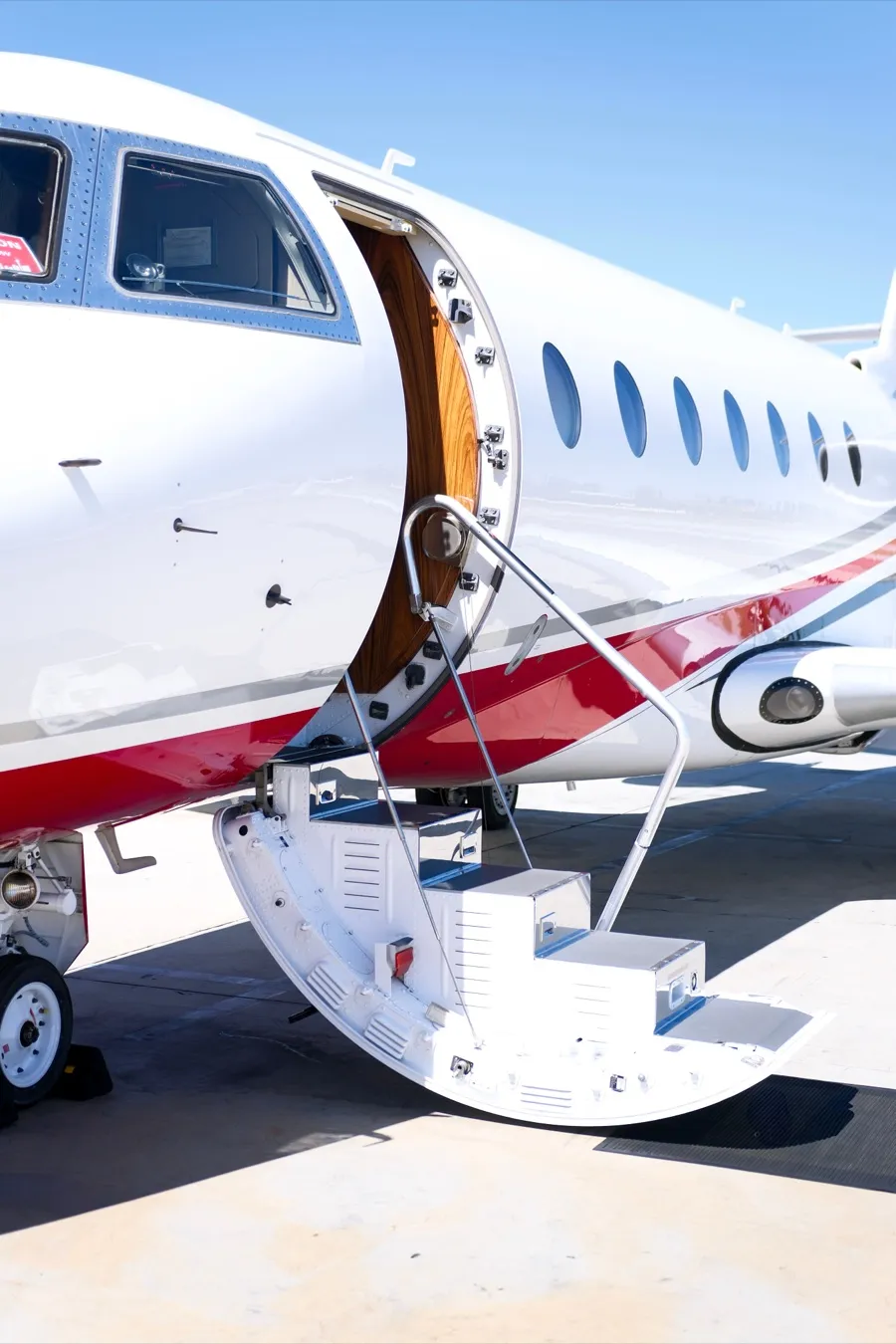





Choosing between a private jet and a helicopter is not a question of which aircraft makes the greater impression. For travelers comparing private jet vs helicopter options in 2026, the right answer depends on distance, landing access, party size, baggage, weather, and the time required to complete the entire journey.
The most effective itinerary may rely on one aircraft or combine both. As a charter broker, we source aircraft through vetted operators and consider each leg independently. This approach allows the jet, helicopter, or ground transfer to serve the part of the journey it handles best.
Private jet vs helicopter: the essential difference
A helicopter is primarily an access solution. It connects approved landing sites closer to city centers, waterfront areas, private properties, and destinations where conventional runway access is unavailable or inconvenient.
A private jet is designed for longer distances and sustained travel. Depending on the selected aircraft category, it offers more cabin space, greater baggage capacity, more seating flexibility, and an environment better suited to an extended journey.
The difference becomes clearer when reviewing private aircraft charter categories. Turboprops and private jets serve a range of regional and long-distance missions, while helicopters occupy a distinct role in short, access-driven segments.
Neither aircraft is automatically better in every situation. The correct choice depends on how efficiently it connects your actual point of departure with the final destination, rather than simply how quickly it travels through the air.
When helicopter charter vs jet makes sense
Helicopter charter deserves consideration when the proposed transfer is around 60 miles or less and suitable landing access exists at both ends. That distance is a useful planning signal rather than a universal rule, since local restrictions, road conditions, baggage, weather, and passenger requirements can change the result.
This is why a helicopter charter vs jet comparison should consider the complete itinerary. A short helicopter segment offers little benefit if reaching the departure site requires a lengthy car journey, while a conveniently positioned approved landing site transforms the same general route.
Helicopters also solve the final portion of a trip when the destination does not have practical runway access. Transfers toward Portofino are a useful example, as are select connections around St. Barts where your final location is better reached through a separately planned local segment.
Every proposed landing location requires confirmation. Availability depends on permissions, operating limitations, local requirements, the selected operator, and current conditions, so access should never be assumed from a map alone.
When a private jet becomes the stronger choice
A private jet becomes compelling when the route extends beyond a local transfer. City-to-city journeys, cross-country travel, and flights connecting major regions call for the speed, cabin environment, baggage capacity, and broader mission profile of fixed-wing aircraft.
Expected travel time is another useful indicator. Once a proposed helicopter segment extends beyond roughly 60 minutes, the private jet should be evaluated carefully because its speed and cabin characteristics usually provide a more suitable overall experience.
Party size shifts the decision as well. For groups larger than five, a jet presents more practical options, although capacity must always be confirmed against the specific aircraft, seating configuration, baggage requirements, and operator limitations.
Weather influences the helicopter vs private jet assessment. The appropriate recommendation depends on the aircraft, operator, crew, route, forecast, and current conditions, meaning broad claims about either mode should not replace mission-specific planning.
When to take a helicopter vs jet for the fastest journey
The fastest aircraft in the air does not always produce the shortest door-to-door journey. Airport location, approved landing access, ground traffic, security procedures, positioning requirements, and the final car transfer all affect the actual arrival time.
A helicopter creates a meaningful advantage when road congestion would otherwise dominate a short local route. A private jet is more effective when the main distance is substantial and you value a larger cabin, more baggage flexibility, or a more suitable environment for work and rest.
The clearest way to decide when to take a helicopter vs jet is to map every stage of the trip. Our team compares the departure transfer, aircraft segment, connection time, arrival process, and final ground journey before recommending a structure.
This method also reveals when a car is the cleaner answer. Adding an aircraft does not improve an itinerary if landing access, baggage handling, or an additional transfer removes the expected time advantage.
Los Angeles: choosing VNY for the primary jet leg
Van Nuys Airport (VNY) is an established private aviation gateway for Los Angeles. It serves as the fixed-wing departure or arrival point for regional and long-distance charter itineraries, subject to aircraft suitability and current operating considerations.
For a journey between Los Angeles and Aspen, the jet carries the primary distance between VNY and Aspen/Pitkin County Airport (ASE). Aircraft selection depends on your passenger count, baggage, departure conditions, operating requirements, and the broader schedule.
A helicopter remains a consideration for a separate local transfer within the Los Angeles region. Its value depends on your origin, the location of an approved departure site, the final destination, surface traffic, and the practical handling of passengers and baggage.
A coordinated journey might use a helicopter for a short local connection before continuing by private jet from VNY. The benefit requires establishment through door-to-door analysis rather than being assumed solely from the airborne portion of the trip.
New York: when to take a helicopter vs jet through TEB
Teterboro Airport (TEB) is a prominent private aviation gateway for the New York area. For longer journeys from the region, including travel toward Aspen, the private jet normally serves as the principal aircraft.
The calculation changes for select local and regional transfers. A helicopter warrants consideration for travel between an approved New York area landing site and a destination where road congestion otherwise consumes a substantial part of the schedule.
Travel toward the Hamptons illustrates the planning principle. The helicopter creates a useful access advantage, but the journey to the departure site, approved arrival access, baggage requirements, final car transfer, and current conditions must all factor into the comparison.
For some travelers, the most effective itinerary pairs a private jet through TEB with a distinct helicopter connection. For others, a direct ground transfer remains the more coherent choice once the entire journey is considered.
Miami: pairing OPF with the right local transfer
Miami Opa-locka Executive Airport (OPF) serves private aviation in the Miami area. Travelers arriving from another state or a distant city generally use a private jet for the main flight into OPF, with the onward transfer planned around the final address.
A helicopter is appropriate for a time-sensitive connection to an approved site closer to a waterfront destination. That option requires evaluation against a direct car transfer, particularly when baggage movement or an additional surface journey offsets the expected advantage.
Miami itineraries also demand careful attention to current weather and landing access. A plan that appears efficient under ideal conditions includes a practical alternative if the helicopter segment cannot proceed as intended.
This is where coordinated itinerary design becomes particularly valuable. We compare the sequence of the jet, helicopter, and ground components so the transfer supports your schedule rather than introducing unnecessary complexity.
Aspen: planning a private jet itinerary through ASE
Aspen/Pitkin County Airport (ASE) serves a mountain destination where aircraft selection requires careful attention to operating requirements and current conditions. For travelers arriving from Los Angeles, New York, Miami, or another distant city, a private jet generally carries the main portion of the journey.
The suitable aircraft category depends on more than route length. Passenger count, baggage, departure conditions, operator review, schedule, and mission requirements all contribute to the final recommendation.
A helicopter serves as a separate local segment only when approved access and current conditions support the plan. Specific landing locations require confirmation during itinerary development rather than being treated as routinely available.
In many cases, a private jet into ASE followed by a car is the most coherent arrangement. Where a helicopter connection offers a genuine benefit, we design it as a distinct segment with coordinated timing and an appropriate contingency.
Napa Valley: using APC as the fixed-wing gateway
Napa County Airport (APC) provides a private aviation gateway for Napa Valley. For travel from Los Angeles, New York, Miami, or another distant origin, a private jet or suitable turboprop normally completes the main fixed-wing portion of the route.
After arrival at APC, the appropriate transfer depends on the property, road journey, passenger preferences, baggage, and confirmed landing access. A helicopter warrants consideration for select connections, but a private car remains the more direct answer for many estates, wineries, and resorts.
The central question is whether the helicopter removes meaningful friction. If it introduces an additional transfer or separates passengers from their baggage, the apparent time saving does not improve the actual experience.
This measured approach keeps the aircraft decision focused on practical value. It also preserves flexibility if weather, access, or local conditions require the itinerary to change.
Private jet or helicopter: how to compare time and cost
The most common comparison mistake is looking only at hourly charter rates. A lower hourly figure does not necessarily produce a lower total, just as a shorter airborne segment does not always deliver the earliest door-to-door arrival.
A private jet quote accounts for aircraft category, positioning, airport charges, taxes, scheduling, and other mission requirements. Helicopter pricing is equally specific to the proposed route, operator, aircraft, waiting requirements, and landing arrangements.
For a broader explanation of these variables, the 2026 private jet charter cost guide outlines why a complete quote is more useful than a generalized hourly comparison. The same principle applies when deciding between a private jet or helicopter for a particular segment.
Practical comfort also warrants consideration. Cabin space, baggage volume, seating arrangement, privacy, work requirements, and the preferences of each traveler may outweigh a modest difference in estimated travel time.
Why the best itinerary may combine a jet and helicopter
Private jets and helicopters are often more effective as complementary aircraft than as direct rivals. The jet handles the principal distance, while the helicopter addresses a short connection affected by road congestion or limited runway access.
A New York itinerary might use a private jet through TEB before a separately coordinated local helicopter transfer. In Miami, a jet could arrive at OPF before travelers continue to an approved waterfront site, while journeys through ASE or APC may pair the flight with either a carefully assessed helicopter segment or a private car.
Coordinating two aircraft requires more than making separate reservations. Arrival timing, passenger movement, baggage handling, landing permissions, operator communication, current conditions, contingencies, and ground transportation must work together.
As a charter broker, we evaluate those elements as one journey and source aircraft through vetted operators. You can learn more about our planning approach and service standards through why clients choose Amalfi Jets.
Choosing the right aircraft for your 2026 itinerary
The most useful private jet vs helicopter principle is straightforward. A helicopter makes sense when local access creates a meaningful advantage, while a private jet becomes the stronger choice when distance, expected travel time, cabin space, baggage, or passenger requirements take priority.
For Los Angeles, New York, Miami, Aspen, and Napa Valley, the answer depends on more than geography. VNY, TEB, OPF, ASE, and APC can anchor the fixed-wing portion of an itinerary, while any helicopter segment must be assessed around approved access and the practical movement of passengers and baggage.
Our team compares each option and coordinates the selected itinerary through qualified operators. To begin planning, request a private charter itinerary tailored to your route, schedule, passengers, and final destination.